Why Pricing Office Cleaning Services Correctly Matters for Your Business
Learning how to price office cleaning services is critical for your cleaning business. Price too high, and you’ll scare away clients; price too low, and you’ll work for free.
Quick Answer – How to Price Office Cleaning Services:
- Calculate labor costs – Include wages, taxes, and insurance (typically $15-30/hour per cleaner)
- Add supply and overhead costs – Usually 20-25% of labor costs
- Apply profit margin – Industry standard is 10-28% markup
- Choose pricing model – Per square foot ($0.10-0.40), hourly ($30-90), or flat fee
- Consider key factors – Office size, cleaning frequency, and service type
Pricing commercial cleaning jobs takes skill. As one industry expert noted, “If you price too low, you’ll diminish your profits; if you price too high, you may lose customers.”
Most cleaning companies use per-square-foot pricing for offices, with rates from $0.10 to $0.40 per square foot. Small offices under 2,000 square feet typically cost $100-400 per session, while larger spaces can run $600-1,200 or more.
The key is finding the sweet spot where you cover costs, make a fair profit, and stay competitive.
I’m Bill McGrath, owner of So Clean of Woburn. I’ve spent years perfecting how to price office cleaning services for profitability and client satisfaction. My experience in the Greater Boston area has shown me that accurate pricing is the foundation of a successful cleaning business.
Essential how to price office cleaning services terms:
- how hiring a professional cleaning service benefits your office
- office cleaning service company
- corporate cleaning company
Key Factors That Determine Your Quote
When creating an estimate, I don’t just guess. How to price office cleaning services involves evaluating several interconnected factors to determine the final quote.
Key factors include office size, scope of work (basic vs. deep cleaning), cleaning frequency, geographic location (costs vary across the Greater Boston area), and facility type (a medical office has different needs than a tech startup). These elements create a unique pricing puzzle for each client, which is why cookie-cutter estimates fail. See what we can do for your business with our Commercial Cleaning Services.
The Impact of Office Size and Layout
Square footage is the foundation of most cleaning estimates, but it’s not the whole story. A small office under 2,000 square feet might cost $100 to $200 per visit, while a large office over 10,000 square feet could run $600 to $1,200 or more per session.
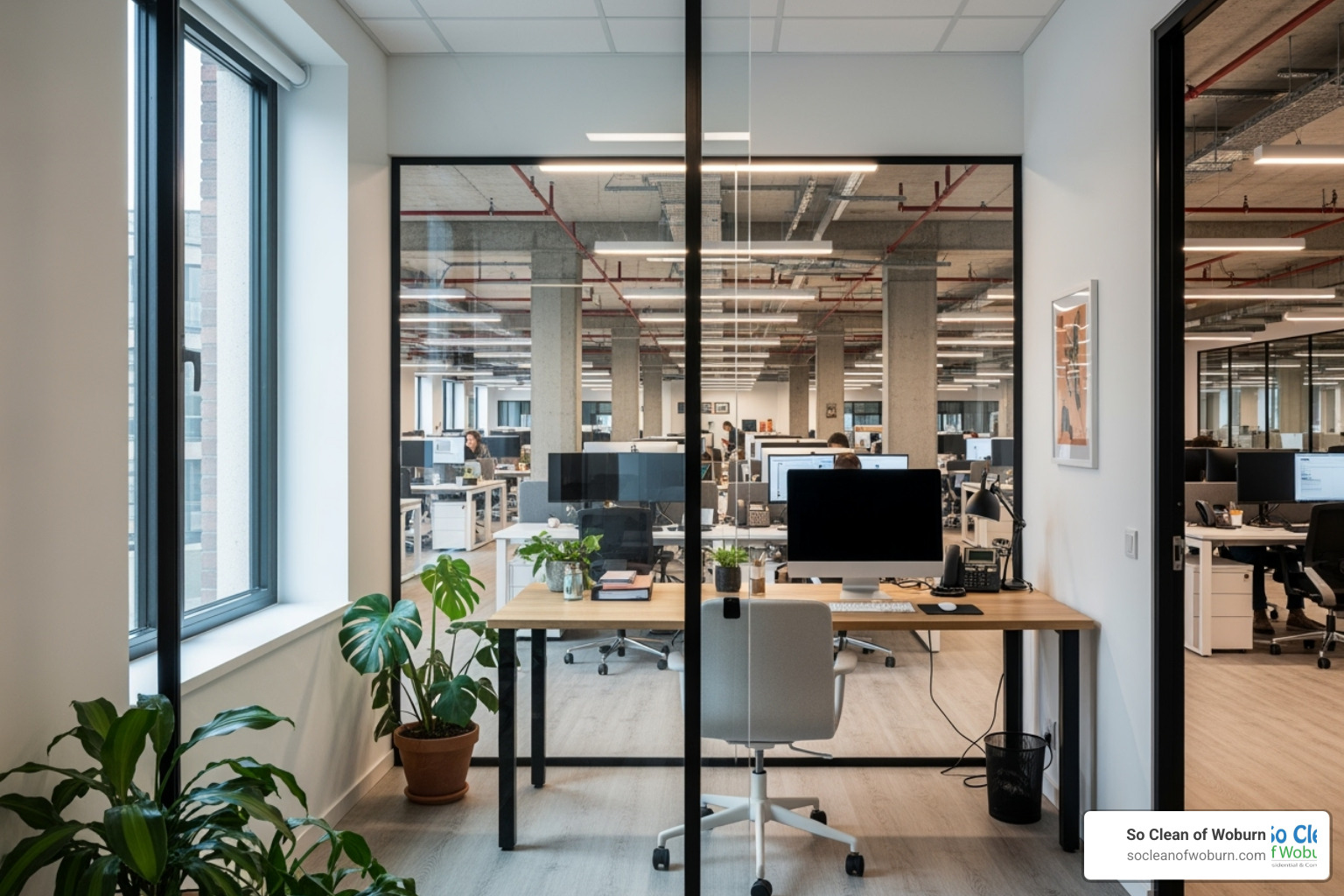
But the layout can completely change those numbers. An open-plan office might seem straightforward, but it often means more surface area to dust and larger floors that need specialized equipment. Conversely, an office packed with cubicles or individual rooms creates a maze that slows down our cleaning crew.
Every additional room adds complexity. Floor types matter enormously—switching between carpet and hardwood means switching tools and techniques. High-traffic areas like lobbies and break rooms need extra attention and can easily double the time we spend in certain zones.
A 3,000 square foot office with twenty individual offices takes significantly longer to clean than a 3,000 square foot open workspace. The layout dictates our workflow.
Basic vs. Deep and Specialized Cleaning
Not all cleaning is created equal, and the price difference can be dramatic. Basic cleaning covers everyday maintenance: dusting surfaces, vacuuming carpets, emptying trash, and sanitizing restrooms. This routine work typically costs between $0.10 to $0.50 per square foot.
Deep cleaning is more intensive, including high dusting of vents, baseboard cleaning, and detailed sanitization. While basic monthly service for a medium office might be $300-$600, a deep clean could cost $600-$1,400 for the same space.
Add-on services are also available. Carpet cleaning can range from $0.15 to $0.80 per square foot. Window washing is often priced per pane, typically $4 to $10 each, though accessibility and size affect the cost. Floor waxing is another specialty service that can cost $0.30 to $0.60 per square foot.
| Service Type | Key Tasks Included | Typical Frequency |
|---|---|---|
| Basic Cleaning | Dusting, vacuuming, mopping, trash removal, restroom sanitation | Daily, weekly, bi-weekly |
| Deep Cleaning | High dusting, baseboard cleaning, detailed kitchen/restroom sanitization, interior window spot cleaning | Monthly, quarterly, semi-annually |
We’re proud to offer eco-friendly options. Check out our Green Cleaning Services Near Me if you’re interested in healthier products for your workspace.
How Cleaning Frequency Affects Price
Surprisingly, more frequent cleaning often costs less per visit. Like car maintenance, consistent effort prevents bigger, more costly problems.
Daily cleaning is best for high-traffic offices in busy areas like downtown Boston. While the monthly bill is higher (often $1,000 to $2,000+), each visit costs less because we’re maintaining rather than deep cleaning.
Weekly cleaning is a popular choice, typically running $400 to $1,000 per month depending on size and scope.
Bi-weekly rates work well for smaller offices, with monthly costs usually between $300 to $800.
Monthly services are perfect for very small offices or as a supplement to in-house cleaning, often costing $200 to $600 per visit.
We offer contract discounts for regular clients. Predictable income and familiarity with your space allow our team to work more efficiently, cleaning more thoroughly in less time. The principles in How to Create a Cleaning Schedule for Efficient Apartment Building Maintenance can also apply to offices.
The Core Calculation: How to Price Office Cleaning Services
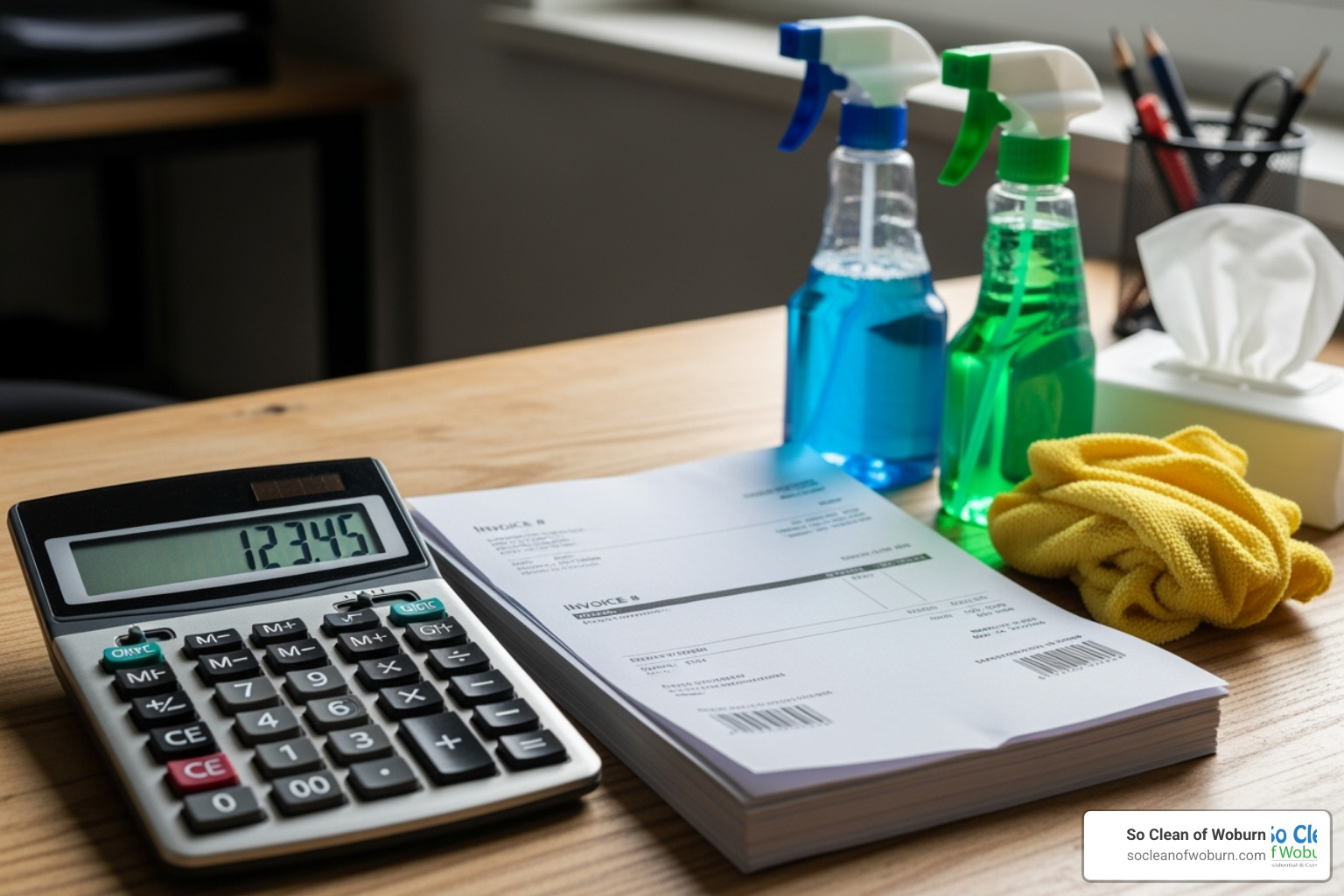
Every accurate cleaning estimate is a calculation of labor costs, supplies and overhead, and profit margin. These three components are essential for a strong business and key to providing competitive and profitable Janitorial Services.
Step 1: Calculate Your Labor Costs
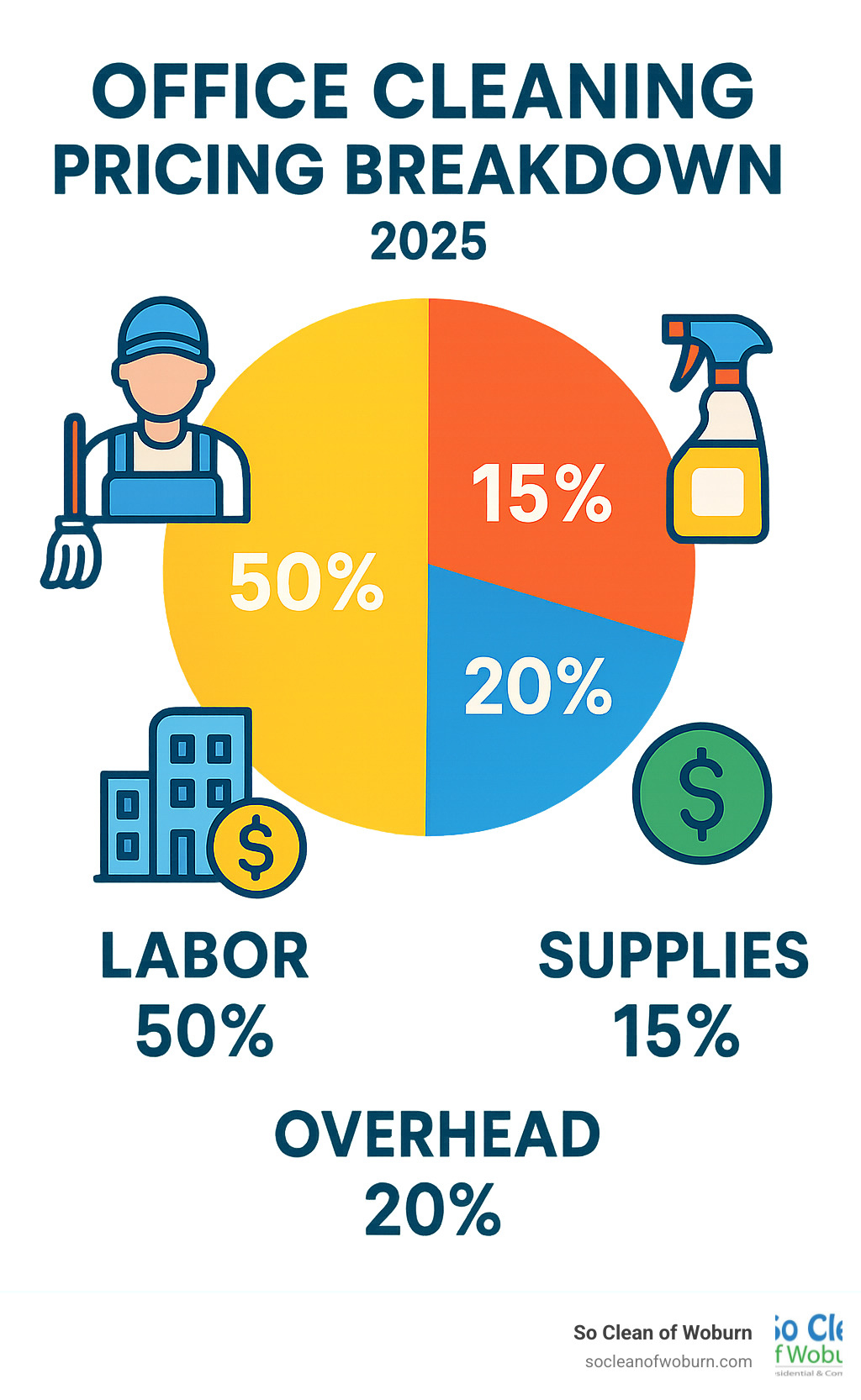
Labor is the backbone of how to price office cleaning services, making up 50-60% of the total cost. A common mistake is only considering the hourly wage.
The real cost of labor is deeper. A $15/hour wage can become $20-25/hour after adding payroll taxes (Social Security, Medicare, unemployment) and workers’ compensation insurance (often 15-25% of wages). You must also factor in general liability insurance and any benefits like health coverage or paid time off. That $15-per-hour cleaner actually costs us around $22-25 per hour in total labor expenses.
Time estimation is where experience pays off. A skilled cleaner can typically handle 1,000-1,500 square feet per hour for basic tasks, but this varies with office layout. A cluttered office with many rooms takes longer than an open floor plan. Accurately calculating labor costs requires this detailed planning.
For example, a 2,000 square foot office that takes two hours with one cleaner at a fully-loaded labor cost of $25 per hour means $50 in labor costs for that visit.
Step 2: Factor in Supplies, Equipment, and Overhead
These are the “hidden” costs of running a cleaning business, and they add up quickly. Cleaning supplies aren’t just a bottle of cleaner; we invest in high-quality, often eco-friendly products. For a typical office, supplies might run $5-15 per visit.
Equipment depreciation is another factor. Commercial vacuums, floor buffers, and carpet extractors don’t last forever. A good commercial vacuum might cost $800 and last three years—that’s part of your cost structure.
Vehicle expenses (fuel, maintenance, insurance), office rent, business insurance, marketing, and administrative costs are also significant.
In the Greater Boston area, these overhead costs typically add 20-30% to your labor expenses. If labor for a job is $50, we add another $10-15 for supplies and overhead, bringing our total cost to around $60-65.
Step 3: Determine Your Profit Margin
Your profit margin isn’t just extra money; it’s what allows you to grow your business, invest in better equipment, train your team, and handle unexpected challenges.
Successful commercial cleaning companies typically aim for profit margins between 10-28%. This is net profit after all expenses. When pricing, we use a markup percentage.
If our total cost for a job is $65, a 25% profit margin means pricing the job around $87. That $22 profit keeps our business strong and service reliable.
Business growth goals and competitive positioning also influence profit margins. If we’re expanding or positioning ourselves as a premium service, our margins will reflect that value.
The key is finding the sweet spot where we’re profitable enough to grow while offering competitive pricing that attracts and retains clients throughout Woburn, Burlington, Winchester, and surrounding areas.
Choosing the Right Pricing Model
After calculating costs and profit, you must choose how to present the price to clients. Different situations require different pricing models. At So Clean of Woburn, we find that flexibility helps us serve everyone from small startups in Cambridge to large corporate offices in Boston. This adaptability is what defines a professional Corporate Cleaning Company.
Multiple models let you match the client’s preference. Some want predictable monthly bills, while others prefer pricing based on their space’s size.
When to Charge Per Square Foot
Per-square-foot pricing is the go-to method for commercial cleaning, especially for larger spaces. It’s straightforward, scalable, and easy for clients to understand.
This model is best for large offices over 5,000 square feet where efficiency is high. Setup time is spread over more square footage, making the economics favorable.
Standardized cleaning tasks are perfect for this approach. For routine work like vacuuming, mopping, and general dusting, the per-square-foot model provides consistent, fair pricing.
Predictable spaces with consistent layouts and regular traffic patterns allow for accurate time estimates. Recurring contracts also benefit from this model, as it simplifies billing and budgeting.
For basic cleaning in the Greater Boston area, rates are typically $0.10 to $0.40 per square foot. Specialized services or complex layouts can push that range up to $0.80 per square foot. A 3,000-square-foot office might pay $300 to $1,200 monthly for weekly cleaning, depending on the service level.
When to Use an Hourly or Flat-Fee Rate
When per-square-foot pricing doesn’t fit, hourly rates and flat fees are excellent alternatives.
Hourly pricing typically ranges from $30 to $90 per hour per cleaner in the Greater Boston market. It’s ideal for small offices under 1,000 square feet, where per-square-foot calculations might not capture the true time investment.
For unpredictable conditions, like varying mess levels or clutter, hourly pricing is fair to both parties. You’re paid for the actual work, and the client doesn’t overpay on easier days.
Deep cleaning projects and one-time services like post-construction or event cleanup are also natural fits for hourly rates due to their variable scope.
Flat-fee pricing appeals to clients who value budget certainty. With a clearly defined scope, a flat rate removes billing surprises. This works well for small to medium offices (500-3,000 sq. ft.), where a quote might range from $150 to $600 per visit.
Mastering how to price office cleaning services means matching the model to the situation. Offering options helps win more contracts and build stronger client relationships.
Advanced Strategies and Common Pitfalls
Correctly pricing office cleaning is just the start. The real challenge is avoiding common mistakes and implementing strategies to stay competitive in the Greater Boston market. After years serving businesses from Woburn to Cambridge, we’ve learned what to avoid.

Common Mistakes When You Price Office Cleaning Services
Realizing a quote missed something crucial is a terrible feeling. Here are the pitfalls we’ve learned to avoid.
Underpricing is the silent killer of cleaning businesses. Winning a bid feels good, but working for less than you’re worth leads to burnout. You’re not just competing on price; you’re providing value.
Forgetting overhead costs is a sneaky trap. It’s easy to calculate labor and supplies but forget vehicle maintenance, insurance, and marketing. These “invisible” expenses can eat 20-25% of your revenue.
Not accounting for travel time is another error. Travel costs money, especially in the Greater Boston area. A 30-minute drive from Arlington to Lexington has costs: fuel, vehicle wear, and lost time. Factor it in.
Inflexible pricing can cost you clients. Forcing every office into the same model doesn’t work. A small law office in Woburn might need a flat fee, while a large corporate campus may prefer per-square-foot pricing.
Ignoring inflation strangles profits. If supply costs rise 10% and your prices don’t, your profit shrinks. We once had to raise our rates 15% in a year to keep up with rising overhead. As they say about offering discount pricing, it’s not a sustainable long-term strategy.
How to Remain Competitive Yet Profitable
The secret isn’t being the cheapest; it’s being the best choice. Here’s how we stay competitive and profitable in the Greater Boston market.
Market research keeps us grounded. We regularly check competitor pricing to ensure our rates are appropriate. Understanding the market’s pricing standard helps us position ourselves as a premium service.
We emphasize value over price. We create healthier workspaces that reduce sick days, improve morale, and impress clients. Our preventative approach also saves businesses money by extending the life of their assets.
Tiered packages give clients options. By offering different service levels, we can meet various budgets while maintaining healthy margins.
Building client trust through transparent pricing is our secret weapon. We explain what’s in our quotes and why our services cost what they do. When clients understand the value, price becomes less of an issue.
We conduct regular price reviews annually. This isn’t about gouging clients; it’s about staying viable. When costs rise, we adjust accordingly and communicate these changes honestly.
The goal is building long-term partnerships. When you consistently deliver excellent service at fair prices, clients stick around, providing recurring revenue that’s worth more than any one-time bargain.
Frequently Asked Questions about Office Cleaning Prices
Business owners across the Greater Boston area, from Andover to Medford, often ask about pricing. Here are straight answers based on our years of experience.
How much should I charge for a small office?
For a small office (under 2,000 sq. ft.), basic weekly or bi-weekly cleaning typically costs $150 to $400 per visit. The range reflects the difference between a simple tidy-up and a thorough cleaning.
A one-time deep clean can range from $200 to $800. The higher end is for offices that haven’t been professionally cleaned in a while or need significant attention.
From my experience, a flat fee works best for small offices. Clients appreciate the predictable cost, which simplifies billing. A flat rate of $200 to $500 is common, depending on specific needs.
What are typical costs for specialty services like carpet or window cleaning?
Specialty services require special equipment, training, and time, so the pricing reflects this added value.
For carpet cleaning, expect to pay $0.15 to $0.40 per square foot for standard service. Heavily soiled areas or specialized treatments can increase the cost to $0.80 per square foot. High-traffic areas and tough stains are more challenging.
Window washing is typically priced per pane, from $4 to $10 per window. The final cost depends on size, accessibility (ground floor vs. higher), and how dirty they are.
Other specialty services include floor stripping and waxing (typically $0.30 to $0.50 per square foot) and tile cleaning (usually $0.12 to $0.21 per square foot).
How do I price a medical office differently than a standard office?
Pricing for medical offices is different. The required level of cleanliness is much higher, so rates must be too.
Medical facilities require hospital-grade disinfectants and strict protocols for high-touch surfaces, waiting rooms, and exam areas. We’re not just cleaning; we’re preventing cross-contamination and ensuring patient safety.
Regulatory compliance with OSHA, HIPAA, and health regulations is mandatory. This requires specific methods and documentation, adding complexity.
Our teams receive specialized training for medical environments, including proper waste disposal, bloodborne pathogen protocols, and infection control.
Due to these factors, medical office cleaning typically costs $0.25 to $0.60 per square foot, higher than standard rates. This price reflects the critical health and safety standards required and the expertise needed to protect patient health.
Conclusion: Master Your Pricing, Grow Your Business
Learning how to price office cleaning services is like mastering a recipe. The key is correctly calculating labor costs (including taxes and insurance), factoring in supplies and overhead, and adding a healthy profit margin.
The goal is to balance accurate pricing with genuine value. This builds relationships with clients who see your worth and signals that you are a professional, reliable business.
Remember the key factors: office size and layout, cleaning frequency, and the difference between basic and specialized services all impact the final price. The value you provide in creating a healthier, more productive workspace is paramount.
Building long-term partnerships starts with transparent, fair pricing. When clients understand what they’re paying for, they are more likely to stay with you, changing one-time jobs into steady revenue that supports your growth.
At So Clean of Woburn, our reputation is built on this foundation of honest pricing and exceptional results. We serve the Greater Boston area, understanding that each office has unique needs and deserves pricing that reflects that.
Ready to put these strategies to work? For expert advice and reliable cleaning solutions, explore our professional Office Cleaning Services. We believe in building lasting relationships, one sparkling clean office at a time.
To learn more about what makes a great cleaning partner, check out our insights on the Top 5 Things to Look For in a Professional Cleaning Company. Mastering your pricing isn’t just about numbers—it’s about creating a business that serves your community with pride.
Like us on Facebook!