
A practical hybrid office cleaning schedule keeps a fixed baseline for shared, high-touch, and hygiene-sensitive spaces, then changes the service level for flexible work zones according to actual use. It should not cut the entire office to a light schedule simply because average attendance is lower. Restrooms, entrances, break areas, conference rooms, and occupied desk neighborhoods can carry very different workloads on the same day.
The scheduling task is therefore not “How often should we clean the office?” It is “Which zones need an agreed reset, which zones change with use, and what signal tells the cleaning team to adjust?”
Start with planning inputs, not a generic frequency
- Attendance pattern: expected open days, normal peak days, and the gap between scheduled attendance and what actually happens.
- Zone map: entrances, restrooms, food areas, conference rooms, workstations, focus rooms, reception, stairs, elevators, and storage.
- Use signals: room bookings, hosted events, visible soil, supply use, work orders, and facility-manager observations.
- Service constraints: cleaning window, occupied areas, alarm and key procedures, locked rooms, noise limits, and who may authorize a change.
Use badge counts to inform attendance estimates, then confirm which zones were actually occupied. Check room reservations against observed use. Treat operational signals as prompts for a walkthrough, not as automatic proof that a task was or was not needed.
Give every zone a baseline and a trigger
The fixed baseline protects spaces that should not depend on a perfect occupancy forecast. The trigger determines when a flexible zone receives more or less attention. This separation makes the schedule easier to price, explain, and revise.
| Office zone | Stable baseline | Useful adjustment trigger |
|---|---|---|
| Entrances and main paths | Inspect and reset on every service visit. | Rain, leaves, winter salt, deliveries, or a hosted event increase floor attention. |
| Restrooms | Maintain the agreed cleaning, supply, and inspection standard independent of desk attendance. | Supply depletion, odor, fixture condition, or a known visitor surge prompts added service. |
| Break and coffee areas | Reset food-contact surroundings, sinks, waste, floors, and agreed appliances on each occupied service day. | Higher waste volume, catered meetings, spills, or a refrigerator-cleanout assignment changes the scope. |
| Conference rooms | Inspect after booked or observed use and restore the agreed room setup. | Bookings, fingerprints, glass condition, food service, or an upcoming client meeting prompts a fuller reset. |
| Workstation neighborhoods | Follow a documented rotation for floors, waste, and permitted desk surfaces. | Actual occupancy, visible debris, overflowing waste, or a team on-site day moves a zone forward. |
| Low-use rooms | Inspect on a defined cadence even when unused. | Visible dust, use since the last inspection, maintenance work, or an upcoming reservation triggers cleaning. |
Build a weekly service map for the real attendance pattern
Identify the office's actual busiest days and occupied zones from attendance and room-use observations. Assign preparation before those peaks, recovery after shared-space use, and periodic tasks during suitable access windows. Organize the service map around these modes:
- Pre-peak reset: prepare entrances, restrooms, food areas, booked meeting rooms, and expected workstation zones before peak attendance.
- Peak-day recovery: prioritize shared spaces, waste, touchpoints, floors, and rooms used by groups.
- End-of-week reset: clear accumulated soil, inspect low-use zones, rotate detailed workstation or floor tasks, and prepare for the next occupied day.
These modes describe why the visit changes; the signed scope should still name the tasks, responsible party, exclusions, and completion standard. Document routine and periodic tasks separately. Keep overall visit frequency distinct from the zone-level adjustments made within each visit.
Create a calendar handoff the cleaning team can use
A complicated dashboard is not required. The cleaning provider needs a timely, controlled summary of the changes that affect the next service visit. Choose a designated facility contact and a cutoff for updates.
- Expected high-attendance zones and any team-wide office day
- Conference rooms used for food, visitors, training, or evening events
- Rooms that will be locked, occupied late, or unavailable
- Construction, furniture moves, deliveries, or maintenance work that changes access
- Weather-related entry conditions such as heavy rain, leaves, snow, or deicing residue
- Approved additions and the person authorized to accept any cost change
Do not send personal employee schedules or unnecessary access data. Report expected occupancy and service needs at the zone level without disclosing who will be present.
Calibrate the plan against observed use
Any new hybrid schedule begins with assumptions. Set an initial review period with the provider and keep a compact log after each service.
- Coverage: Did every fixed-baseline zone receive the agreed service? Which flexible zones were unexpectedly busy?
- Triggers: Did the chosen signals predict work accurately? Which bookings, attendance estimates, or weather alerts produced false positives or missed needs?
- Balance: Are complaints, visible soil, supply shortages, or repeated extra requests concentrated in a particular zone or day?
At the review, document each adjustment separately so its effect can be tracked. Specify the affected zone, task, and service day rather than telling the crew to “clean more when it is busy.” Once the schedule is stable, use a consistent quality check—such as the site's office cleaning quality-control scorecard—to separate schedule problems from missed execution.
Put the schedule into the cleaning agreement
The final schedule should identify fixed services, flexible zones, trigger sources, notification cutoff, access rules, exclusions, and the approval path for extra work. It should also state how often the plan will be reviewed. That keeps a reasonable adjustment from turning into an informal scope change that nobody can price or verify.
If you are reviewing office service in Woburn or the supported service area across Middlesex, Essex, and Suffolk Counties, use So Clean's office-cleaning service page as the service overview. Bring a zone map and attendance and room-use observations to the estimate conversation so the proposed schedule reflects how the office is actually used.
To switch commercial cleaning companies without a service gap, manage the final visit from the outgoing provider and the first visit from the incoming provider as one transition. Set a written cutoff, inventory access and supplies, document the building’s starting condition, and give every handoff task an owner and due date.
The contract decision is only one part of the change. Disruptions can happen between approval and launch: a key is not returned, the alarm process is unclear, dispensers use a different supply, or each company assumes the other will handle the same final task.
Build the transition backward from the first service
Select the incoming provider only after confirming scope, schedule, insurance requirements, building rules, and authorization. Then use the first scheduled service as day zero and work backward.
| Timing | Facility action | Outgoing-provider action | Incoming-provider action |
|---|---|---|---|
| 30 days before | Confirm notice, final service, incoming scope, and internal decision owner | Acknowledge cutoff and closeout requirements | Complete walkthrough and name the launch supervisor |
| 14 days before | Inventory keys, credentials, supplies, equipment, storage, and open issues | Identify company-owned items and unresolved tickets | Confirm products, equipment, staffing, and access needs |
| 7 days before | Approve the handoff list and communicate the change to affected contacts | Schedule item removal and access return | Finalize route, task sequence, escalation contacts, and first-night checklist |
| Day zero | Verify the outgoing closeout and release only approved access | Complete final tasks and return facility property | Start from the documented baseline and report exceptions |
| Days 1–30 | Inspect agreed zones and close launch defects | Respond only to documented closeout matters | Stabilize service, correct misses, and confirm recurring and periodic schedules |
If the outgoing contract requires a different notice period, use that requirement. Do not create an informal overlap that causes two crews to work in the same secured space without clear authorization, responsibility, and supervision.
Choose the cutover by readiness, not just the date
Before the outgoing provider’s final visit, have the facility decision owner and incoming supervisor mark each open handoff item as launch-blocking or deferrable. Treat an item as launch-blocking when the crew cannot complete an essential first-service task safely and with authorized access. Define those essential tasks by room and service window, including the facility’s restroom, waste, spill-response, and occupied-area priorities. A missing after-hours credential may block that route; an unresolved final invoice need not, if access and service responsibilities are settled.
- Direct cutover: Choose this when the incoming supervisor has confirmed the crew, tested access, approved supplies, and essential route without relying on an outgoing employee. It avoids a second booked handoff visit, but leaves no shared visit for resolving unknowns. Close those unknowns before releasing the start.
- Authorized short overlap: Choose this when a joint walkthrough can resolve a specific open item and both companies agree to participate. The facility owner must approve the time, supervisor, room assignments, and who performs each task. Budget for the agreed extra time; do not let both crews assume the other owns essential coverage.
- Delayed cutover: Choose this when a launch-blocking item remains. Seek a written, time-limited extension only if the outgoing provider agrees and the contract permits it. Otherwise arrange separately authorized coverage by a qualified provider. Do not treat an unconfirmed extension or a promised replacement crew as coverage.
If the outgoing company will not cooperate, record the missing handoff evidence. Rebuild the baseline and inventory from facility records and a supervised walkthrough, and have the facility’s security contact verify access recovery. Do not assume an unreturned key is inactive. The facility decision owner must record the chosen fallback, each essential task’s temporary owner, the next service window, and the evidence needed to release the new start. If coverage cannot be confirmed, escalate to the responsible facility manager to decide occupancy or service restrictions under the facility’s procedures; do not silently skip the work.
Freeze the new scope before discussing the old provider
The incoming company needs a complete description of the work it is expected to perform—not a list of frustrations with the prior service. Build the scope by room, task, frequency, approved service window, and exception. Separate routine work from periodic projects such as carpet extraction, floor refinishing, high dusting, or interior glass.
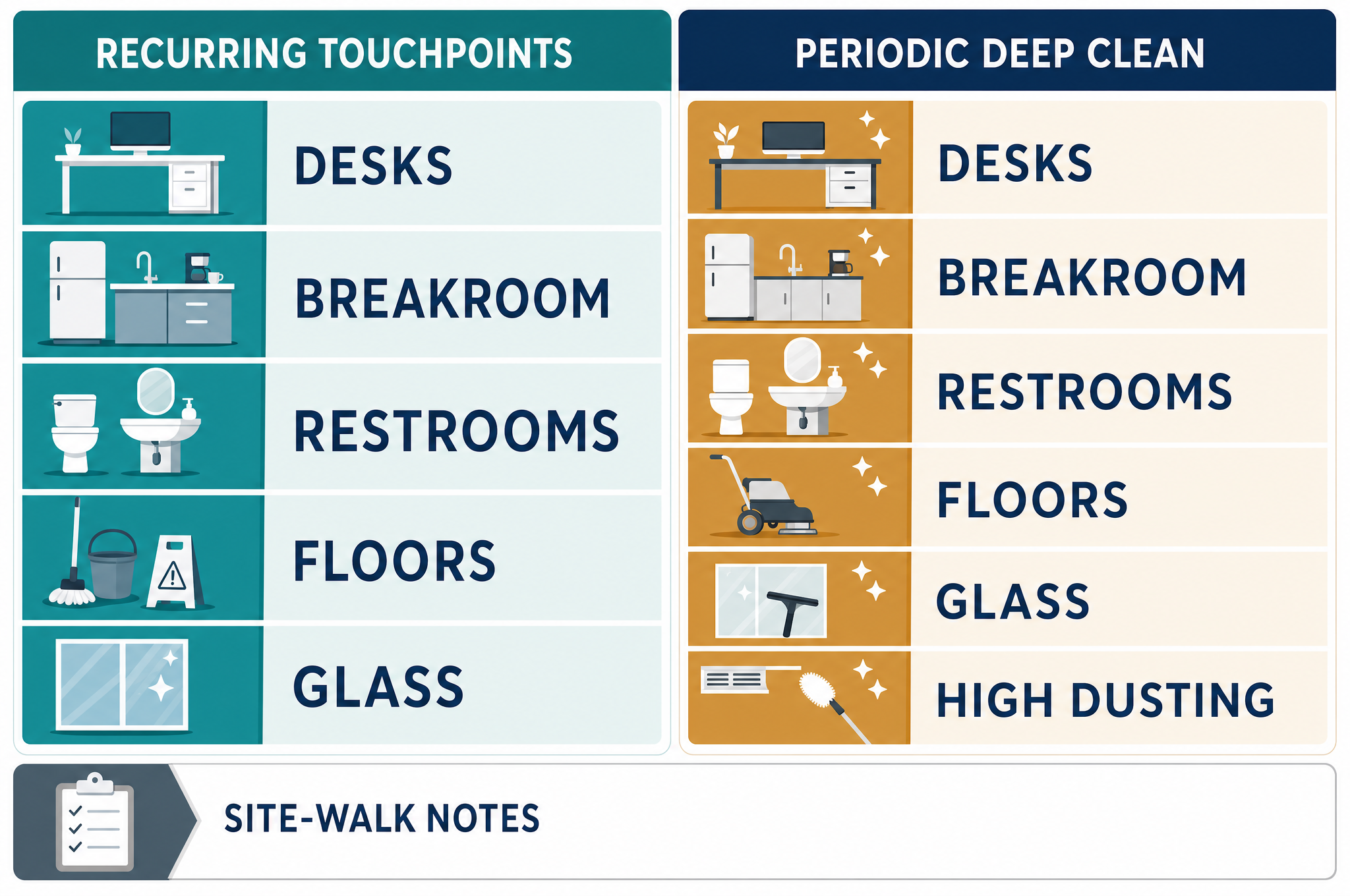
Use So Clean’s breakdown of daily touchpoints and periodic office-cleaning tasks to prevent a monthly or quarterly item from silently becoming a first-night expectation. The company’s existing guide to office-cleaning contract terms also identifies details to settle before launch.
Create a condition baseline before the final handoff
Walk the facility with the approved scope in hand. Record the current condition of entrances, main floor routes, restrooms, breakrooms, waste areas, supply rooms, and any periodic-work surfaces. Note damaged finishes, permanent stains, worn fixtures, full storage areas, and unresolved maintenance conditions separately from cleaning defects.
A useful baseline includes:
- Dated photographs of agreed rooms and notable pre-existing conditions.
- A list of open service tickets and who remains responsible for each one.
- The last completed date for periodic tasks that affect the incoming schedule.
- An inventory that distinguishes facility-owned, outgoing-provider-owned, and incoming-provider-owned supplies or equipment.
- Known access restrictions, occupied rooms, confidential areas, and surfaces with manufacturer-specific care requirements.
The baseline protects all three parties. It prevents the incoming team from being held responsible for an old condition, and it prevents an actual launch miss from being dismissed as pre-existing.
Separate access transfer from service scheduling
Create an access register with the identifier, current holder, permitted area, return or activation date, and verifier for every physical key, card, fob, code, parking credential, elevator permission, loading instruction, or sign-in process. Do not copy an outgoing person’s credentials to an incoming person. Deactivate and reissue access through the facility’s normal security process.
The incoming supervisor should know:
- Where the team enters and exits, and which doors must never be propped open.
- Who can authorize access changes outside the planned window.
- How to report an alarm, failed credential, locked room, or unexpected occupant.
- Which rooms are excluded, escorted, or governed by special privacy rules.
- Where keys or devices are checked in and how return is verified at the end of service.
Test approved access before the first cleaning visit. A walkthrough during business hours does not prove that an after-hours card, loading entrance, elevator, or alarm workflow will function as planned.
Resolve products, dispensers, and stored materials
List every dispenser, liner size, paper product, soap system, chemical station, dilution device, vacuum, floor machine, and storage shelf that affects the scope. Decide who owns each item, whether it stays, and who replenishes it during the transition.
For cleaning chemicals, confirm the incoming company’s labeling, storage, handling, and safety-data-sheet process before materials arrive. OSHA’s Hazard Communication guidance for cleaning chemicals explains employer responsibilities for labels, safety data sheets, and worker training. The cleaning employer and facility’s own safety procedures—not the transition checklist—should govern chemical use.
Do not combine unidentified leftovers, transfer products into unlabeled containers, or assume that one company’s equipment and chemistry can remain for another company to use.
Use one handoff register
A single register prevents tasks from disappearing across email threads. Each line should name the item, category, owner, due date, evidence of completion, and status.
| Category | Closeout evidence | Launch evidence |
|---|---|---|
| Scope and schedule | Final service and unresolved items acknowledged | Room-task-frequency matrix approved |
| Access | Outgoing keys and credentials returned or disabled | New credentials issued, tested, and assigned |
| Supplies and equipment | Outgoing property removed and facility property counted | Incoming materials inventoried and stored in approved locations |
| Building condition | Open defects and damage recorded | Incoming supervisor accepts the dated baseline or records exceptions |
| Communication | Final invoice and closeout contact confirmed | Day, after-hours, and escalation contacts tested |
Treat the first 30 days as a stabilization period
Inspect the first service promptly, then repeat the same route after several visits. The first review should focus on entrances, primary floors, restrooms, breakrooms, waste, access closeout, and any promise made during the walkthrough. Record each issue by exact location, scope item, owner, due date, and verification status.
At the end of week one, check whether the planned time, staffing, access, and supplies support the scope. At the end of the first month, review recurring results and confirm the calendar for periodic work. If occupancy or traffic differs from the original assumptions, adjust the cleaning frequency deliberately instead of allowing unofficial extra tasks to accumulate.
Avoid five common transition failures
- No documented starting condition. Old damage and new service misses become impossible to separate.
- Access changes happen on the first night. A single card or alarm error can block the entire service.
- Periodic tasks are assumed due immediately. The launch is judged against work that was never scheduled.
- Supplies are treated as interchangeable. Dispensers, liners, equipment, and approved products may not match.
- Everyone can report issues, but no one owns closure. Assign one facility decision maker and one incoming supervisor for the stabilization period.
Plan the switch around the actual facility
So Clean of Woburn provides office and commercial cleaning services in Greater Boston and the North Shore. A transition walkthrough can map the building’s rooms, service windows, floor types, access controls, supply responsibilities, and periodic tasks before the first visit. That preparation gives the incoming team a clear starting point and gives the facility manager a practical way to verify continuity.
An office cleaning quality control checklist should answer three questions: Was the contracted work completed, does the result meet the agreed standard, and was any missed item corrected? A useful checklist scores outcomes by zone, applies the same inspection route each time, and links every deduction to a specific part of the cleaning scope.
That makes the review fair to both the facility manager and the cleaning team. It also replaces vague feedback such as “the office did not look right” with a location, an observable condition, and a due date.
Score the result against the contracted scope
Begin with the signed scope, not a generic internet checklist. A lobby scheduled for nightly attention should not be judged the same way as a storage room scheduled monthly. Separate routine tasks from periodic work before assigning points. So Clean’s guide to daily and periodic office-cleaning tasks provides a practical way to make that distinction.
The scorecard below is a starting framework for a typical office. Reweight or remove rows to match the actual building and contract; the total should remain 100 points so results are easy to compare over time.
| Inspection zone | Weight | Observable pass standard | Typical evidence |
|---|---|---|---|
| Entrances and reception | 10 points | Scheduled floors, glass, mats, and reception surfaces show no missed debris, streaks, or obvious residue | One wide photo plus a close view of any defect |
| Floors and circulation paths | 20 points | Contracted vacuuming or hard-floor work is complete, including specified edges and routes | Route inspection under normal lighting |
| Restrooms | 20 points | Fixtures and scheduled touchpoints are visibly clean, dispensers are handled as assigned, and waste is removed | Room-level inspection without photographing occupants or personal items |
| Breakrooms and shared spaces | 15 points | Contracted counters, sinks, tables, floors, and waste tasks are complete | Wide view and exact missed location |
| Work areas and touchpoints | 10 points | Only the approved surfaces and touchpoints are serviced, with personal work materials left as agreed | Spot checks in preselected representative areas |
| Waste and recycling | 10 points | Assigned containers are emptied, relined when included, and returned to position without cross-stream mixing | Container spot check and collection-point review |
| Edges and periodic details | 10 points | Baseboards, corners, vents, or other details due in the current cycle are completed | Compare the inspection date with the periodic-task calendar |
| Communication and closeout | 5 points | Access issues, damaged items, low supplies, and incomplete work are reported through the agreed channel | Service log or ticket with timestamp and owner |
Use a consistent inspection route
Quality scores become more useful when the inspector follows the same path, at a similar point in the service cycle, under normal building conditions. A practical route starts at the main entrance, follows the highest-traffic corridor, checks one representative work area, then covers restrooms, shared spaces, waste points, and one rotating detail zone.
Record four facts for every deduction:
- Location: building, floor, room, and the exact surface or fixture.
- Condition: what is observable, such as debris along the east baseboard or an assigned bin not emptied.
- Scope reference: the task and frequency that make the item due.
- Evidence time: when the condition was observed relative to the cleaning visit and normal office use.
This evidence rule prevents an old photo, an out-of-scope request, or a condition created hours after service from being treated as an automatic cleaning failure.
Do not let a total score hide an urgent condition
A 92 can still require immediate attention. Use a severity override beside the numeric score:
- Routine defect: a localized missed item that can be corrected during the next agreed service window.
- Service-impacting defect: repeated or broad incomplete work that affects a room, zone, or business operation and needs a prompt response.
- Escalation item: a condition involving access, suspected damage, an unknown spill, an exposed sharp, or another issue that should be isolated and routed through the facility’s own safety or incident process.
OSHA’s walking-working surfaces standard addresses clean, orderly, sanitary, and, to the extent feasible, dry workplace surfaces. The facility’s safety program should determine who guards, investigates, or corrects a potentially hazardous condition; a quality score does not replace that process.
Set scoring rules before the first inspection
Choose one deduction rule and use it consistently. For example, award full points when the zone meets the defined standard, deduct 25% of that row for one localized miss, deduct 50% for several misses, and deduct all row points when most contracted work in the zone is incomplete. Document the rule in the service file so a new manager or supervisor can reproduce it.
A simple interpretation band can help:
| Score | Interpretation | Next action |
|---|---|---|
| 95–100 | Standard met with, at most, isolated minor misses | Log the result and watch for patterns |
| 85–94 | Correction is needed in one or more zones | Assign owners and verify the correction |
| Below 85 | The delivered result does not consistently meet the agreed standard | Review supervision, timing, access, and scope before the next cycle |
These bands are management tools, not universal industry grades. Your contract may use different thresholds, and any escalation item should be handled separately regardless of the total.
Close every defect through the same five-step loop
- Log it. Create one record with the location, condition, scope reference, evidence, severity, and reporter.
- Assign it. Name the cleaning supervisor, facility contact, building manager, or other responsible party instead of sending a group message with no owner.
- Set a response time. Use the contract’s service level or an agreed time based on severity.
- Verify it. Reinspect the exact location after the reported correction; a message saying “done” is not the final check.
- Look for recurrence. Tag repeated defects by zone and task so the team can distinguish one miss from a scope, training, access, equipment, or scheduling problem.
If the same restroom item fails three inspections, simply repeating the task may not solve the cause. The issue could be an unrealistic service window, a locked supply area, occupancy that exceeds the original assumption, or a task that was never included. That is when the manager should review the office-cleaning frequency and the written scope together.
Choose an inspection rhythm that matches the building
Inspect more frequently when a service begins, a building reopens, occupancy changes, construction ends, or Greater Boston winter weather increases entrance and floor demand. Once results stabilize, rotate deeper inspections while retaining a short routine check. Avoid inspecting only after complaints; that produces inconsistent evidence and makes trends harder to see.
For multi-tenant or multi-floor offices, keep the core scorecard consistent and rotate a subset of low-traffic areas. The main lobby and primary restrooms might be checked every time, while storage areas or secondary conference rooms rotate by week.
A one-page checklist is enough when the definitions are clear
The finished form needs only the inspection date, service date, route, weighted zone scores, defect records, severity overrides, total, corrective owners, and verification status. Attach photos only when they clarify the condition, and follow the organization’s privacy and security rules.
So Clean of Woburn provides office and commercial cleaning across Greater Boston and the North Shore. During a walkthrough, the service scope and quality-control scorecard can be built around the facility’s real rooms, traffic, access limits, and cleaning frequencies—so both teams know what a passing result looks like before service begins.
Winter office cleaning in Greater Boston should respond to weather, not just the calendar. Snow, slush, and ice-melt residue arrive through the same few entrances, then spread along employee and visitor routes. A useful plan captures that material early, changes service when conditions change, and makes each party’s responsibility clear.
The practical goal is a clean, orderly, and usable path from the exterior door to the office. That begins with the entrance system, not with more mopping throughout the building.
Use weather triggers instead of one fixed winter schedule
A normal weekly scope may work during a dry stretch and fall behind during a storm cycle. Build three operating modes into the plan:
- Pre-storm mode: Check mat placement, confirm the interior route, empty or replace saturated equipment, and make sure the cleaning team knows which entrance will carry the most traffic.
- Active-weather mode: Inspect entrances more often based on visible moisture, salt residue, mat saturation, and traffic. Remove tracked material near the source before it spreads to elevators, corridors, and work areas.
- Post-storm mode: Lift and clean beneath mats when conditions allow, remove dried residue from compatible surfaces, and inspect the full travel path for material that moved beyond the lobby.
OSHA’s general requirements for walking-working surfaces require workplaces to keep those surfaces clean, orderly, and sanitary, and floors clean and, to the extent feasible, dry. Your facility’s safety program—not a blog checklist—should determine inspection, guarding, and corrective-action procedures.
Build a three-zone entrance system
Each zone has a different job. One mat at the interior door cannot scrape, absorb, and finish the whole process effectively on its own.
| Zone | Primary job | What to inspect | Cleaning response |
|---|---|---|---|
| Exterior approach | Reduce loose snow and grit before the threshold | Blocked path, displaced scraper mat, material accumulating at the door | Property management or the snow contractor clears exterior conditions; keep the entry mat correctly positioned |
| Vestibule | Capture moisture and coarse residue | Mat saturation, curled edges, residue around the mat, door clearance | Extract or replace the mat as planned and clean the surrounding floor with a material-compatible method |
| Interior walk-off | Remove remaining fine moisture and residue before office circulation | Footprints beyond the mat, dried film, residue at elevators or stairs | Vacuum or clean the route before the material reaches work areas |
In a small suite, the three zones may fit within one short path. In a multi-level facility, treat the loading entrance, parking connection, main lobby, and employee entrance as separate systems. The production office and commercial cleaning service confirms that carpet vacuuming and hard-floor cleaning can be tailored to the actual workspace.
Assign winter responsibilities before the first storm
Interior cleaning cannot compensate for an exterior route that has not been cleared, and an office cleaning scope should not silently absorb snow-removal duties. Use a responsibility matrix.
| Task | Property manager or landlord | Office contact | Cleaning team |
|---|---|---|---|
| Exterior snow and ice | Assign and manage the qualified exterior vendor | Report blocked or changing entrance conditions | Outside routine interior-cleaning scope unless expressly contracted |
| Mats and entrance layout | Approve mat type, placement, and building rules | Keep furniture, deliveries, and displays out of the walk-off path | Inspect condition and clean, exchange, or report mats according to scope |
| Storm communication | Identify closures and building-access changes | Provide the cleaning contact with occupancy and schedule changes | Adjust the approved task sequence to the actual open entrances |
| Interior track-in | Escalate building-wide conditions | Flag affected routes promptly | Capture residue and moisture using the approved floor method |
Match the cleaning method to the floor
Winter residue looks similar across surfaces, but the correct response depends on the floor and its finish. Record the material at every entrance: sealed stone, ceramic tile, resilient flooring, finished wood, concrete, or carpet.
- Remove loose grit before adding moisture so it is not dragged across the finish.
- Use the floor manufacturer’s approved product, dilution, tools, and contact limits.
- Use clean pads, mop heads, and solution so residue is removed rather than spread.
- Avoid treating an unknown white film with a guessed chemical combination.
- Report worn finish, lifted mat edges, damaged thresholds, or recurring leaks to the property contact instead of hiding them with a temporary clean.
Periodic floor work and storm-day entry cleaning belong to different parts of the contract. So Clean’s guide to daily touchpoints and periodic office-cleaning tasks can help keep those responsibilities separate.
Set trigger points the office can actually observe
A facility does not need a complicated dashboard to know when the winter mode should change. Use observable triggers:
- The mat is visibly wet, loaded with grit, displaced, or no longer lying flat.
- Footprints or residue extend beyond the interior walk-off zone.
- A second entrance opens for deliveries, events, or a schedule change.
- Occupancy is higher than the normal cleaning scope assumes.
- Residue appears at elevator doors, stair landings, reception, or other downstream points.
- A dry period begins, making under-mat and edge cleaning practical.
These triggers complement the normal office cleaning frequency. They do not require the entire office to receive a deep clean every time weather changes.
Add a winter section to the cleaning scope
A concise winter addendum should name the active months, covered entrances, mat responsibilities, approved floor methods, storm communication contact, inspection triggers, downstream routes, excluded exterior duties, and the process for authorizing extra service.
During the walkthrough, trace the path people actually take from the door to reception, elevators, restrooms, breakrooms, and shared corridors. That route—not a generic checklist—should determine where winter tasks begin and end.
So Clean of Woburn serves offices across Greater Boston and the North Shore. A winter office cleaning plan can be built around your entrances, floor materials, occupancy, and building responsibilities so the scope changes when the conditions do.
Post-construction cleaning for occupied spaces needs a different plan from cleaning an empty building. The goal is not simply to remove visible dust. You need to keep renovation residue from moving into rooms that are still in use, define who controls each zone, and release cleaned rooms one at a time.
For a Greater Boston home, apartment building, or office, start with a clear handoff between the contractor, property contact, and cleaning team. If dust-producing work is still active, the space is not ready for a final clean.
First decide whether the area is cleaning-ready
A cleaning crew should not be asked to work around active cutting, sanding, drilling, or demolition. Those tasks can create new dust after surfaces have already been cleaned. Before the cleaning visit, confirm that:
- Dust-producing construction work is complete in the rooms being released.
- Contractors have removed large debris, scrap material, fasteners, and their tools.
- Paint, adhesive, grout, sealant, and floor finishes have reached the manufacturer’s stated cleaning or foot-traffic condition.
- Temporary barriers still separate the work zone from occupied rooms.
- The property contact has identified surfaces that need special handling.
- No trade is scheduled to return and reopen walls, ceilings, floors, or cabinets before handoff.
This gate prevents an expensive loop in which a room is detailed, construction resumes, and dust settles again.
Map three zones before cleaning starts
A simple zone map gives everyone the same definition of “clean.” It also keeps tools and foot traffic moving in one direction.
| Zone | What belongs there | Access rule | Release condition |
|---|---|---|---|
| Work zone | Rooms where renovation occurred, plus the contractor’s material and debris path | Restricted to the assigned trade and cleanup team until work stops | Construction is complete and bulk debris is removed |
| Transition zone | Doorway, short corridor, elevator landing, or protected floor path between work and occupied areas | No unprotected tools, carts, or shoes cross into the clean side | Barriers, mats, and the route itself are clean |
| Occupied zone | Rooms that remain open to residents, staff, customers, or tenants | Keep renovation equipment and cleanup waste out | Remains outside the construction traffic pattern |
The U.S. Environmental Protection Agency’s remodeling and indoor-air guidance explains that containment and ventilation help keep dust and pollutants out of the general living area. Those controls belong in the renovation plan before final cleaning begins.
Assign responsibilities before the crew arrives
Post-construction cleanup becomes confusing when every party assumes someone else owns the same task. Put the handoff in writing, even if it is a short email.
| Responsibility | Contractor or trade | Property contact | Cleaning team |
|---|---|---|---|
| Containment | Build and maintain it while dust-producing work is active | Approve occupied routes and restricted areas | Protect the barrier during cleaning and report damage |
| Debris | Remove construction waste, offcuts, hardware, and trade materials | Confirm disposal and loading access | Remove ordinary cleaning waste created by the agreed scope |
| Surface detail | Identify uncured or specialty materials | Confirm priorities and exclusions | Capture fine dust and clean approved surfaces from high to low |
| Hazard clearance | Provide required trade or environmental documentation | Engage the qualified specialist | Do not represent visual cleaning as regulated clearance |
If you are still defining the broad service, review what post-construction apartment cleaning covers. The occupied-space plan here starts after the renovation scope and contractor handoff are clear.
Use a five-stage cleaning and handoff sequence
- Confirm the boundary. Walk the work zone, transition route, and occupied zone with the property contact. Photograph existing damage and note surfaces that are excluded from the cleaning scope.
- Capture loose dust from high to low. Begin above eye level, then move to walls, trim, fixtures, cabinets, and floors. Use equipment and attachments appropriate for fine dust rather than pushing residue from one surface to another.
- Detail horizontal and hidden surfaces. Check ledges, cabinet interiors, window tracks, door tops, baseboards, and the edges of protected flooring. These are common places for settled dust to remain after an otherwise polished room looks finished.
- Wet-clean compatible surfaces. Match the product and moisture level to the material. Fresh paint, natural stone, unfinished wood, specialty coatings, and new floor finishes may each require different handling.
- Inspect before reopening. Review the room in normal light, check the transition route, and record anything that needs a contractor callback rather than a cleaning correction.
Do not remove containment simply because the visible surfaces look clean. The contractor or responsible project lead should confirm that the work area can be released and that no dust-producing task will restart.
Release one room at a time
A whole-property “done” declaration is too vague for an occupied project. Use a room-release checklist instead:
- No loose construction debris remains.
- No visible dust remains on horizontal surfaces, trim, fixtures, or floor edges.
- Cleaned surfaces are dry and ready for normal use.
- Air returns, supply vents, and temporary coverings have been handled according to the project lead’s plan.
- Furniture or stored belongings have not been moved back into a room that still needs trade work.
- The access route is clean, and waste can leave without crossing reopened rooms.
- Any required hazard-specific inspection or clearance is documented separately.
This checklist verifies the cleaning handoff. It is not a laboratory test, air-quality certification, or lead-dust clearance.
Know when ordinary cleaning is not the next step
Pause routine cleaning when the project may involve lead-based paint, asbestos-containing material, mold remediation, sewage, chemical residue, or another regulated hazard. The responsible property contact should identify the correct qualified contractor or environmental professional before a general cleaning crew enters.
For pre-1978 homes, EPA’s lead-safe renovation guidance describes containment, HEPA vacuuming, wet cleaning, and the need to keep non-workers out of the work area. A standard cleaning visit should never be presented as a substitute for those requirements.
Give the cleaning team a useful project brief
Before the walkthrough, send a one-page brief with the property address, occupied rooms, work-zone boundaries, approved access route, parking or loading instructions, alarm and key contact, floor and countertop materials, areas that remain under contractor control, and the deadline for each room release.
So Clean’s Greater Boston office and commercial cleaning team can build a post-construction scope around the rooms that are actually ready, the materials on site, and the way the property must stay in use. A clear handoff protects the clean result and keeps the next trade from undoing it.
How often an office should be professionally cleaned depends on occupancy, visitor traffic, shared facilities, work hours, and the standard the organization wants to maintain. A small appointment-only office and a busy workplace with a shared kitchen should not follow the same schedule.
Match frequency to use, not square footage alone
Square footage helps define scope, but use patterns determine how quickly an area needs attention. Entrances, restrooms, break rooms, conference rooms, and high-touch shared areas usually require a different cadence from private offices, records rooms, or lightly used storage.
| Office condition | Frequency to evaluate | Focus |
|---|---|---|
| High daily occupancy or public traffic | Daily service, with selected tasks repeated during operating hours | Restrooms, entries, waste, floors, shared surfaces, and supplies |
| Moderate weekday office use | Several visits per week | Restrooms and break areas each visit; rotate dusting and detail work |
| Small, low-traffic professional office | Weekly service, adjusted after review | Floors, waste, restroom, surfaces, and scheduled detail tasks |
| Hybrid or irregular occupancy | Service aligned with occupied days and events | Pre-occupancy resets, post-event cleaning, and periodic unused-area checks |
These are planning ranges, not fixed rules. A walkthrough should establish the actual task frequency for each zone.
Separate every-visit tasks from rotating tasks
A workable scope distinguishes tasks that must happen on every visit from tasks that can rotate. Every-visit work might include waste removal, restroom care, break-room surfaces, visible floor soil, and replenishing agreed supplies. Rotating work can cover detailed dusting, interior glass, low ledges, chair bases, and perimeter cleaning.
This separation makes the proposal easier to compare and the completed work easier to inspect.
Look for signs that the current cadence is too light
- Waste or recycling regularly reaches capacity before the next visit
- Restroom supplies run out or fixtures show visible buildup
- Entry soil tracks beyond the first floor-care zone
- Break-room counters, sinks, or appliance exteriors remain soiled
- Dust becomes visible on work surfaces before the next service
- Complaints cluster after busy days, meetings, or visitor events
Before adding a full extra cleaning visit, identify whether one zone needs a higher frequency or the entire office does. A targeted restroom, entry, or break-room touch-up may solve the problem more efficiently.
Account for season and weather
Greater Boston offices often carry in more grit, moisture, and deicing residue during winter. Spring pollen and wet-weather traffic can also change floor and entry needs. The schedule should allow seasonal changes to mat care, vacuuming, mopping, and detail work without rewriting the entire agreement.
Define the operating details
Frequency is only one part of the scope. Document access times, alarm procedures, locked rooms, waste locations, supply responsibilities, recycling rules, preferred communication, and the person authorized to request changes. Note privacy or security requirements before service begins.
Review the schedule after a trial period
Use the first few weeks to test the planned cadence. Review recurring misses, unnecessary tasks, seasonal effects, and service timing. A good office cleaning plan should be specific enough to inspect and flexible enough to change when occupancy changes.
So Clean provides office cleaning services in the Woburn area. A walkthrough can turn occupancy and traffic patterns into a zone-by-zone service schedule.
A useful office cleaning scope names the space, task, frequency, standard, and responsibility for every recurring item. Daily service should concentrate on waste, restrooms, break rooms, floors, and high-touch points. Detail work such as carpet extraction, high dusting, interior glass, floor refinishing, and appliance interiors belongs on a weekly, monthly, quarterly, or separately approved schedule.
That separation matters because “clean the office” is not measurable. A written scope gives the facility contact and cleaning team the same definition of complete, makes pricing easier to compare, and prevents periodic work from disappearing behind urgent nightly tasks.
Start with four definitions
- Cleaning removes soil, dust, and many germs with detergent, water, and physical action.
- Sanitizing reduces germs to levels established by public-health requirements.
- Disinfecting uses a registered product to kill remaining germs on a surface after it has been cleaned.
- Detail or restorative cleaning addresses buildup that routine service is not designed to remove, such as carpet extraction or floor-finish restoration.
The distinction is not just wording. The CDC explains that cleaning is usually the first step and that disinfection is most relevant when illness or higher-risk conditions make it necessary. A proposal should never use “disinfect” as a vague synonym for wiping.
A practical frequency matrix
| Frequency | Typical work | Scope question |
|---|---|---|
| Each visit | Trash and recycling, restroom fixtures, break-room counters and sinks, entry glass, vacuuming or spot mopping, agreed high-touch points | Which rooms are occupied, and what must be reset before opening? |
| Weekly | Desk-edge dusting where clear, full hard-floor mopping, low ledges, interior glass partitions, appliance exteriors | May cleaners move papers, electronics, or personal items? |
| Monthly | Baseboards, reachable vents, chair bases, door frames, deeper restroom detailing, partition spot cleaning | What height limit and access equipment are included? |
| Quarterly or seasonal | Carpet extraction, machine floor care, high dusting, full interior glass, salt-residue recovery | Is this in the base price or approved separately? |
Match frequency to how the office is actually used
A small law office with twenty assigned desks does not create the same cleaning load as a call center, clinic, shared workspace, or warehouse office with constant foot traffic. Record the number of occupants, visitor volume, restrooms, food-preparation areas, floor types, and days of operation. Then identify the spaces that can be serviced only during restricted hours.
Greater Boston seasons also change the workload. Winter entry zones collect meltwater, grit, and deicing residue. Spring pollen shows quickly on dark furniture and glass. A good Woburn-area scope anticipates those cycles instead of treating every month as identical.
Copyable sample scope for a 10,000-square-foot professional office
This example is a planning model, not a quote. It shows the level of detail a facility manager can bring to a walkthrough.
| Area | Task and standard | Frequency |
|---|---|---|
| Open office and private offices | Empty liners as needed; vacuum traffic lanes; damp-wipe clear shared surfaces; leave papers and electronics undisturbed | Nightly |
| Two restrooms | Clean fixtures, mirrors, counters, partitions, and floors; refill client-supplied consumables; report leaks or damaged dispensers | Nightly |
| Break room | Clean sink, counters, tables, appliance exteriors, and floor; refrigerator interior excluded unless scheduled | Nightly |
| Carpet and resilient flooring | Spot clean as reported; extract carpet and perform appropriate machine care after inspection | Quarterly or approved separately |
Write exclusions and responsibilities into the scope
Common disputes begin with unspoken assumptions. State whether the cleaning provider or client supplies paper goods, liners, soap, and chemicals. Identify locked rooms, alarm procedures, key control, waste locations, recycling rules, security-sensitive desks, sharps or biohazards, pest evidence, and who can approve extra work.
Also list what is not routine janitorial work: exterior windows, post-construction dust, hazardous materials, bodily-fluid cleanup, data-center spaces, high work beyond the agreed limit, and moving heavy furniture. Cleaning chemicals require appropriate labels, training, and handling; OSHA’s cleaning-industry guidance is a useful reference for workplace hazards. The EPA Safer Choice label can help purchasers identify products evaluated against its ingredient and performance criteria.
Use a walkthrough and a change-control rule
- Walk every included room and record floor type, fixtures, access limits, and current condition.
- Mark each task as each-visit, weekly, monthly, seasonal, or on request.
- Define what “complete” looks like and how issues are reported.
- Name the person who can authorize additions, schedule changes, or emergency service.
- Review the scope after the first month and whenever occupancy or space use changes.
Questions facility managers ask
How often should an office be cleaned?
There is no responsible one-size answer. Occupancy, visitor traffic, restrooms, food service, floor types, operating hours, and required standards determine frequency. Many offices need waste, restrooms, break rooms, and traffic lanes addressed each service visit, with detail work rotated.
Who supplies cleaning products and consumables?
Either arrangement can work, but the proposal should name the responsible party for chemicals, liners, paper products, hand soap, and dispensers. It should also explain how low stock is reported.
What should not be included automatically?
Hazardous or regulated cleanup, exterior windows, construction cleanup, high-access work, heavy lifting, and restorative floor care should be specifically assessed and authorized rather than implied by a general janitorial line item.
For a site-specific walkthrough in Woburn, Greater Boston, or the North Shore, review So Clean’s office cleaning service and confirm whether your address is within the company’s service area.
What Is the Average Cost for Bi Weekly House Cleaning?
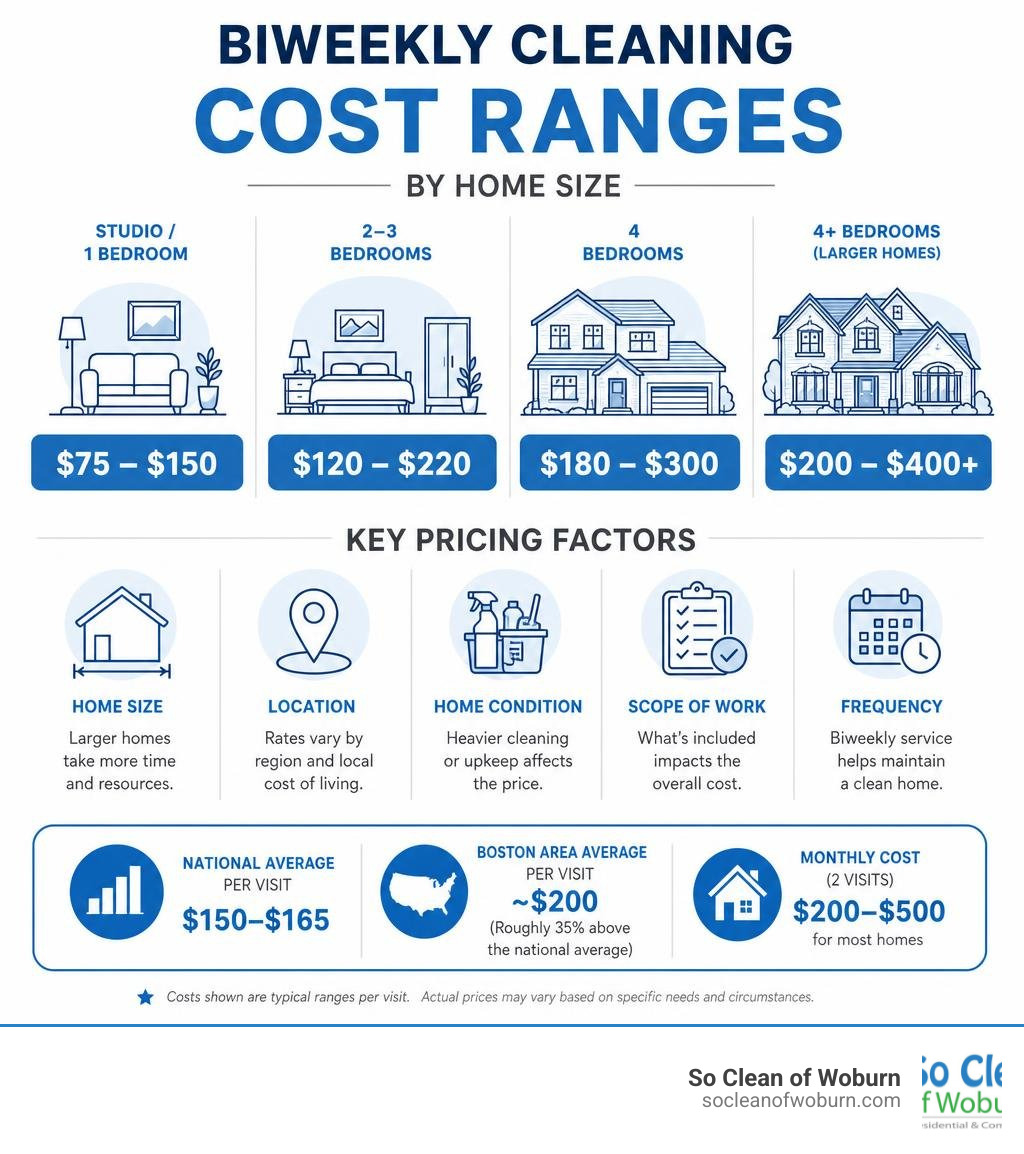
The average cost for bi weekly house cleaning in 2026 ranges from about $100 to $300 per visit, depending on your home size, location, and condition.
Here’s a quick snapshot of what most homeowners pay:
| Home Size | Typical Biweekly Cost Per Visit |
|---|---|
| Studio / 1 bedroom | $75 – $150 |
| 2–3 bedrooms | $120 – $220 |
| 4 bedrooms | $180 – $300 |
| 4+ bedrooms (larger homes) | $200 – $400+ |
- National average per visit: ~$150–$165
- Greater Boston area average: ~$200 per visit (roughly 35% above the national average)
- Monthly cost (2 visits): ~$200–$500 for most homes
Biweekly cleaning is the most popular recurring schedule — and for good reason. It keeps your home consistently clean without the higher cost of weekly service.
Many homeowners don’t realize how wide the price range can be until they start getting quotes. Three services quoting the same 3-bedroom home might come back at $140, $220, and $425 — all for the same scope of work. Understanding what drives those differences can save you real money.
I’m Bill McGrath, owner of So Clean of Woburn, and after years of providing residential cleaning across the Greater Boston area, I’ve seen how confusing it can be to make sense of the average cost for bi weekly house cleaning — so I put this guide together to cut through the noise. Read on for a full breakdown of every factor that affects your rate.
Average cost for bi weekly house cleaning glossary:
- What is the average home cleaning cost per hour for residential maid services in the Essex County area?
- cost of monthly cleaning service
- house cleaning cost per square foot
What is the Average Cost for Bi Weekly House Cleaning in 2026?
When you look at the numbers across the country in 2026, the baseline average cost for bi weekly house cleaning sits comfortably around $150 per visit. However, a single number doesn’t tell the whole story. Depending on where you live and the size of your space, homeowners typically see a wide price range starting from $100 on the low end for small apartments and scaling up to $300 or more for larger, multi-story family homes.
To help you visualize how these costs break down, we have put together a comparative table that contrasts national estimates with local Massachusetts rates:
| Home Profile | National Average Cost | Massachusetts Average Cost | High-End Premium Range |
|---|---|---|---|
| Small Home / Apt (under 1,000 sq ft) | $100 – $130 | $130 – $180 | $260 – $360 |
| Mid-Sized Home (1,400 – 2,000 sq ft) | $150 – $220 | $180 – $260 | $360 – $520 |
| Large Family Home (2,400+ sq ft) | $200 – $300 | $250 – $350 | $500 – $700 |
As you can see, local rates in Middlesex and Essex Counties trend noticeably higher than the national averages. This is primarily driven by the higher cost of living, strict local insurance requirements, and the premium placed on professional, background-checked labor in our region.
If you are trying to map out a long-term budget for your home maintenance, choosing a recurring plan is always the smartest financial move. When you sign up for a regular schedule, you can dive deeper into the logistics with our Bi-Weekly House Cleaning Complete Guide. Maintaining a home on a continuous basis prevents the heavy buildup of soap scum, grease, and dust, allowing professional teams to complete the work efficiently. For a broader overview of standard pricing structures, check out our comprehensive House Cleaning Cost Guide.
Key Factors That Influence Your Biweekly Cleaning Rates
Have you ever wondered why two identical houses on the same street in Arlington, MA, can receive completely different quotes? It is because professional cleaning companies look at much more than just your home’s layout.
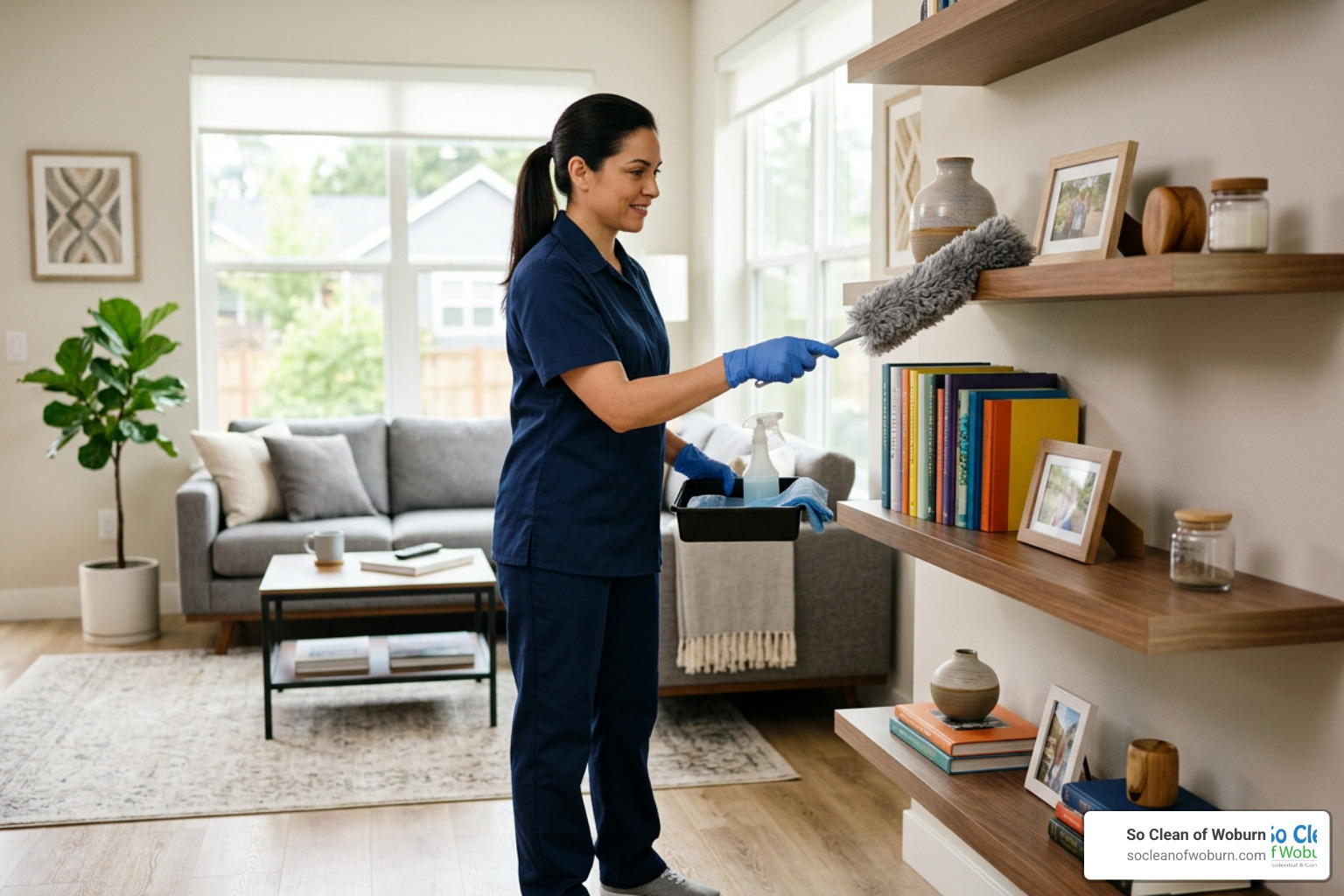
When we build a custom cleaning quote, several key factors come into play:
- Overall Condition of the Home: If it has been several months since your last professional clean, the first visit will require significantly more “elbow grease.” This initial catch-up work is why first-time cleans are often billed at a higher rate before transitioning to the lower biweekly maintenance pricing.
- Pet Hair and Dander: We love our furry friends, but they certainly leave their mark. Homes with shedding pets require specialized vacuum attachments, extra time to lift hair from upholstery, and more frequent filter changes on our equipment. This can add a modest premium of 15% to 25% to the base rate.
- Clutter Levels: Cleaners are there to sanitize and scrub surfaces. If a team has to spend the first 30 minutes picking up toys, organizing mail, and clearing clothes off the floor just to reach the countertops and carpets, the total labor time increases.
- Local Market Dynamics: Labor rates in affluent suburban markets like Arlington, MA, naturally reflect the regional demand for high-quality, fully insured services. You can read more about how these variables interact in our guide on How Much Does House Cleaning Cost.
How Home Size Impacts the Average Cost for Bi Weekly House Cleaning
It goes without saying that a 3,000-square-foot home takes longer to clean than a 1,000-square-foot townhouse. However, square footage is only one part of the equation. Professional estimators pay close attention to the specific room configurations—especially the bathrooms.
Bathrooms are the true labor bottlenecks of any residential cleaning job. Scrubbing tile grout, sanitizing toilets, polishing glass shower doors, and removing soap scum from tubs require intensive physical labor and specialized products. A 1,500-square-foot home with 3 bathrooms will often cost more to clean than a 2,000-square-foot home with only 1.5 bathrooms because of the sheer detail work required in those wet areas.
Bedrooms, by contrast, are relatively quick to clean. They mostly require dusting flat surfaces, vacuuming carpets, and emptying trash bins. If you want to understand how companies translate these spaces into hard numbers, read our practical breakdown of House Cleaning Cost Per Square Foot: A Practical Guide.
Regional Pricing and the Average Cost for Bi Weekly House Cleaning in Massachusetts
Where you live in Massachusetts plays a massive role in what you will pay for professional home care. In the Greater Boston area and the North Shore, standard pricing sits roughly 35% above the national average.
For instance, a standard standard clean for a 3-bedroom home in downtown Boston typically averages around $200 per visit, with a normal range of $150 to $400 depending on the level of detail required. To put this in perspective, our high-end premium range for larger or more complex properties can reach up to $400 per visit—exactly double our standard starting rates.
When you look at specific communities:
- In Belmont, MA, local service standards are exceptionally high. Homeowners here often seek out fully bonded and insured teams who can handle historic home finishes with care.
- In Beverly, MA, local rate factors are heavily influenced by the coastal climate and seasonal changes, which can bring unique cleaning challenges like salt air residue and mudroom buildup.
- In Arlington, MA, rates reflect the busy lifestyles of commuting professionals who prioritize consistency and rapid communication.
No matter which town you call home, working with a local provider who understands the unique architectural styles and climate challenges of New England is key to getting the best value.
Comparing Cleaning Frequencies: Weekly vs. Biweekly vs. Monthly
Choosing the right frequency for your home is a balancing act between your budget, your household’s lifestyle, and how much daily maintenance you are willing to do yourself.

Here is how the three main recurring options stack up against each other:
- Weekly Cleaning: This is the ultimate luxury for busy families, homes with multiple pets, or working parents who simply do not want to lift a finger on weekends. Because the home never has time to get truly dirty, weekly visits are highly efficient and often come with the steepest per-visit discounts (sometimes up to 30% off standard one-time rates).
- Biweekly Cleaning: For the vast majority of households, biweekly is the “sweet spot.” It prevents heavy grime, dust, and soap scum from bonding to your surfaces, meaning your home always feels relatively fresh. It strikes an excellent balance, offering a substantial discount over one-off cleanings while keeping your monthly investment manageable. To explore why so many families choose this route, read The Real Cost of Bi-Weekly House Cleaning and Why It Is Worth It.
- Monthly Cleaning: This option is best suited for solo occupants, frequent travelers, or exceptionally tidy households. The challenge with monthly visits is that four weeks is a long time for dust and grime to build up. As a result, monthly visits take longer, require heavier scrubbing, and generally cost more per visit. You can find more details on these rates in our analysis of What Is the Going Rate for a Monthly House Cleaner in 2026.
Smart Ways to Save Money on Recurring Cleaning Services
You do not have to stretch your budget to its breaking point to enjoy the life-changing benefits of a professionally cleaned home. With a few strategic adjustments, you can keep your biweekly rates highly affordable:
- Declutter Before the Team Arrives: You are paying for professional cleaning, not organizing. If our team doesn’t have to spend time sorting through toys, clearing papers off the dining table, or picking up clothes, they can focus 100% of their energy on deep-cleaning your surfaces. This keeps the appointment efficient and your costs down.
- Skip Rooms You Don’t Use: Do you have a guest bedroom that only gets used during the holidays? Or a basement playroom that is currently closed off for the season? Ask your provider to omit these rooms from the regular biweekly rotation. Skipping just one bedroom and bathroom can instantly shave $20 to $40 off your per-visit rate.
- Establish Clear Priorities: Focus our team’s time where it matters most. If you don’t mind vacuuming your own bedrooms but absolutely loathe scrubbing the kitchen and bathrooms, request a customized “wet areas only” plan.
For a step-by-step breakdown of how to build a budget-friendly plan, check out our Step-by-Step Guide to House Cleaning Cost Estimates. When you are ready to reach out, you can learn how to navigate the process smoothly with our guide on How to Get a Thorough House Cleaning Quote Without the Stress.
Frequently Asked Questions About Biweekly House Cleaning
Do I need to be home during a biweekly cleaning?
No, you do not need to be home! In fact, the majority of our recurring clients prefer to schedule their appointments while they are at work, running errands, or enjoying outdoor activities. It is incredibly satisfying to walk through the front door after a long day and immediately step into a pristine, fresh-smelling home.
If you choose to be away, you can easily coordinate secure entry instructions with us. Most homeowners provide a spare key, a garage keypad code, or an electronic lockbox code. Rest assured, establishing trust and security is our absolute highest priority for residents in areas like Andover, MA, and throughout the region.
Should I tip my biweekly house cleaners?
Tipping is never mandatory, but it is always deeply appreciated by the hard-working professionals who care for your home.
If you choose to tip, a standard guideline is 10% to 15% of the service price per visit. For recurring biweekly services, many homeowners find it easier to provide a larger holiday bonus at the end of the year—typically equivalent to the cost of one full cleaning visit—along with a warm, personalized note.
Do cleaners bring their own supplies?
Yes, professional companies should always arrive fully equipped! Our teams bring professional-grade vacuums, fresh microfiber cloths, mops, and a complete suite of specialized cleaning solutions.
If you have specific preferences—such as eco-friendly, plant-based products to protect your indoor air quality, or specialized polishes for delicate stone countertops—simply let us know ahead of time. We are always happy to customize our approach to fit your household’s needs. To learn more about what goes into professional-grade service rates, check out our guide on House Cleaning Rates. You can also cross-reference these standards with regional labor statistics from the U.S. Bureau of Labor Statistics to understand the local cost of professional service.
Conclusion
At the end of the day, investing in a biweekly house cleaning service is about more than just maintaining a beautiful home—it is about reclaiming your precious weekends, reducing daily stress, and ensuring a healthy, allergen-free environment for your family.
At So Clean of Woburn, we pride ourselves on delivering top-notch, customized cleaning solutions at affordable prices across the Greater Boston area, including Middlesex and Essex Counties. Whether you are located in Woburn, Burlington, Lexington, or Beverly, we are here to help you design a recurring plan that fits your budget perfectly.
Ready to experience the joy of a truly clean home without the hassle? Book professional house cleaning services with So Clean of Woburn today and let us handle the hard work for you!
Why an Office Cleaning Contract Is the Foundation of Every Successful Cleaning Business
An office cleaning contract is a written agreement between a cleaning service provider and a client that defines exactly what services will be delivered, when, and at what cost. If you’re looking to land commercial cleaning work, here’s what you need to know at a glance:
What an office cleaning contract typically covers:
- Parties involved — the cleaning company and the client
- Scope of work — which areas are cleaned and how often
- Payment terms — rate, schedule, and late fee policies
- Legal protections — liability, insurance, confidentiality, and termination clauses
- Performance standards — inspection protocols and quality benchmarks
Getting commercial cleaning work is competitive. Clients want to know they can trust you before you ever set foot in their building. A clear, professional contract signals that you run a serious operation — and it protects both sides if something goes wrong.
Without one, even a small misunderstanding — like a missed service or a disputed charge — can end a client relationship fast. A handshake deal might feel friendly, but it leaves you with no recourse when things go sideways.
The good news? You don’t need a law degree to put together a solid contract. You just need to know what belongs in it.
I’m Bill McGrath, owner of So Clean of Woburn, and through years of providing commercial janitorial services across Greater Boston, I’ve seen how a well-structured office cleaning contract can make or break a client relationship — and I’m here to walk you through exactly how to get it right.
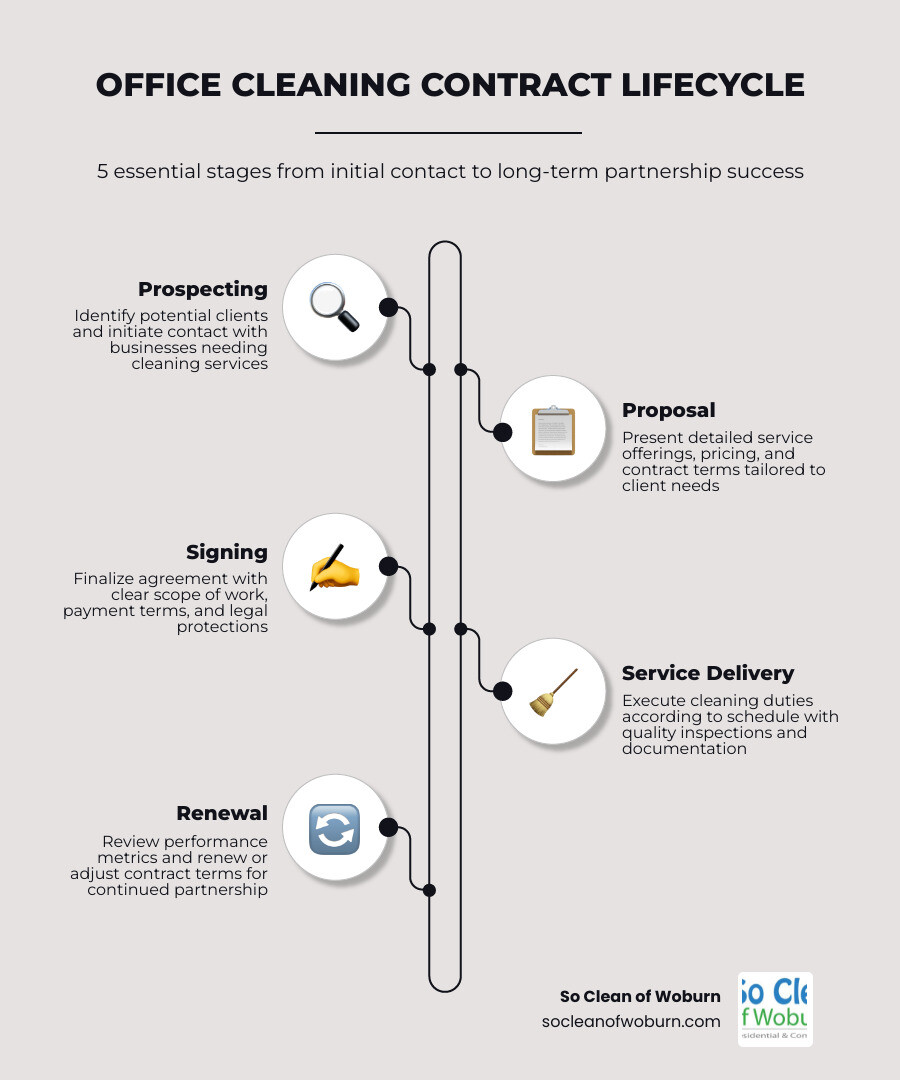
Office cleaning contract definitions:
- how to price office cleaning services
- how hiring a professional cleaning service benefits your office
- janitorial commercial services
Understanding the Essentials of an office cleaning contract
An office cleaning contract is not just paperwork. It is the operating manual for the relationship between a business and its cleaning provider.
At minimum, the contract should identify:
- The legal names of both parties
- The service address or addresses
- The contract start date
- The term length
- The exact services included
- The price and payment schedule
- Who provides supplies and equipment
- Insurance and liability requirements
- How service quality will be reviewed
- How either side can end or renew the agreement
For Massachusetts offices, clear language matters even more when multiple stakeholders are involved. A property manager may sign the agreement, an office administrator may report issues, and building management may control access. If those roles are not spelled out, confusion shows up fast.
We also recommend matching your office agreement to the structure used in other service contracts so expectations stay consistent. If you want to compare how service agreements are organized, our guides on Residential Cleaning Contract and Office Cleaning Service Near Me are helpful starting points.

Defining the Scope of Work in Your office cleaning contract
This is the heart of the contract. If the scope of work is vague, everything else gets messy.
A strong scope of work should answer:
- What gets cleaned?
- How often?
- At what standard?
- During what hours?
- With whose supplies?
Typical office cleaning duties may include:
- Vacuuming carpets
- Dusting desks, ledges, and reachable surfaces
- Emptying trash and replacing liners
- Cleaning and sanitizing restrooms
- Restocking soap, paper towels, and toilet paper
- Cleaning breakrooms and kitchenettes
- Mopping hard floors
- Spot-cleaning glass and entry doors
- Disinfecting high-touch points like switches, handles, and shared surfaces
It should also list what is not included, such as:
- Biohazard cleanup
- Exterior window washing
- Post-construction cleanup
- Data center or restricted IT room cleaning
- Deep carpet extraction unless separately scheduled
Frequency should be specific, not casual. Instead of “regular restroom cleaning,” write:
- Restrooms cleaned and sanitized 5 evenings per week
- Trash removed nightly
- Breakroom floors mopped 3 times per week
- Interior glass spot-cleaned weekly
If supply replenishment is included, say so directly. Some public and private contracts require the cleaning provider to restock consumables and invoice separately or include them in the monthly fee. That one line can save a lot of email chains later.
For comparison, the way duties are broken out in an Apartment Cleaning Contract can also help you think through room-by-room expectations.
Independent Contractor Status and Legal Protections
Most commercial cleaning agreements treat the cleaning company as an independent contractor, not an employee of the client. That matters for taxes, supervision, and liability.
A contract should clarify that:
- We control our own methods and staffing
- The client is not responsible for payroll taxes for our workers
- We remain responsible for compliance with employment laws
- The agreement does not create a partnership or joint venture
It should also identify the governing law, which for local work should generally be Massachusetts law. This becomes important if there is a payment dispute, property damage claim, or disagreement over service failure.
If you are trying to land larger opportunities, especially through bid platforms, review how public listings frame legal requirements. Sample Contracts to Bid for MASSACHUSETTS – GovWin IQ is useful for seeing how formal buyers organize janitorial solicitations in Massachusetts.
Key Clauses and Performance Metrics for Success
A good cleaning contract protects revenue. A great one also protects reputation.
Beyond scope and price, these clauses should usually appear in an office agreement:
- Confidentiality
- Indemnification
- Damage reporting
- Key and access control
- Non-solicitation of staff if relevant
- Service change requests
- Cancellation policy
- Termination rights
- Force majeure
- Entire agreement
- Modification in writing
- Governing law
Termination language is especially important. Many disputes come down to one simple question: can the client cancel immediately, or is notice required? Most balanced contracts use a cure period. For example:
- Either party may provide written notice of a material breach
- The other party has a set number of days to fix the issue
- If the issue is not corrected, the agreement can be terminated
That gives everyone a fair path before the relationship blows up over one rough week.
You can also see how service expectations fit into a broader commercial context in our Commercial Janitorial Services MA Complete Guide.

Quality Assurance and Inspection Protocols
If it is not measurable, it is arguable.
Cleaning contracts work best when they include simple performance metrics such as:
- Completion rate of scheduled tasks
- Inspection scores
- Response time for service issues
- Restroom stocking compliance
- Complaint resolution window
Some large janitorial agreements require nightly quality checks by a supervisor and retention of inspection records. That is smart even for smaller offices. A basic inspection protocol might include:
- Site supervisor review once or twice per week
- Monthly walk-through with the client
- Digital checklist verification
- Photo documentation for issue resolution
- Written follow-up on corrective actions
This protects both sides. The client gets accountability, and we get a documented record that services were completed.
For recurring commercial accounts, we like using checklists tied to zones of the building:
- Reception and lobby
- Workstations and offices
- Conference rooms
- Restrooms
- Kitchen and break areas
- Hallways and common areas
That structure keeps performance conversations factual instead of emotional. Nobody wants a 7:15 a.m. mystery email that says, “The office looked off.” A checklist narrows down what “off” actually means.
For more on service standards, visit our Commercial Cleaning Services page.
Safety Standards and OSHA Compliance
Cleaning contracts should never treat safety like an afterthought.
At a minimum, the agreement should address:
- OSHA compliance
- Proper labeling and handling of chemicals
- PPE requirements
- Slip-and-fall prevention procedures
- Hazard communication
- Storage of supplies and equipment
- Waste disposal rules
Larger contracts often require Safety Data Sheets, still commonly called MSDS, to be maintained for products used on site. That is a best practice even for smaller offices in Boston, Cambridge, Woburn, Arlington, or surrounding communities.
Your contract should also spell out whether staff may handle:
- Sharps
- Bodily fluids
- Unknown chemicals
- Hazardous waste
If not, exclude them clearly.
Public-sector and large institutional contracts may require broader compliance and site-specific procedures. A large UK public tender such as 1FM – Cleaning and Associated Services – Find a Tender shows how formal buyers often evaluate operational readiness, not just price.
How to Price and Structure Your office cleaning contract
Pricing is where many cleaning companies either win smart or win broke.
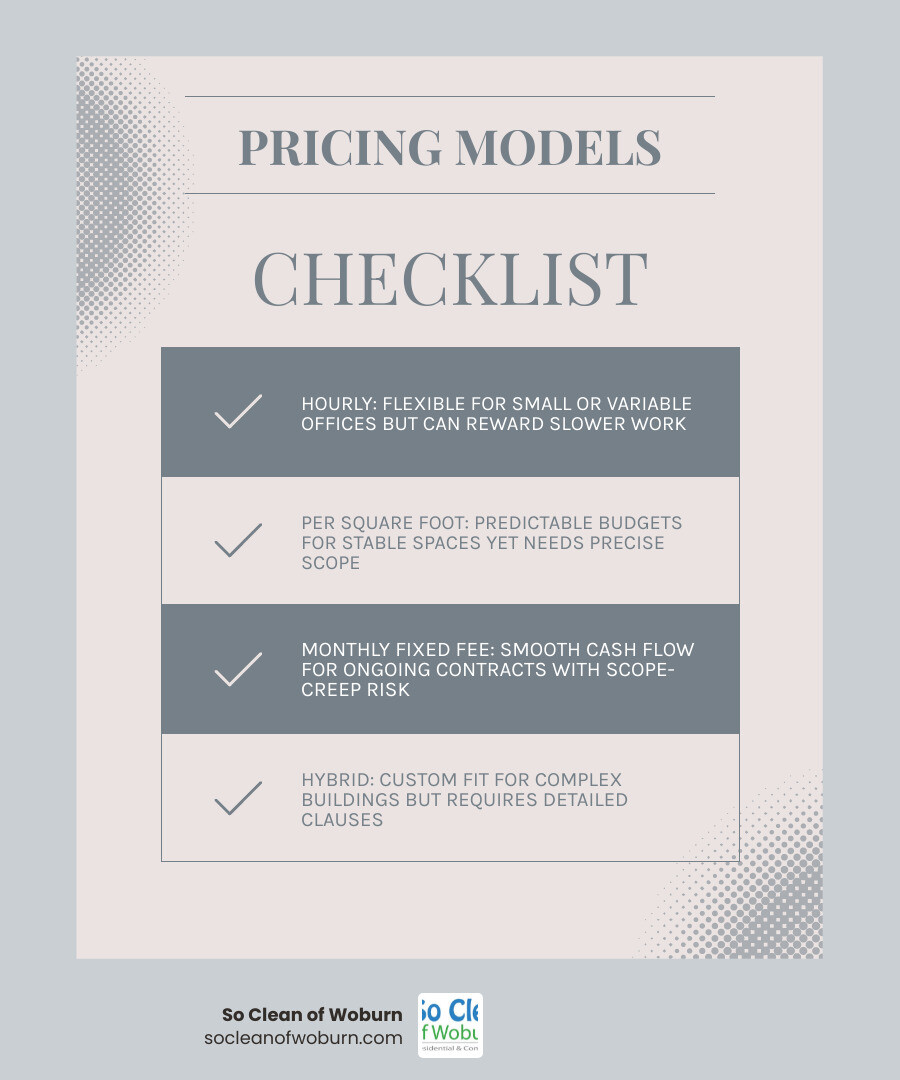
An office contract can be priced in several ways:
- Hourly
- Per square foot
- Per visit
- Monthly fixed fee
- Hybrid pricing for routine plus extra work
Here is a simple comparison:
| Pricing model | Best for | Pros | Watch-outs |
|---|---|---|---|
| Hourly | Small or variable-scope offices | Flexible, easy to explain | Can reward slow work |
| Per square foot | Stable recurring spaces | Predictable budgeting | Needs accurate scope |
| Per visit | Small scheduled cleans | Simple invoices | Easy to underprice |
| Monthly fixed fee | Ongoing janitorial contracts | Smooth cash flow | Scope creep risk |
| Hybrid | Complex buildings | Custom fit | More contract detail needed |
Payment terms should state:
- Invoice date
- Due date
- Accepted payment methods
- Late fee policy
- Deposits if applicable
- Extra work approval process
If the office has unused areas or partially vacant suites, some contracts use vacancy credits or reduced pricing for closed-off space. That only works if access conditions and cleaning frequency are documented clearly.
For deeper pricing help, see How to Price Office Cleaning Services and our Office Cleaning Prices Complete Guide.
Understanding Market Rates in 2026
In 2026, office cleaning pricing is still shaped by a few big factors:
- Labor costs
- Payroll taxes and insurance
- Frequency of cleaning
- Building layout
- Daytime vs. after-hours access
- Supply responsibilities
- Specialty disinfection or floor care
- Security and background check requirements
- Travel time across service areas
One useful labor benchmark from the research: janitors and custodians average about $29,760 per year, or $14.31 per hour, while residential maids and housekeepers average about $31,920 per year, or $15.35 per hour. Those are wage indicators, not bill rates. A contract rate must also cover supervision, overhead, insurance, equipment, admin time, and profit.
For local estimating, a practical broad range for commercial office cleaning is often around $30 to $85 per labor hour depending on complexity, timing, frequency, and scope. Per-square-foot pricing varies too much by building type to use responsibly without a walkthrough.
If you want a broader commercial pricing framework, our Commercial Cleaning Prices Complete Guide breaks it down further.
Estimating Contract Value for Massachusetts Businesses
When estimating value, start with square footage, frequency, and labor intensity.
A real-world contract example in the research covered approximately 277,163 square feet of office space across two locations. That tells us how large commercial janitorial agreements can get once multiple buildings, porter coverage, and evening service are added.
Another benchmark from the research: a public office cleaning contract in Stirling was estimated at £230,000. While that is not a Massachusetts job and should not be used as a local quote standard, it does show that office cleaning contracts can be substantial when they involve routine, planned, and ad hoc services under formal procurement rules.
For Massachusetts businesses, estimate in layers:
- Base recurring cleaning
- Consumables and restocking
- Periodic floor or glass work
- Day porter or daytime touch-up service
- Emergency or after-event work
For example, a small office may need a modest monthly contract, while a multi-tenant office in Greater Boston with restrooms, kitchen areas, conference rooms, and high traffic can justify a much higher recurring fee. The mistake is pricing only the mopping and vacuuming while forgetting supervision, supplies, communication time, and issue resolution.
Licensing, Insurance, and Bonding Requirements
To land serious office contracts, you need more than a mop and confidence.
A professional cleaning provider should typically have:
- A valid business registration
- Any required local or state business licenses
- Workers’ compensation if the business has employees
- General liability insurance
- Commercial auto if business vehicles are used
- Bonding when required by the client
- Potential umbrella coverage for larger accounts
Research on cleaning business requirements also points to common insurance types such as:
- General liability
- Commercial property
- Business owner’s policy
- Workers’ compensation
- Commercial auto
- Hired and non-owned auto
- Umbrella coverage
- Janitorial or surety bond
Bonding is especially common when a client wants added protection against theft or dishonest acts by workers who have building access.
Our guide on How to Start an Office Cleaning Service explains the business setup side in more detail.
Minimum Coverage Limits for Commercial Tenders
Private clients may ask for basic proof of insurance. Public and institutional buyers usually want much more.
One public office-cleaning tender in the research required:
- Employer’s Liability: £5,000,000
- Public Indemnity: £5,000,000
- Professional Indemnity: £100,000
Those exact limits are from a UK public tender and are not a Massachusetts legal standard, but they illustrate how formal solicitations often set high minimums and require proof before award.
For local commercial bids, clients may also ask for:
- Additional insured status
- Certificate holder language
- Waiver of subrogation
- Proof of workers’ compensation
- Bond certificates
- Claims history
If your target client includes municipalities, schools, transit authorities, or large management companies, be ready for more documentation than a typical private office would request.
Strategies for Securing High-Value Contracts
Landing better contracts is rarely about luck. It is about being visible, credible, and easy to evaluate.
Businesses typically secure office cleaning contracts through:
- Referrals
- Property manager relationships
- Local networking
- Direct outreach
- Website and local SEO
- Bid platforms and procurement portals
- Chamber of commerce connections
- Facility management partnerships
- Requests for proposals
For local service companies in Greater Boston, referrals still matter a lot. Office managers trust other office managers. Property managers trust vendors who communicate well and show up when promised. Revolutionary stuff, we know.
To improve your odds:
- Build a clean, professional proposal template
- Define your service area clearly
- Offer site walkthroughs
- Respond quickly to bid requests
- Provide insurance certificates promptly
- Include a detailed scope matrix
- Share quality control procedures
- Be realistic on price
If you want to strengthen the service side that supports your sales process, our Office Cleaning page is a good next step.
Navigating the Public Sector Procurement Process
Government and public-sector contracts differ from private ones in a few major ways.
They often require:
- Formal registration on procurement portals
- Strict deadlines
- Standardized bid forms
- Technical and pricing responses
- References for similar work
- Insurance certificates
- Sometimes certifications such as ISO quality or environmental standards
Public buyers also tend to score proposals with weighted criteria. One office-cleaning tender in the research used 80% quality and 20% price. That is a useful reminder: low price alone does not always win, especially when a public client cares about staffing, methods, supervision, and service continuity.
In some public systems, vendors may need to wait for agency outreach or join pre-qualified contractor lists rather than directly pitch departments. That is very different from private-sector selling, where direct networking and relationship building are common.
Public-sector contracts may also include:
- Longer terms with renewal options
- Detailed compliance language
- Security screening requirements
- Sustainability expectations
- Multi-site service schedules
- Event or emergency response clauses
If you pursue this type of work, read every instruction twice. Then once more with coffee.
Frequently Asked Questions about Office Cleaning Contracts
What is the typical duration of a commercial cleaning contract?
Many office cleaning contracts run for 12 months with renewal options. Larger agreements may run 2 to 3 years, sometimes with one-year extensions. Public contracts often specify the initial term and all possible renewals in advance. The right length depends on the building, onboarding costs, and how much flexibility both parties want.
Can I terminate a cleaning contract early if the service is poor?
Usually yes, but the answer depends on the termination clause. Many contracts allow early termination for cause if service failures continue after written notice and a chance to fix the issue. Others allow termination for convenience with 30 to 60 days’ notice. Never assume. Put the process in writing before the work starts.
Do cleaning contracts usually include the cost of supplies?
Sometimes. Some contracts bundle consumables into the monthly fee. Others separate labor from products like toilet paper, hand soap, liners, and paper towels. The contract should clearly state who purchases, stores, and restocks supplies. If that section is fuzzy, billing disputes are almost guaranteed.
Conclusion
A strong office cleaning contract does more than secure a signature. It defines the work, sets the standard, protects both sides, and creates the structure needed for a long-term client relationship.
At So Clean of Woburn, we believe the best office agreements are clear, practical, and customized to the building they serve. That is how we help businesses across the Greater Boston area maintain a healthier environment without overcomplicating the process or overpricing the service.
If you are ready to move from vague expectations to a cleaning plan that actually works, seal your next deal with professional office cleaning services.
Why Janitorial Services for Business Are Worth Every Penny
Janitorial services for business are professional cleaning programs that keep commercial spaces clean, safe, and presentable — on a regular, ongoing basis.
Here’s a quick breakdown of what they typically include:
- Routine tasks (daily or weekly): trash removal, restroom cleaning, vacuuming, mopping, surface disinfection
- Periodic tasks: carpet cleaning, window washing, floor stripping and waxing
- Specialized services: healthcare-grade sanitation, day porter services, post-construction cleanup
- Best for: offices, retail stores, medical facilities, schools, warehouses, and more
Think about this: the average office desk carries 400 times more germs than a toilet seat. Most employees would never know — and that’s exactly the problem.
A workspace that looks clean isn’t always safe to work in. And for busy professionals in Massachusetts and New Hampshire, there simply isn’t time to manage that gap yourself.
That’s where professional janitorial services come in. They protect your employees, reduce sick days, and make a strong first impression on every client who walks through your door.
I’m Bill McGrath, owner of So Clean of Woburn, and I’ve spent years helping Greater Boston businesses find the right janitorial services for business — from small offices to large commercial facilities. In this guide, I’ll walk you through everything you need to evaluate your options and make a confident decision.
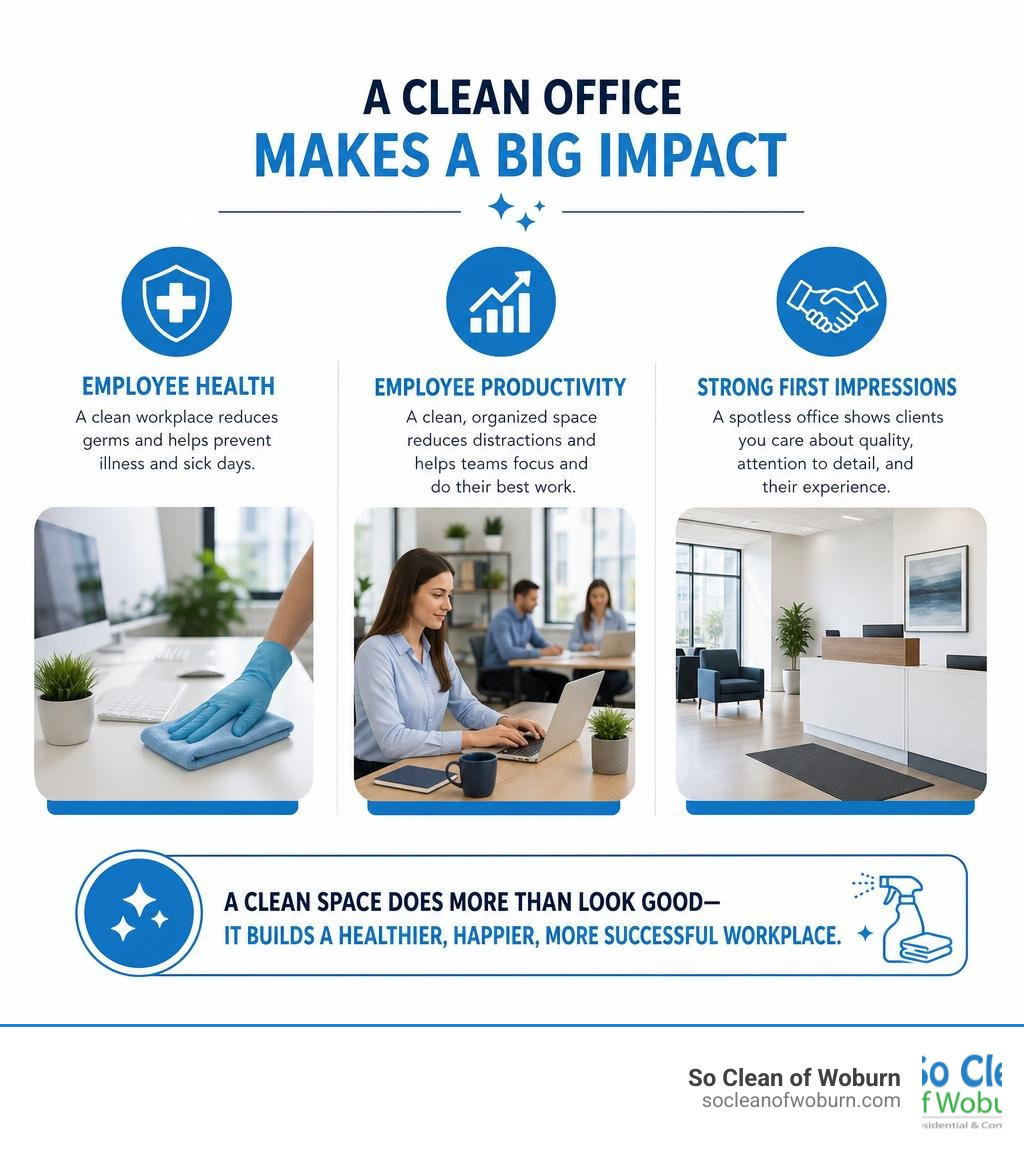
Key Janitorial services for business vocabulary:
What Are Janitorial Services for Business?
When we talk about janitorial services for business, we are talking about the heartbeat of facility maintenance. These are the consistent, everyday routines that prevent a busy commercial space from spiraling into chaos. Without regular upkeep, dust gathers, trash bins overflow, and high-touch areas become hotspots for spreading bacteria.
At its core, professional janitorial care is about consistency. It is the steady presence of a trained team executing a carefully structured checklist. Standard general cleaning and janitorial services typically cover the foundational tasks that keep your doors open and your environment healthy:
- Routine Trash Removal: Emptying waste containers and recycling bins, replacing liners, and hauling garbage to designated outdoor dumpsters.
- Restroom Sanitization: Deep-cleaning toilets, urinals, sinks, and mirrors, alongside disinfecting high-touch areas like flush handles and soap dispensers.
- Dusting and Surface Care: Wiping down desks, countertops, reception areas, and bookshelves to eliminate allergens and dust buildup.
- Floor Maintenance: Sweeping, mopping, and vacuuming hard surfaces and carpeted areas to protect your flooring investments.
By relying on a structured Commercial Janitorial Services Guide, local business owners in communities like Woburn, Burlington, and Boston can hand off these operational tasks entirely. This keeps your internal team focused on what they do best, rather than arguing over whose turn it is to empty the breakroom trash.
Defining Janitorial Services for Business vs. Deep Cleaning
One of the most common points of confusion for business owners is the difference between routine janitorial care and deep commercial cleaning. While they work hand-in-hand, they serve entirely different purposes.
Think of routine janitorial services as your daily or weekly dental hygiene routine (brushing and flossing), while deep cleaning is the intensive, bi-annual checkup and scaling at the dentist’s office.
| Feature / Task | Routine Janitorial Services | Deep Commercial Cleaning |
|---|---|---|
| Primary Goal | Maintain daily cleanliness, health, and order. | Address deep-seated dirt, stains, and buildup. |
| Frequency | Daily, semi-weekly, or weekly. | Monthly, quarterly, bi-annually, or seasonally. |
| Core Tasks | Emptying trash, wiping desks, vacuuming, cleaning bathrooms. | Carpet extraction, window washing, floor stripping/waxing. |
| Disruption Level | Extremely low (often done after hours or quietly by day porters). | Moderate (requires clear spaces and drying/curing time). |
| Equipment Used | Microfiber cloths, standard vacuums, mop systems. | Rotary floor buffers, commercial extractors, pressure washers. |
To get the best results, we always suggest combining both. Consistent routine care keeps your facility presentable day-to-day, while scheduled deep cleanings extend the lifespan of your carpets, upholstery, and hard floors. If you want to dive deeper into how these schedules work, check out our Commercial Janitorial Services MA Complete Guide. For local business owners located on the North Shore, finding targeted commercial cleaning services on the North Shore of Massachusetts can help ensure your facility gets the exact balance of daily upkeep and specialized seasonal deep cleans it needs.
Industry-Specific Janitorial Services for Business Needs
Every industry has its own unique cleaning challenges. A busy auto dealership in Danvers has completely different needs than a high-tech laboratory in Cambridge or a corporate headquarters in downtown Boston.
- Corporate Offices & Tech Firms: These spaces prioritize dust mitigation to protect sensitive electronics, alongside thorough lobby cleaning to maintain a polished corporate image.
- Life Sciences & Labs: In places like Cambridge and Waltham, cleaning requires highly rigorous, specialized training. Cleaners must understand chemical safety, cross-contamination prevention, and strictly follow Good Manufacturing Practices (GMP).
- Healthcare & Medical Facilities: Medical suites require clinical-grade disinfection protocols. Every surface must be treated with EPA-approved disinfectants to prevent the spread of pathogens, ensuring full compliance with healthcare standards.
- Retail Developments & Showrooms: High-traffic retail spaces require pristine floors, streak-free window cleaning, and immaculate public restrooms to keep customers coming back.
No matter what field you are in, partnering with a provider that understands these nuances is critical. If you are located in Massachusetts or New Hampshire, exploring Commercial Janitorial Services MA or looking into professional janitorial services in Massachusetts and New Hampshire will help you find a partner equipped with the right certifications, tools, and training for your specific industry.
The Business Benefits: Productivity, Health, and Compliance

Investing in professional janitorial services isn’t just about aesthetics; it directly impacts your business’s bottom line. A clean workplace is a highly productive workplace. When employees work in an environment that smells fresh, looks organized, and is free of clutter, their focus and morale naturally improve.
Moreover, consistent sanitation protects your brand reputation. When clients, investors, or potential hires walk into your office, the cleanliness of your lobby, conference rooms, and restrooms sends a powerful signal about your attention to detail and professional standards. Businesses that invest in consistent sanitation see long-term savings, stronger brand reputations, and better employee retention. For a complete look at how this impacts local businesses, see our Commercial Janitorial Services MA Complete Guide. If you operate in Southern Massachusetts, utilizing professional commercial cleaning services in Bristol County can help you secure these exact benefits.
Boosting Employee Health and Productivity
As we mentioned earlier, office desks are incredibly germ-dense. In fact, standard office equipment like keyboards, phone receivers, and mouse devices are major breeding grounds for viruses and bacteria. When one employee catches a cold, it can quickly spread through shared breakrooms and meeting spaces, leading to a spike in employee absenteeism.
Professional cleaning services can help businesses reduce health risks and improve employee productivity. By utilizing advanced equipment, such as HEPA-filtered vacuums and color-coded microfiber cloths, professional cleaners trap airborne allergens and prevent cross-contamination between different areas of your building (like restrooms and desks).
By keeping dust, mold spores, and pollen to a minimum, you improve indoor air quality, which reduces headaches, fatigue, and allergy symptoms among your staff. To learn more about how professional cleaning keeps your workforce healthy, read The Ultimate Guide to Office Janitorial Companies Boston.
Maintaining Regulatory and Environmental Compliance
Operating a business in Massachusetts means adhering to strict regulatory guidelines. From OSHA safety standards to local health department codes, maintaining a clean and safe workplace is a legal requirement.
Professional janitorial providers help you stay compliant by:
- Preventing Slips, Trips, and Falls: Ensuring floors are dry, clean, and free of debris.
- Bloodborne Pathogen Training: Ensuring staff are trained to handle biohazards safely and legally if an incident occurs.
- Proper Safety Data Sheets (SDS): Maintaining accessible documentation for all cleaning chemicals stored on-site.
Additionally, modern businesses are increasingly focused on environmental responsibility. Partnering with a provider that offers green, eco-friendly cleaning options helps you meet your sustainability goals. This includes using biodegradable, non-toxic cleaning agents that are safe for your employees, your clients, and the planet. If you are searching for compliant, green-focused partners, start by looking for Janitorial Services Near Me.
Choosing and Customizing Your Commercial Cleaning Plan
There is no such thing as a one-size-fits-all cleaning plan. A small accounting office in Winchester might only need a quick weekly visit, while a multi-tenant office building in Boston requires a dedicated daily team.
The key to a successful partnership is customization. When evaluating your options, a professional provider will conduct an on-site walkthrough to assess your square footage, floor types, high-traffic zones, and specific operational hours. To find out how to tailor a plan specifically for your location, read our guide on Janitorial Services Cambridge MA: How to Choose the Best for Your Business.
Determining Your Cleaning Frequency and Schedule
How often should your business be cleaned? It generally comes down to foot traffic, facility size, and budget.
- Daily or Nightly Cleaning: Essential for large offices, medical clinics, schools, and retail spaces with high daily turnover.
- Weekly or Bi-Weekly Cleaning: Perfect for smaller professional offices (under 15 employees) where foot traffic is minimal.
- Day Porter Services: For large corporate campuses or active facilities, having an on-site day porter ensures that restrooms are restocked, trash is managed, and spills are cleaned up in real-time during business hours.
Most businesses prefer after-hours cleaning (evenings or weekends) to prevent any disruption to their daily operations. However, professional teams can easily work around your schedule to find the least intrusive timing. If you are ready to explore scheduling options, search for trusted Janitorial Services Near Me to find a local team that fits your workflow.
Evaluating Costs and Pricing Models
Understanding how janitorial services are priced helps you budget effectively. Most professional commercial cleaning companies utilize one of two primary pricing models: flat-rate monthly contracts or square-footage-based pricing.
When looking at average prices, commercial janitorial services typically range from $500 to $1,500 per month for standard mid-sized office spaces, with an average cost of $1,000 per month. For highly specialized, large-scale facilities or multi-site enterprises requiring intensive daily care, high-end custom pricing can reach up to $2,000 per month (which is 2X our average rate).
To get a better idea of what local providers charge, check out Commercial Janitorial Companies Near Me. If you are interested in exploring the broader commercial cleaning market in Massachusetts, you can also review listings for Massachusetts Commercial Cleaning and Janitorial For Sale.
Frequently Asked Questions About Commercial Cleaning
How do I evaluate the quality of a janitorial service provider?
Evaluating quality comes down to consistency, clear communication, and structured quality control. Look for providers that use detailed checklists, conduct routine supervisor audits, and offer transparent communication channels (such as dedicated client portals or mobile apps). Reading local reviews and checking for industry certifications are also excellent ways to verify reliability. To find top-rated local teams, search Janitorial Companies Near Me.
Do I need to provide my own cleaning supplies and equipment?
No, professional commercial cleaning companies typically provide all of their own commercial-grade equipment, eco-friendly cleaning agents, and personal protective equipment (PPE). Many providers also offer consumables management, meaning they can track, order, and restock your restroom paper products, hand soaps, and trash liners, saving you time and reducing costs. Learn more about professional equipment standards at Professional Janitorial Services.
Are commercial cleaning services scalable for multi-site businesses?
Yes, reputable commercial janitorial providers can scale their services to accommodate business growth. Whether you are expanding to a second office in Woburn or managing dozens of retail locations across Massachusetts, a professional partner can provide centralized oversight, consistent cleaning standards, and streamlined billing across all of your sites. Discover more about scalable commercial care at Commercial Janitorial Services MA.
Conclusion
Maintaining an immaculate commercial space is about more than just keeping up appearances. It is a strategic investment in your employees’ health, your operational safety, and your brand’s reputation.
At So Clean of Woburn, we are proud to serve businesses throughout the Greater Boston area, including Middlesex and Essex Counties. We specialize in delivering customized, top-notch cleaning solutions at affordable prices, ensuring impressive results and a healthy environment for both homes and offices.
Ready to experience the difference that professional, stress-free janitorial care can make for your business? Contact us today at So Clean of Woburn to schedule your free consultation and receive a customized cleaning plan tailored to your facility’s exact needs. Let us handle the cleaning, so you can focus on growing your business!