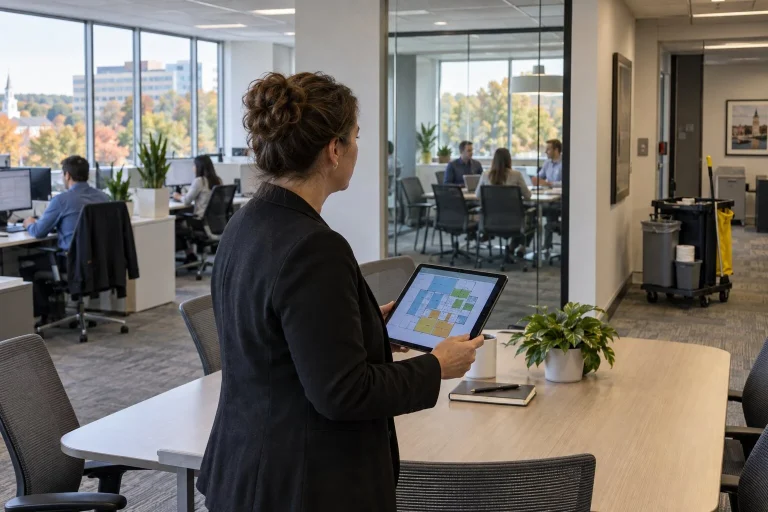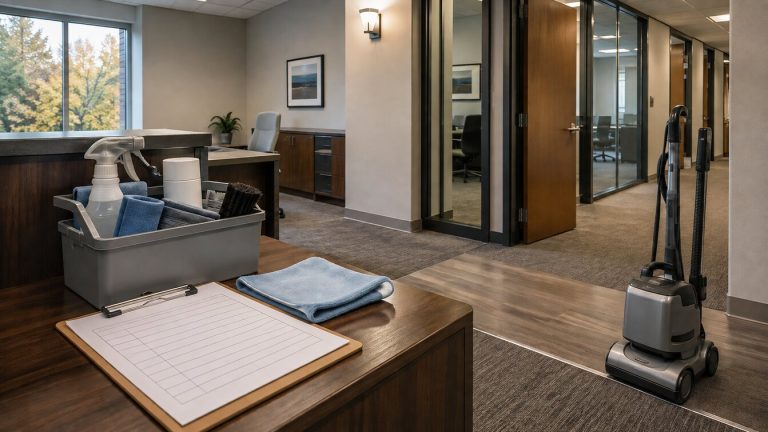
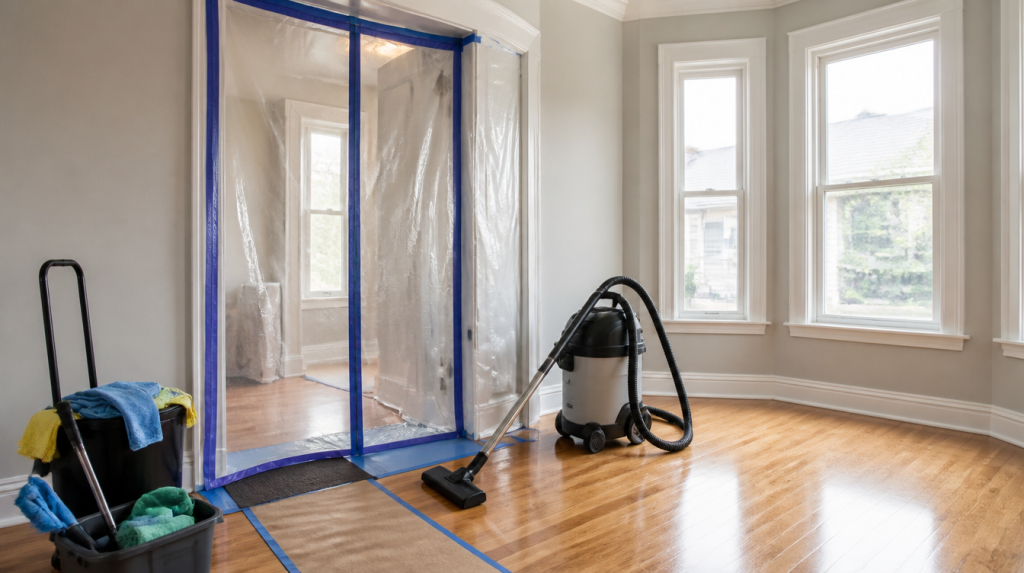
Post-construction cleaning for occupied spaces needs a different plan from cleaning an empty building. The goal is not simply to remove visible dust. You need to keep renovation residue from moving into rooms that are still in use, define who controls each zone, and release cleaned rooms one at a time.
For a Greater Boston home, apartment building, or office, start with a clear handoff between the contractor, property contact, and cleaning team. If dust-producing work is still active, the space is not ready for a final clean.
First decide whether the area is cleaning-ready
A cleaning crew should not be asked to work around active cutting, sanding, drilling, or demolition. Those tasks can create new dust after surfaces have already been cleaned. Before the cleaning visit, confirm that:
- Dust-producing construction work is complete in the rooms being released.
- Contractors have removed large debris, scrap material, fasteners, and their tools.
- Paint, adhesive, grout, sealant, and floor finishes have reached the manufacturer’s stated cleaning or foot-traffic condition.
- Temporary barriers still separate the work zone from occupied rooms.
- The property contact has identified surfaces that need special handling.
- No trade is scheduled to return and reopen walls, ceilings, floors, or cabinets before handoff.
This gate prevents an expensive loop in which a room is detailed, construction resumes, and dust settles again.
Map three zones before cleaning starts
A simple zone map gives everyone the same definition of “clean.” It also keeps tools and foot traffic moving in one direction.
| Zone | What belongs there | Access rule | Release condition |
|---|---|---|---|
| Work zone | Rooms where renovation occurred, plus the contractor’s material and debris path | Restricted to the assigned trade and cleanup team until work stops | Construction is complete and bulk debris is removed |
| Transition zone | Doorway, short corridor, elevator landing, or protected floor path between work and occupied areas | No unprotected tools, carts, or shoes cross into the clean side | Barriers, mats, and the route itself are clean |
| Occupied zone | Rooms that remain open to residents, staff, customers, or tenants | Keep renovation equipment and cleanup waste out | Remains outside the construction traffic pattern |
The U.S. Environmental Protection Agency’s remodeling and indoor-air guidance explains that containment and ventilation help keep dust and pollutants out of the general living area. Those controls belong in the renovation plan before final cleaning begins.
Assign responsibilities before the crew arrives
Post-construction cleanup becomes confusing when every party assumes someone else owns the same task. Put the handoff in writing, even if it is a short email.
| Responsibility | Contractor or trade | Property contact | Cleaning team |
|---|---|---|---|
| Containment | Build and maintain it while dust-producing work is active | Approve occupied routes and restricted areas | Protect the barrier during cleaning and report damage |
| Debris | Remove construction waste, offcuts, hardware, and trade materials | Confirm disposal and loading access | Remove ordinary cleaning waste created by the agreed scope |
| Surface detail | Identify uncured or specialty materials | Confirm priorities and exclusions | Capture fine dust and clean approved surfaces from high to low |
| Hazard clearance | Provide required trade or environmental documentation | Engage the qualified specialist | Do not represent visual cleaning as regulated clearance |
If you are still defining the broad service, review what post-construction apartment cleaning covers. The occupied-space plan here starts after the renovation scope and contractor handoff are clear.
Use a five-stage cleaning and handoff sequence
- Confirm the boundary. Walk the work zone, transition route, and occupied zone with the property contact. Photograph existing damage and note surfaces that are excluded from the cleaning scope.
- Capture loose dust from high to low. Begin above eye level, then move to walls, trim, fixtures, cabinets, and floors. Use equipment and attachments appropriate for fine dust rather than pushing residue from one surface to another.
- Detail horizontal and hidden surfaces. Check ledges, cabinet interiors, window tracks, door tops, baseboards, and the edges of protected flooring. These are common places for settled dust to remain after an otherwise polished room looks finished.
- Wet-clean compatible surfaces. Match the product and moisture level to the material. Fresh paint, natural stone, unfinished wood, specialty coatings, and new floor finishes may each require different handling.
- Inspect before reopening. Review the room in normal light, check the transition route, and record anything that needs a contractor callback rather than a cleaning correction.
Do not remove containment simply because the visible surfaces look clean. The contractor or responsible project lead should confirm that the work area can be released and that no dust-producing task will restart.
Release one room at a time
A whole-property “done” declaration is too vague for an occupied project. Use a room-release checklist instead:
- No loose construction debris remains.
- No visible dust remains on horizontal surfaces, trim, fixtures, or floor edges.
- Cleaned surfaces are dry and ready for normal use.
- Air returns, supply vents, and temporary coverings have been handled according to the project lead’s plan.
- Furniture or stored belongings have not been moved back into a room that still needs trade work.
- The access route is clean, and waste can leave without crossing reopened rooms.
- Any required hazard-specific inspection or clearance is documented separately.
This checklist verifies the cleaning handoff. It is not a laboratory test, air-quality certification, or lead-dust clearance.
Know when ordinary cleaning is not the next step
Pause routine cleaning when the project may involve lead-based paint, asbestos-containing material, mold remediation, sewage, chemical residue, or another regulated hazard. The responsible property contact should identify the correct qualified contractor or environmental professional before a general cleaning crew enters.
For pre-1978 homes, EPA’s lead-safe renovation guidance describes containment, HEPA vacuuming, wet cleaning, and the need to keep non-workers out of the work area. A standard cleaning visit should never be presented as a substitute for those requirements.
Give the cleaning team a useful project brief
Before the walkthrough, send a one-page brief with the property address, occupied rooms, work-zone boundaries, approved access route, parking or loading instructions, alarm and key contact, floor and countertop materials, areas that remain under contractor control, and the deadline for each room release.
So Clean’s Greater Boston office and commercial cleaning team can build a post-construction scope around the rooms that are actually ready, the materials on site, and the way the property must stay in use. A clear handoff protects the clean result and keeps the next trade from undoing it.