
An office cleaning quality control checklist should answer three questions: Was the contracted work completed, does the result meet the agreed standard, and was any missed item corrected? A useful checklist scores outcomes by zone, applies the same inspection route each time, and links every deduction to a specific part of the cleaning scope.
That makes the review fair to both the facility manager and the cleaning team. It also replaces vague feedback such as “the office did not look right” with a location, an observable condition, and a due date.
Score the result against the contracted scope
Begin with the signed scope, not a generic internet checklist. A lobby scheduled for nightly attention should not be judged the same way as a storage room scheduled monthly. Separate routine tasks from periodic work before assigning points. So Clean’s guide to daily and periodic office-cleaning tasks provides a practical way to make that distinction.
The scorecard below is a starting framework for a typical office. Reweight or remove rows to match the actual building and contract; the total should remain 100 points so results are easy to compare over time.
| Inspection zone | Weight | Observable pass standard | Typical evidence |
|---|---|---|---|
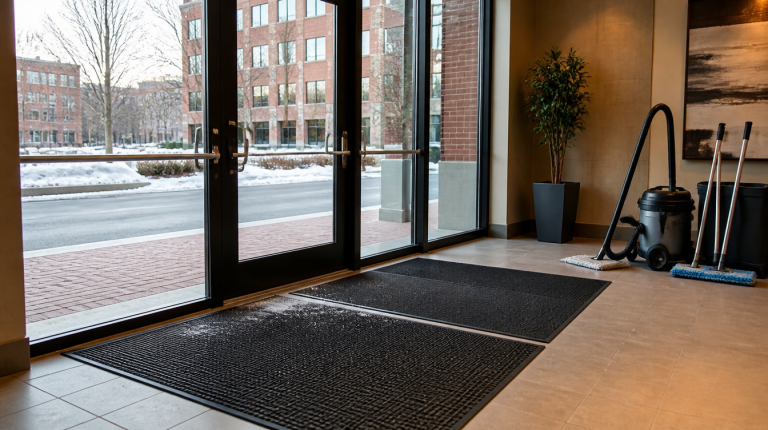
| Entrances and reception | 10 points | Scheduled floors, glass, mats, and reception surfaces show no missed debris, streaks, or obvious residue | One wide photo plus a close view of any defect |
| Floors and circulation paths | 20 points | Contracted vacuuming or hard-floor work is complete, including specified edges and routes | Route inspection under normal lighting |
| Restrooms | 20 points | Fixtures and scheduled touchpoints are visibly clean, dispensers are handled as assigned, and waste is removed | Room-level inspection without photographing occupants or personal items |
| Breakrooms and shared spaces | 15 points | Contracted counters, sinks, tables, floors, and waste tasks are complete | Wide view and exact missed location |
| Work areas and touchpoints | 10 points | Only the approved surfaces and touchpoints are serviced, with personal work materials left as agreed | Spot checks in preselected representative areas |
| Waste and recycling | 10 points | Assigned containers are emptied, relined when included, and returned to position without cross-stream mixing | Container spot check and collection-point review |
| Edges and periodic details | 10 points | Baseboards, corners, vents, or other details due in the current cycle are completed | Compare the inspection date with the periodic-task calendar |
| Communication and closeout | 5 points | Access issues, damaged items, low supplies, and incomplete work are reported through the agreed channel | Service log or ticket with timestamp and owner |
Use a consistent inspection route
Quality scores become more useful when the inspector follows the same path, at a similar point in the service cycle, under normal building conditions. A practical route starts at the main entrance, follows the highest-traffic corridor, checks one representative work area, then covers restrooms, shared spaces, waste points, and one rotating detail zone.
Record four facts for every deduction:
- Location: building, floor, room, and the exact surface or fixture.
- Condition: what is observable, such as debris along the east baseboard or an assigned bin not emptied.
- Scope reference: the task and frequency that make the item due.
- Evidence time: when the condition was observed relative to the cleaning visit and normal office use.
This evidence rule prevents an old photo, an out-of-scope request, or a condition created hours after service from being treated as an automatic cleaning failure.
Do not let a total score hide an urgent condition
A 92 can still require immediate attention. Use a severity override beside the numeric score:
- Routine defect: a localized missed item that can be corrected during the next agreed service window.
- Service-impacting defect: repeated or broad incomplete work that affects a room, zone, or business operation and needs a prompt response.
- Escalation item: a condition involving access, suspected damage, an unknown spill, an exposed sharp, or another issue that should be isolated and routed through the facility’s own safety or incident process.
OSHA’s walking-working surfaces standard addresses clean, orderly, sanitary, and, to the extent feasible, dry workplace surfaces. The facility’s safety program should determine who guards, investigates, or corrects a potentially hazardous condition; a quality score does not replace that process.
Set scoring rules before the first inspection
Choose one deduction rule and use it consistently. For example, award full points when the zone meets the defined standard, deduct 25% of that row for one localized miss, deduct 50% for several misses, and deduct all row points when most contracted work in the zone is incomplete. Document the rule in the service file so a new manager or supervisor can reproduce it.
A simple interpretation band can help:
| Score | Interpretation | Next action |
|---|---|---|
| 95–100 | Standard met with, at most, isolated minor misses | Log the result and watch for patterns |
| 85–94 | Correction is needed in one or more zones | Assign owners and verify the correction |
| Below 85 | The delivered result does not consistently meet the agreed standard | Review supervision, timing, access, and scope before the next cycle |
These bands are management tools, not universal industry grades. Your contract may use different thresholds, and any escalation item should be handled separately regardless of the total.
Close every defect through the same five-step loop
- Log it. Create one record with the location, condition, scope reference, evidence, severity, and reporter.
- Assign it. Name the cleaning supervisor, facility contact, building manager, or other responsible party instead of sending a group message with no owner.
- Set a response time. Use the contract’s service level or an agreed time based on severity.
- Verify it. Reinspect the exact location after the reported correction; a message saying “done” is not the final check.
- Look for recurrence. Tag repeated defects by zone and task so the team can distinguish one miss from a scope, training, access, equipment, or scheduling problem.
If the same restroom item fails three inspections, simply repeating the task may not solve the cause. The issue could be an unrealistic service window, a locked supply area, occupancy that exceeds the original assumption, or a task that was never included. That is when the manager should review the office-cleaning frequency and the written scope together.
Choose an inspection rhythm that matches the building
Inspect more frequently when a service begins, a building reopens, occupancy changes, construction ends, or Greater Boston winter weather increases entrance and floor demand. Once results stabilize, rotate deeper inspections while retaining a short routine check. Avoid inspecting only after complaints; that produces inconsistent evidence and makes trends harder to see.
For multi-tenant or multi-floor offices, keep the core scorecard consistent and rotate a subset of low-traffic areas. The main lobby and primary restrooms might be checked every time, while storage areas or secondary conference rooms rotate by week.
A one-page checklist is enough when the definitions are clear
The finished form needs only the inspection date, service date, route, weighted zone scores, defect records, severity overrides, total, corrective owners, and verification status. Attach photos only when they clarify the condition, and follow the organization’s privacy and security rules.
So Clean of Woburn provides office and commercial cleaning across Greater Boston and the North Shore. During a walkthrough, the service scope and quality-control scorecard can be built around the facility’s real rooms, traffic, access limits, and cleaning frequencies—so both teams know what a passing result looks like before service begins.