
Why an Office Cleaning Contract Is the Foundation of Every Successful Cleaning Business
An office cleaning contract is a written agreement between a cleaning service provider and a client that defines exactly what services will be delivered, when, and at what cost. If you’re looking to land commercial cleaning work, here’s what you need to know at a glance:
What an office cleaning contract typically covers:
- Parties involved — the cleaning company and the client
- Scope of work — which areas are cleaned and how often
- Payment terms — rate, schedule, and late fee policies
- Legal protections — liability, insurance, confidentiality, and termination clauses
- Performance standards — inspection protocols and quality benchmarks
Getting commercial cleaning work is competitive. Clients want to know they can trust you before you ever set foot in their building. A clear, professional contract signals that you run a serious operation — and it protects both sides if something goes wrong.
Without one, even a small misunderstanding — like a missed service or a disputed charge — can end a client relationship fast. A handshake deal might feel friendly, but it leaves you with no recourse when things go sideways.
The good news? You don’t need a law degree to put together a solid contract. You just need to know what belongs in it.
I’m Bill McGrath, owner of So Clean of Woburn, and through years of providing commercial janitorial services across Greater Boston, I’ve seen how a well-structured office cleaning contract can make or break a client relationship — and I’m here to walk you through exactly how to get it right.
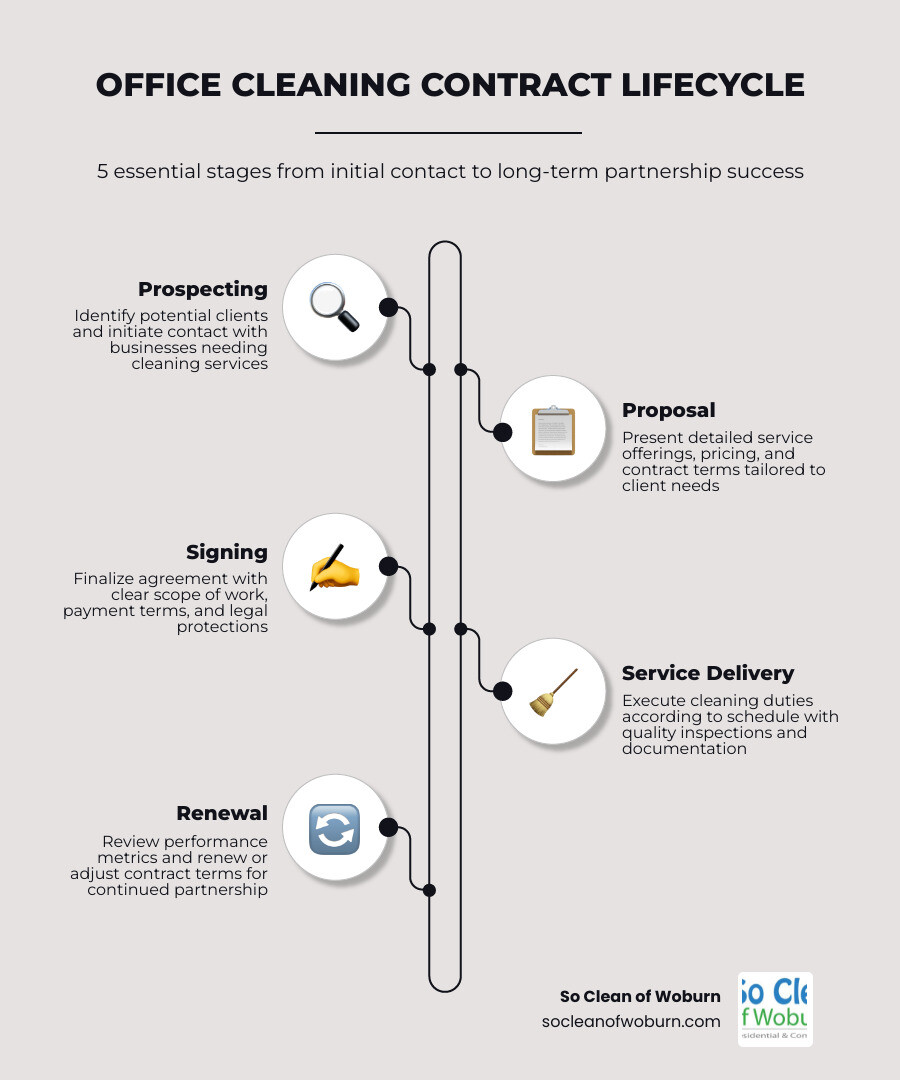
Office cleaning contract definitions:
- how to price office cleaning services
- how hiring a professional cleaning service benefits your office
- janitorial commercial services
Understanding the Essentials of an office cleaning contract
An office cleaning contract is not just paperwork. It is the operating manual for the relationship between a business and its cleaning provider.
At minimum, the contract should identify:
- The legal names of both parties
- The service address or addresses
- The contract start date
- The term length
- The exact services included
- The price and payment schedule
- Who provides supplies and equipment
- Insurance and liability requirements
- How service quality will be reviewed
- How either side can end or renew the agreement
For Massachusetts offices, clear language matters even more when multiple stakeholders are involved. A property manager may sign the agreement, an office administrator may report issues, and building management may control access. If those roles are not spelled out, confusion shows up fast.
We also recommend matching your office agreement to the structure used in other service contracts so expectations stay consistent. If you want to compare how service agreements are organized, our guides on Residential Cleaning Contract and Office Cleaning Service Near Me are helpful starting points.

Defining the Scope of Work in Your office cleaning contract
This is the heart of the contract. If the scope of work is vague, everything else gets messy.
A strong scope of work should answer:
- What gets cleaned?
- How often?
- At what standard?
- During what hours?
- With whose supplies?
Typical office cleaning duties may include:
- Vacuuming carpets
- Dusting desks, ledges, and reachable surfaces
- Emptying trash and replacing liners
- Cleaning and sanitizing restrooms
- Restocking soap, paper towels, and toilet paper
- Cleaning breakrooms and kitchenettes
- Mopping hard floors
- Spot-cleaning glass and entry doors
- Disinfecting high-touch points like switches, handles, and shared surfaces
It should also list what is not included, such as:
- Biohazard cleanup
- Exterior window washing
- Post-construction cleanup
- Data center or restricted IT room cleaning
- Deep carpet extraction unless separately scheduled
Frequency should be specific, not casual. Instead of “regular restroom cleaning,” write:
- Restrooms cleaned and sanitized 5 evenings per week
- Trash removed nightly
- Breakroom floors mopped 3 times per week
- Interior glass spot-cleaned weekly
If supply replenishment is included, say so directly. Some public and private contracts require the cleaning provider to restock consumables and invoice separately or include them in the monthly fee. That one line can save a lot of email chains later.
For comparison, the way duties are broken out in an Apartment Cleaning Contract can also help you think through room-by-room expectations.
Independent Contractor Status and Legal Protections
Most commercial cleaning agreements treat the cleaning company as an independent contractor, not an employee of the client. That matters for taxes, supervision, and liability.
A contract should clarify that:
- We control our own methods and staffing
- The client is not responsible for payroll taxes for our workers
- We remain responsible for compliance with employment laws
- The agreement does not create a partnership or joint venture
It should also identify the governing law, which for local work should generally be Massachusetts law. This becomes important if there is a payment dispute, property damage claim, or disagreement over service failure.
If you are trying to land larger opportunities, especially through bid platforms, review how public listings frame legal requirements. Sample Contracts to Bid for MASSACHUSETTS – GovWin IQ is useful for seeing how formal buyers organize janitorial solicitations in Massachusetts.
Key Clauses and Performance Metrics for Success
A good cleaning contract protects revenue. A great one also protects reputation.
Beyond scope and price, these clauses should usually appear in an office agreement:
- Confidentiality
- Indemnification
- Damage reporting
- Key and access control
- Non-solicitation of staff if relevant
- Service change requests
- Cancellation policy
- Termination rights
- Force majeure
- Entire agreement
- Modification in writing
- Governing law
Termination language is especially important. Many disputes come down to one simple question: can the client cancel immediately, or is notice required? Most balanced contracts use a cure period. For example:
- Either party may provide written notice of a material breach
- The other party has a set number of days to fix the issue
- If the issue is not corrected, the agreement can be terminated
That gives everyone a fair path before the relationship blows up over one rough week.
You can also see how service expectations fit into a broader commercial context in our Commercial Janitorial Services MA Complete Guide.

Quality Assurance and Inspection Protocols
If it is not measurable, it is arguable.
Cleaning contracts work best when they include simple performance metrics such as:
- Completion rate of scheduled tasks
- Inspection scores
- Response time for service issues
- Restroom stocking compliance
- Complaint resolution window
Some large janitorial agreements require nightly quality checks by a supervisor and retention of inspection records. That is smart even for smaller offices. A basic inspection protocol might include:
- Site supervisor review once or twice per week
- Monthly walk-through with the client
- Digital checklist verification
- Photo documentation for issue resolution
- Written follow-up on corrective actions
This protects both sides. The client gets accountability, and we get a documented record that services were completed.
For recurring commercial accounts, we like using checklists tied to zones of the building:
- Reception and lobby
- Workstations and offices
- Conference rooms
- Restrooms
- Kitchen and break areas
- Hallways and common areas
That structure keeps performance conversations factual instead of emotional. Nobody wants a 7:15 a.m. mystery email that says, “The office looked off.” A checklist narrows down what “off” actually means.
For more on service standards, visit our Commercial Cleaning Services page.
Safety Standards and OSHA Compliance
Cleaning contracts should never treat safety like an afterthought.
At a minimum, the agreement should address:
- OSHA compliance
- Proper labeling and handling of chemicals
- PPE requirements
- Slip-and-fall prevention procedures
- Hazard communication
- Storage of supplies and equipment
- Waste disposal rules
Larger contracts often require Safety Data Sheets, still commonly called MSDS, to be maintained for products used on site. That is a best practice even for smaller offices in Boston, Cambridge, Woburn, Arlington, or surrounding communities.
Your contract should also spell out whether staff may handle:
- Sharps
- Bodily fluids
- Unknown chemicals
- Hazardous waste
If not, exclude them clearly.
Public-sector and large institutional contracts may require broader compliance and site-specific procedures. A large UK public tender such as 1FM – Cleaning and Associated Services – Find a Tender shows how formal buyers often evaluate operational readiness, not just price.
How to Price and Structure Your office cleaning contract
Pricing is where many cleaning companies either win smart or win broke.
An office contract can be priced in several ways:
- Hourly
- Per square foot
- Per visit
- Monthly fixed fee
- Hybrid pricing for routine plus extra work
Here is a simple comparison:
| Pricing model | Best for | Pros | Watch-outs |
|---|---|---|---|
| Hourly | Small or variable-scope offices | Flexible, easy to explain | Can reward slow work |
| Per square foot | Stable recurring spaces | Predictable budgeting | Needs accurate scope |
| Per visit | Small scheduled cleans | Simple invoices | Easy to underprice |
| Monthly fixed fee | Ongoing janitorial contracts | Smooth cash flow | Scope creep risk |
| Hybrid | Complex buildings | Custom fit | More contract detail needed |
Payment terms should state:
- Invoice date
- Due date
- Accepted payment methods
- Late fee policy
- Deposits if applicable
- Extra work approval process
If the office has unused areas or partially vacant suites, some contracts use vacancy credits or reduced pricing for closed-off space. That only works if access conditions and cleaning frequency are documented clearly.
For deeper pricing help, see How to Price Office Cleaning Services and our Office Cleaning Prices Complete Guide.

Understanding Market Rates in 2026
In 2026, office cleaning pricing is still shaped by a few big factors:
- Labor costs
- Payroll taxes and insurance
- Frequency of cleaning
- Building layout
- Daytime vs. after-hours access
- Supply responsibilities
- Specialty disinfection or floor care
- Security and background check requirements
- Travel time across service areas
One useful labor benchmark from the research: janitors and custodians average about $29,760 per year, or $14.31 per hour, while residential maids and housekeepers average about $31,920 per year, or $15.35 per hour. Those are wage indicators, not bill rates. A contract rate must also cover supervision, overhead, insurance, equipment, admin time, and profit.
For local estimating, a practical broad range for commercial office cleaning is often around $30 to $85 per labor hour depending on complexity, timing, frequency, and scope. Per-square-foot pricing varies too much by building type to use responsibly without a walkthrough.
If you want a broader commercial pricing framework, our Commercial Cleaning Prices Complete Guide breaks it down further.
Estimating Contract Value for Massachusetts Businesses
When estimating value, start with square footage, frequency, and labor intensity.
A real-world contract example in the research covered approximately 277,163 square feet of office space across two locations. That tells us how large commercial janitorial agreements can get once multiple buildings, porter coverage, and evening service are added.
Another benchmark from the research: a public office cleaning contract in Stirling was estimated at £230,000. While that is not a Massachusetts job and should not be used as a local quote standard, it does show that office cleaning contracts can be substantial when they involve routine, planned, and ad hoc services under formal procurement rules.
For Massachusetts businesses, estimate in layers:
- Base recurring cleaning
- Consumables and restocking
- Periodic floor or glass work
- Day porter or daytime touch-up service
- Emergency or after-event work
For example, a small office may need a modest monthly contract, while a multi-tenant office in Greater Boston with restrooms, kitchen areas, conference rooms, and high traffic can justify a much higher recurring fee. The mistake is pricing only the mopping and vacuuming while forgetting supervision, supplies, communication time, and issue resolution.
Licensing, Insurance, and Bonding Requirements
To land serious office contracts, you need more than a mop and confidence.
A professional cleaning provider should typically have:
- A valid business registration
- Any required local or state business licenses
- Workers’ compensation if the business has employees
- General liability insurance
- Commercial auto if business vehicles are used
- Bonding when required by the client
- Potential umbrella coverage for larger accounts
Research on cleaning business requirements also points to common insurance types such as:
- General liability
- Commercial property
- Business owner’s policy
- Workers’ compensation
- Commercial auto
- Hired and non-owned auto
- Umbrella coverage
- Janitorial or surety bond
Bonding is especially common when a client wants added protection against theft or dishonest acts by workers who have building access.
Our guide on How to Start an Office Cleaning Service explains the business setup side in more detail.
Minimum Coverage Limits for Commercial Tenders
Private clients may ask for basic proof of insurance. Public and institutional buyers usually want much more.
One public office-cleaning tender in the research required:
- Employer’s Liability: £5,000,000
- Public Indemnity: £5,000,000
- Professional Indemnity: £100,000
Those exact limits are from a UK public tender and are not a Massachusetts legal standard, but they illustrate how formal solicitations often set high minimums and require proof before award.
For local commercial bids, clients may also ask for:
- Additional insured status
- Certificate holder language
- Waiver of subrogation
- Proof of workers’ compensation
- Bond certificates
- Claims history
If your target client includes municipalities, schools, transit authorities, or large management companies, be ready for more documentation than a typical private office would request.
Strategies for Securing High-Value Contracts
Landing better contracts is rarely about luck. It is about being visible, credible, and easy to evaluate.
Businesses typically secure office cleaning contracts through:
- Referrals
- Property manager relationships
- Local networking
- Direct outreach
- Website and local SEO
- Bid platforms and procurement portals
- Chamber of commerce connections
- Facility management partnerships
- Requests for proposals
For local service companies in Greater Boston, referrals still matter a lot. Office managers trust other office managers. Property managers trust vendors who communicate well and show up when promised. Revolutionary stuff, we know.
To improve your odds:
- Build a clean, professional proposal template
- Define your service area clearly
- Offer site walkthroughs
- Respond quickly to bid requests
- Provide insurance certificates promptly
- Include a detailed scope matrix
- Share quality control procedures
- Be realistic on price
If you want to strengthen the service side that supports your sales process, our Office Cleaning page is a good next step.
Navigating the Public Sector Procurement Process
Government and public-sector contracts differ from private ones in a few major ways.
They often require:
- Formal registration on procurement portals
- Strict deadlines
- Standardized bid forms
- Technical and pricing responses
- References for similar work
- Insurance certificates
- Sometimes certifications such as ISO quality or environmental standards
Public buyers also tend to score proposals with weighted criteria. One office-cleaning tender in the research used 80% quality and 20% price. That is a useful reminder: low price alone does not always win, especially when a public client cares about staffing, methods, supervision, and service continuity.
In some public systems, vendors may need to wait for agency outreach or join pre-qualified contractor lists rather than directly pitch departments. That is very different from private-sector selling, where direct networking and relationship building are common.
Public-sector contracts may also include:
- Longer terms with renewal options
- Detailed compliance language
- Security screening requirements
- Sustainability expectations
- Multi-site service schedules
- Event or emergency response clauses
If you pursue this type of work, read every instruction twice. Then once more with coffee.
Frequently Asked Questions about Office Cleaning Contracts
What is the typical duration of a commercial cleaning contract?
Many office cleaning contracts run for 12 months with renewal options. Larger agreements may run 2 to 3 years, sometimes with one-year extensions. Public contracts often specify the initial term and all possible renewals in advance. The right length depends on the building, onboarding costs, and how much flexibility both parties want.
Can I terminate a cleaning contract early if the service is poor?
Usually yes, but the answer depends on the termination clause. Many contracts allow early termination for cause if service failures continue after written notice and a chance to fix the issue. Others allow termination for convenience with 30 to 60 days’ notice. Never assume. Put the process in writing before the work starts.
Do cleaning contracts usually include the cost of supplies?
Sometimes. Some contracts bundle consumables into the monthly fee. Others separate labor from products like toilet paper, hand soap, liners, and paper towels. The contract should clearly state who purchases, stores, and restocks supplies. If that section is fuzzy, billing disputes are almost guaranteed.
Conclusion
A strong office cleaning contract does more than secure a signature. It defines the work, sets the standard, protects both sides, and creates the structure needed for a long-term client relationship.
At So Clean of Woburn, we believe the best office agreements are clear, practical, and customized to the building they serve. That is how we help businesses across the Greater Boston area maintain a healthier environment without overcomplicating the process or overpricing the service.
If you are ready to move from vague expectations to a cleaning plan that actually works, seal your next deal with professional office cleaning services.