
Why Industrial Janitorial Services in MA Are Critical for Your Factory
If your factory needs industrial janitorial services in MA, here are the most important things to know:
- What they are: Specialized cleaning for manufacturing plants, warehouses, food processing facilities, biotech labs, and other industrial spaces
- Key services: Machine-side floor cleaning, degreasing, high-dust removal, hazardous waste disposal, GMP-compliant cleaning, and cleanroom sterilization
- Who needs them: Manufacturers, food processors, pharmaceutical companies, logistics hubs, and biotech firms across Massachusetts
- Why it matters: Dust, grease, and debris create safety hazards, trigger compliance failures, and can shut down production equipment
- Where to start: Request a free walkthrough from a licensed industrial cleaning company serving MA and NH
Factories are demanding environments. Grease builds up on floors. Metal shavings accumulate near equipment. Dust settles into machinery and vents. Left unchecked, these aren’t just eyesores — they’re safety hazards, compliance risks, and productivity killers.
The Northeastern U.S. market for professional cleaning services is projected to surpass $31 billion by 2026. That growth reflects a simple reality: facility managers across Massachusetts are recognizing that cleanliness isn’t a luxury — it’s a core part of safe, efficient operations.
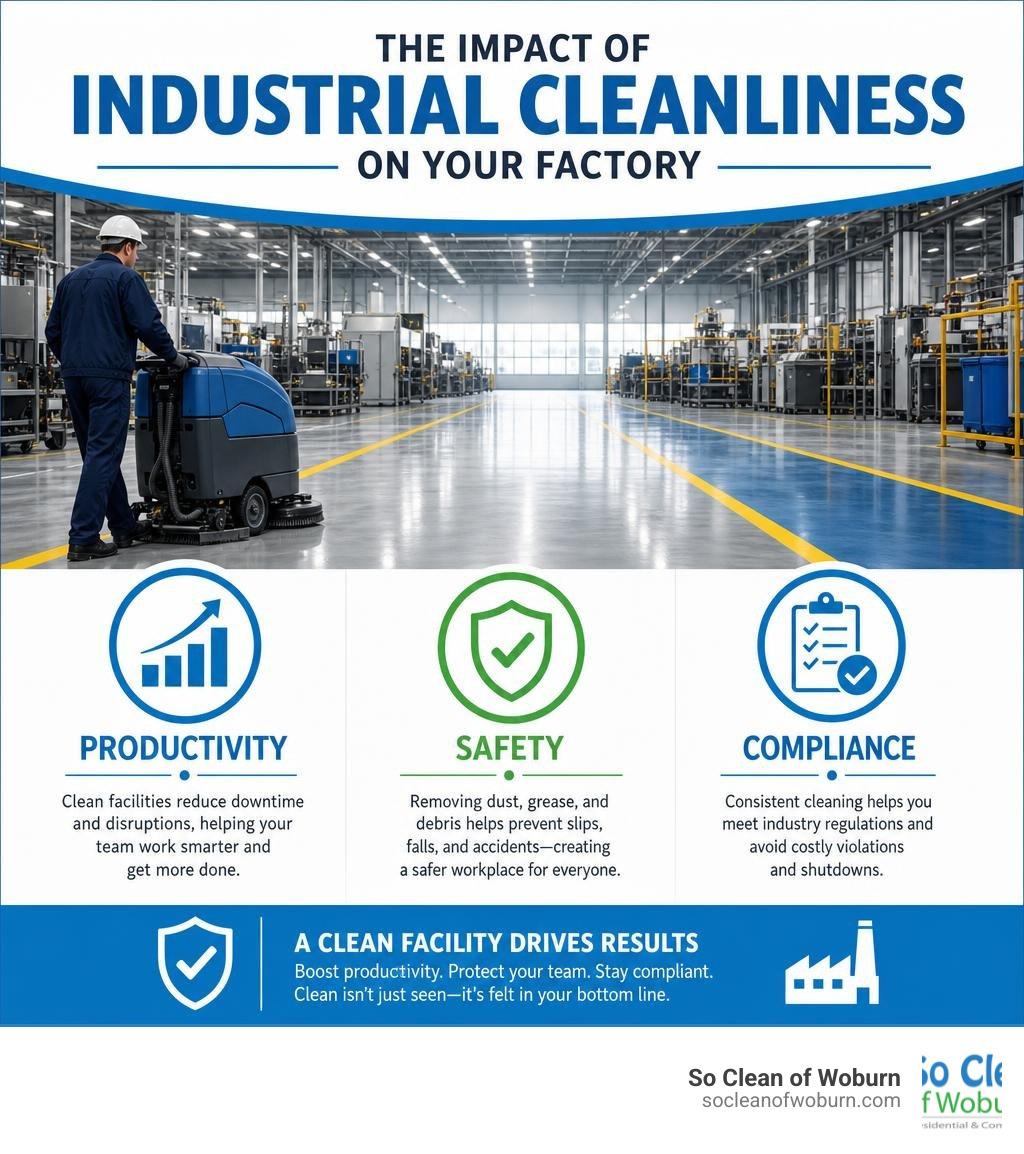
A clean factory floor can boost employee productivity by up to 20% and significantly reduce injury risks and sick days. For industrial facilities, where equipment downtime and compliance failures carry heavy financial consequences, that’s not a small thing.
I’m Bill McGrath, owner of So Clean of Woburn, and I’ve spent years helping Greater Boston businesses — including commercial and industrial facilities — maintain cleaner, safer, and more compliant spaces through professional industrial janitorial services in MA. In this guide, I’ll walk you through everything you need to know to make the right choice for your facility.
Must-know industrial janitorial services MA terms:
How Industrial Cleaning Differs from Standard Commercial Cleaning
When many people think of “cleaning services,” they picture someone emptying office trash cans, vacuuming carpets, and wiping down kitchen counters. While those tasks are essential for corporate offices, they barely scratch the surface of what is required in an industrial setting.
Industrial facilities operate on a completely different scale. They feature heavy machinery, high-clearance ceilings, intricate ventilation networks, and specialized production lines. Because of this, the cleaning techniques, safety protocols, and equipment used in industrial environments must be highly specialized.
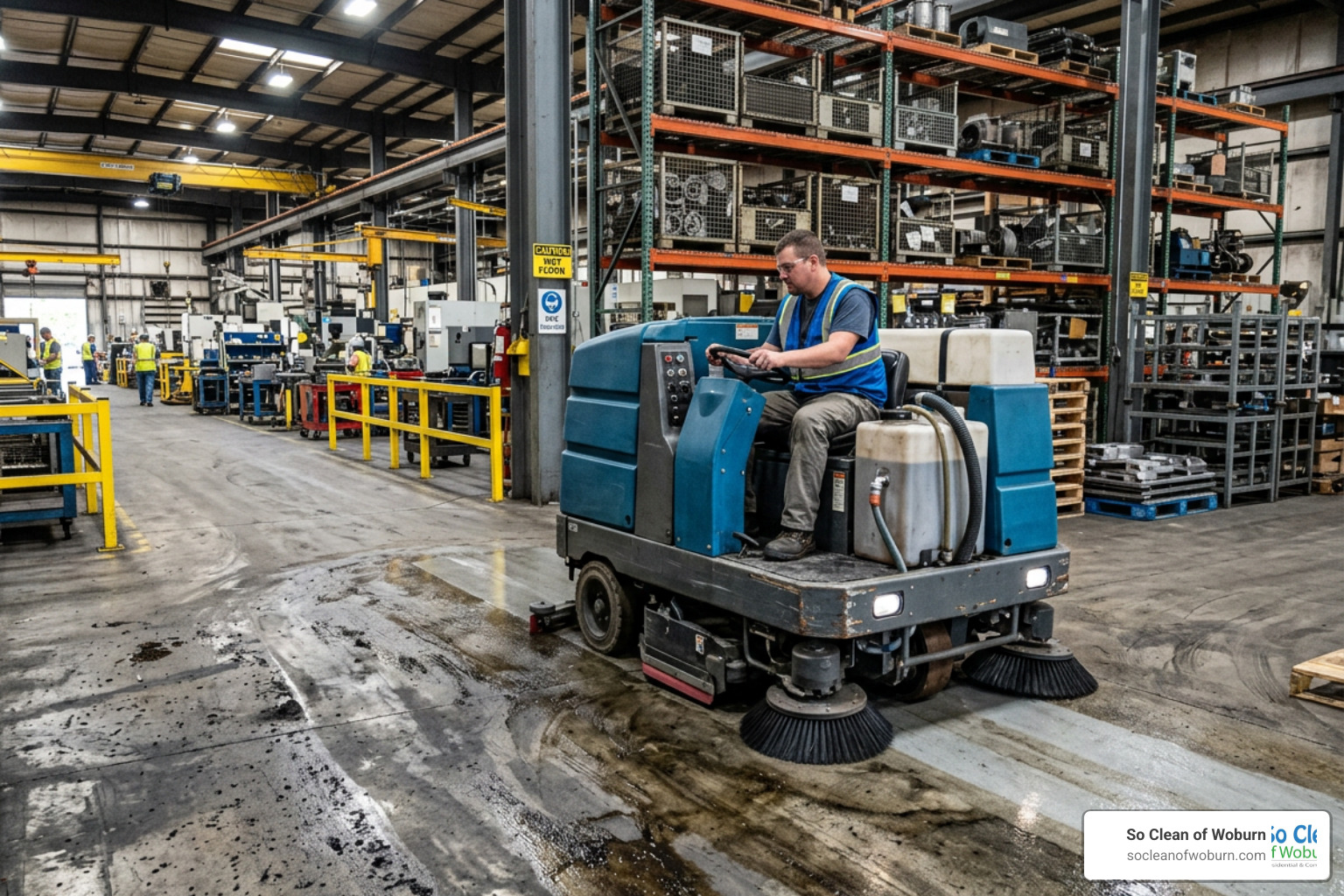
For instance, standard office cleaning rarely has to deal with heavy grease buildup, chemical residues, metal shavings, or combustible dust. In a manufacturing plant, however, these substances are daily byproducts of production. If you try to clean a greasy warehouse floor with standard commercial mops and mild detergents, you will only spread the grease around, creating an incredibly slick and dangerous slip-and-slide for your workers and forklifts.
Instead, industrial environments require heavy-duty degreasers, advanced ride-on auto-scrubbers, and specialized pressure washing systems. This level of care goes far beyond basic dust-busting; it is about maintaining structural integrity, protecting expensive machinery, and keeping your workforce safe.
If you are looking for a comprehensive overview of general office and commercial cleaning, you can read our commercial janitorial services MA guide. However, to understand just how different these two worlds are, let’s look at a direct comparison:
| Feature | Standard Commercial Cleaning | Industrial Janitorial Services |
|---|---|---|
| Primary Environment | Corporate offices, retail shops, banks, schools | Factories, warehouses, biotech labs, power plants |
| Key Challenges | Fingerprints, paper dust, standard trash, high-traffic carpets | Heavy grease, chemical residues, metal shavings, combustible dust |
| Equipment Used | Standard vacuums, microfiber mops, basic wiping cloths | Industrial auto-scrubbers, HEPA vacuums, pressure washers |
| Safety Regulations | Standard OSHA guidelines | Strict OSHA, GMP, Lockout/Tagout, HazCom standards |
| Downtime Impact | Minimal (usually cleaned during off-hours) | High (cleaning must be coordinated with production schedules) |
| Staff Training | Basic cleaning techniques and chemical safety | Advanced hazard communication, heavy machinery safety, PPE use |
Key Standards for Industrial Janitorial Services MA
Because industrial environments present unique physical and chemical hazards, industrial cleaning teams must operate under strict regulatory frameworks. In Massachusetts, safety and compliance are not optional. A failure to adhere to state and federal regulations can result in massive fines, operational shutdowns, and severe injuries.
When we perform industrial janitorial services in MA, our teams must be fully versed in several critical safety standards:
- OSHA Compliance: The Occupational Safety and Health Administration (OSHA) sets strict guidelines for workplace safety. For industrial cleaners, this includes everything from fall protection when cleaning high-clearance rafters to the proper use of Personal Protective Equipment (PPE) such as respirators, safety glasses, and steel-toed boots.
- GMP (Good Manufacturing Practices) Standards: For facilities involved in food processing, pharmaceuticals, or medical devices, GMP compliance is a must. GMP standards require meticulous, documented cleaning protocols to prevent cross-contamination and ensure that products are consistently produced to high-quality standards.
- Lockout/Tagout (LOTO) Procedures: Working around heavy machinery is inherently dangerous. Before any cleaning technician begins degreasing or wiping down a piece of industrial equipment, they must follow strict Lockout/Tagout protocols. This ensures the machine is completely de-energized and cannot be accidentally turned on while someone is cleaning it.
- Hazard Communication (HazCom): Industrial cleaners frequently handle heavy-duty chemical agents, such as industrial degreasers and specialized sanitizers. Under HazCom standards, every team member must be trained to read and understand Safety Data Sheets (SDS) and know exactly how to handle, dilute, and dispose of these chemicals safely.
To learn more about the regulatory landscape of commercial facility maintenance, check out our comprehensive commercial janitorial guide near me.
Specialized Equipment and Hazardous Waste Handling
You cannot clean an industrial plant with tools bought at a local hardware store. Industrial janitorial teams rely on commercial-grade, specialized equipment designed to handle massive spaces and stubborn contaminants.
For example, high-efficiency particulate air (HEPA) vacuums are essential in facilities that produce fine dust, metal shavings, or chemical powders. Standard vacuums often exhaust micro-particles back into the air, which can compromise air quality and create respiratory hazards for your staff. HEPA-filtered vacuums trap these microscopic particles, ensuring they are completely removed from the environment.
Similarly, massive warehouse concrete floors require specialized industrial ride-on scrubbers and sweepers. These machines apply the perfect balance of water, heavy-duty degreaser, and downward brush pressure to lift embedded grease and oil, leaving behind a clean, dry, and slip-resistant surface.
Furthermore, industrial cleaning often involves the handling and disposal of hazardous waste. Whether it is old lubricants, chemical solvents, or contaminated cleaning rags, these materials cannot simply be thrown into a standard dumpster. Industrial cleaning teams must follow strict EPA and Massachusetts state guidelines for the containment, labeling, transportation, and disposal of hazardous waste to avoid environmental contamination and costly regulatory penalties.
Choosing the Right Partner for Industrial Janitorial Services MA

Choosing an industrial cleaning partner is a major decision for any facility manager. Unlike selecting a residential maid service, choosing the wrong industrial cleaner can result in damaged machinery, safety violations, and costly production delays.
When searching for janitorial services near me, facility managers must look beyond the lowest price tag. They need to find a partner with the experience, equipment, and safety record required to operate in high-stakes industrial environments across Massachusetts and New Hampshire.
Customizing Industrial Janitorial Services MA for Your Facility
Every industrial facility is unique. A high-tech biopharmaceutical cleanroom in Cambridge requires a completely different approach than a heavy manufacturing plant in Woburn or a massive logistics warehouse in Wilmington. A one-size-fits-all cleaning plan simply will not work.
When evaluating potential partners, look for a company that takes the time to understand your specific operational needs and design a customized cleaning program. This plan should outline:
- What needs to be cleaned: Specific zones, machinery, floors, high-touch areas, and common spaces.
- How it will be cleaned: The exact chemicals, equipment, and protocols that will be used.
- When it will be cleaned: A detailed schedule (daily, weekly, monthly, or during planned shutdowns) that aligns with your production cycle.
- Who will clean it: A dedicated team trained specifically for your industry’s standards.
For a deeper dive into what to expect from a professional cleaning partnership, consult our janitorial services MA complete guide.
Evaluating Experience and Safety Records
Before signing any contract, it is vital to thoroughly vet your potential cleaning partner’s experience and safety history. Here are the key elements you should request and verify:
- Safety Logs and OSHA Recordables: Ask to see the company’s safety records. A reputable industrial cleaning provider will have a strong safety record and low injury rates.
- Comprehensive Liability Insurance: Industrial cleaning involves working around highly valuable equipment. Ensure the company carries robust liability insurance and workers’ compensation coverage to protect your facility from accidental damage or injury claims.
- Rigorous Employee Background Checks: Industrial facilities often house proprietary technology, expensive tools, and sensitive materials. You need to know that the cleaning technicians entering your facility are trustworthy, fully screened, and background-checked.
- Industry-Specific Certifications: If your facility is a biotech lab or food manufacturing plant, verify that the cleaning team has documented training in GMP, cleanroom protocols, or infection prevention.
To find more tips on vetting local cleaning vendors, check out our guide on janitorial companies near me.
Minimizing Downtime and Ensuring Safety Compliance
In the manufacturing world, downtime is the ultimate enemy. Every minute your production line is halted for cleaning is a minute of lost revenue. Professional industrial cleaning companies understand this reality and design their operations to minimize disruptions.
Through strategic scheduling, zone-by-zone cleaning plans, and off-hours operations, professional cleaners can ensure that your facility remains spotless and compliant without causing work stoppages. Whether it is scheduling floor degreasing during weekend shifts or cleaning machinery during planned maintenance windows, a true industrial cleaning partner works around your schedule.
To learn more about how professional janitorial services can optimize your facility’s daily workflow, read about our janitorial commercial services.
Eco-Friendly Practices and Green Cleaning
Modern industrial facilities are increasingly focusing on environmental stewardship and sustainability. Fortunately, hiring professional industrial janitorial services in MA does not mean you have to compromise on your green initiatives.
In Massachusetts, green cleaning practices are governed by standards like FAC-114, which certifies environmentally responsible cleaning products and methods. Green cleaning in an industrial setting involves:
- Using Eco-Conscious Supplies: Utilizing biodegradable, non-toxic, and low-VOC (volatile organic compound) cleaning agents that are safe for both the environment and your employees.
- Energy-Efficient Equipment: Operating modern, energy-efficient floor scrubbers and vacuums that reduce water and electricity consumption.
- Waste Reduction: Implementing advanced recycling programs and minimizing chemical waste through precise dilution systems.
By incorporating these practices, your facility can maintain a high level of cleanliness while supporting your corporate environmental goals. Explore our full range of eco-friendly cleaning options in our janitorial services overview.
Pricing Models and Contract Structures in Massachusetts
Understanding how industrial cleaning is priced can help you budget effectively and choose the right contract structure for your business. Most industrial cleaning services in Massachusetts use one of three primary pricing models:
- Per Square Foot: This is the most common model for large-scale warehouses and manufacturing plants.
- Hourly Rates: Often used for specialized, one-time tasks such as post-construction cleanup or deep machinery degreasing.
- Flat Monthly Fee: Best for ongoing, daily or weekly maintenance contracts where the scope of work remains consistent.
In the Greater Boston area, the average cost for basic industrial floor care and routine maintenance is approximately $0.15 per square foot. However, because industrial facilities vary wildly in complexity and soil levels, prices can range from a low of $0.05 per square foot for simple warehouse sweeping to a high of $0.30 per square foot for high-complexity, GMP-compliant cleanrooms or heavy degreasing projects.
For a complete breakdown of commercial cleaning costs and contract options, refer to our janitor services complete guide.
Frequently Asked Questions About Industrial Cleaning in Massachusetts
Industrial facility maintenance can raise a lot of questions. Here are some of the most common questions facility managers ask when looking for industrial cleaning solutions in Massachusetts:
What is the difference between in-house cleaning and professional industrial janitorial services MA?
While maintaining an in-house cleaning crew might seem like a cost-effective option, it often comes with hidden expenses and operational challenges.
When you hire an in-house team, you are responsible for payroll taxes, benefits, workers’ compensation, and ongoing safety training. Additionally, you must purchase and maintain expensive industrial-grade equipment, such as ride-on scrubbers and HEPA vacuums. If an in-house cleaner calls in sick, your facility’s cleanliness suffers, creating safety hazards.
By outsourcing to a professional industrial janitorial service, you shift the burden of hiring, training, equipment maintenance, and liability to the vendor. You get access to highly trained specialists who utilize state-of-the-art equipment, ensuring consistent, high-quality results.
If you are weighing your options, you can find more information on local commercial cleaning providers by visiting our page on commercial janitorial companies near me.
How do industrial cleaning companies in MA handle active production lines?
Professional industrial cleaners are trained to work safely around active production lines. This is achieved through close coordination with your facility’s management team.
Before any work begins, we establish clear safety zones and utilize color-coded tools to prevent cross-contamination. Cleaning schedules are carefully timed to coincide with natural lulls in production, shift changes, or scheduled maintenance windows. Cleaners also strictly adhere to Lockout/Tagout procedures when working near active machinery to ensure absolute safety.
What industries in Massachusetts require GMP-compliant cleaning?
GMP-compliant cleaning is critical for highly regulated industries where contamination can ruin products and endanger public health. In Massachusetts, these industries primarily include:
- Biopharmaceutical and Biotech: Research labs and manufacturing plants producing medications, vaccines, and gene therapies.
- Medical Device Manufacturing: Facilities producing sterile surgical tools, implants, and diagnostic equipment.
- Food and Beverage Processing: Plants that package, process, or prepare food products for public consumption.
Conclusion
Maintaining a clean, safe, and compliant factory is a massive undertaking, but you do not have to do it alone. Partnering with a professional industrial cleaning company ensures your facility meets all safety standards, operates at peak efficiency, and provides a healthy environment for your hardworking team.
At So Clean of Woburn, we specialize in providing top-notch, customized commercial and industrial cleaning solutions at affordable prices. Serving the Greater Boston area — including the North Shore, Middlesex County, and Essex County — we are dedicated to delivering impressive results that keep your business moving forward.
Whether you operate a warehouse in Woburn, a manufacturing plant in Burlington, or a high-tech facility in Cambridge, we are here to help. Contact us today to request a free walkthrough and let us build a customized cleaning plan tailored perfectly to your facility’s needs!