Why Greater Boston janitorial experts Are in High Demand Right Now
If you need a quick answer on what to look for when hiring a janitorial company in Greater Boston, here it is:
Top things to look for in a Greater Boston janitorial company:
- Proven experience with your specific industry (office, medical, retail, lab, etc.)
- Flexible scheduling — after-hours, weekends, or day porter coverage
- Certifications — OSHA, HIPAA, GMP, EPA-compliant products
- Quality control systems — digital checklists, supervisor walkthroughs, GPS accountability
- Clear pricing — per square foot, hourly, or monthly retainer with no hidden fees
- Satisfaction guarantee — re-clean policy and 24-hour issue resolution
- Local crews — faster response times and consistent staffing
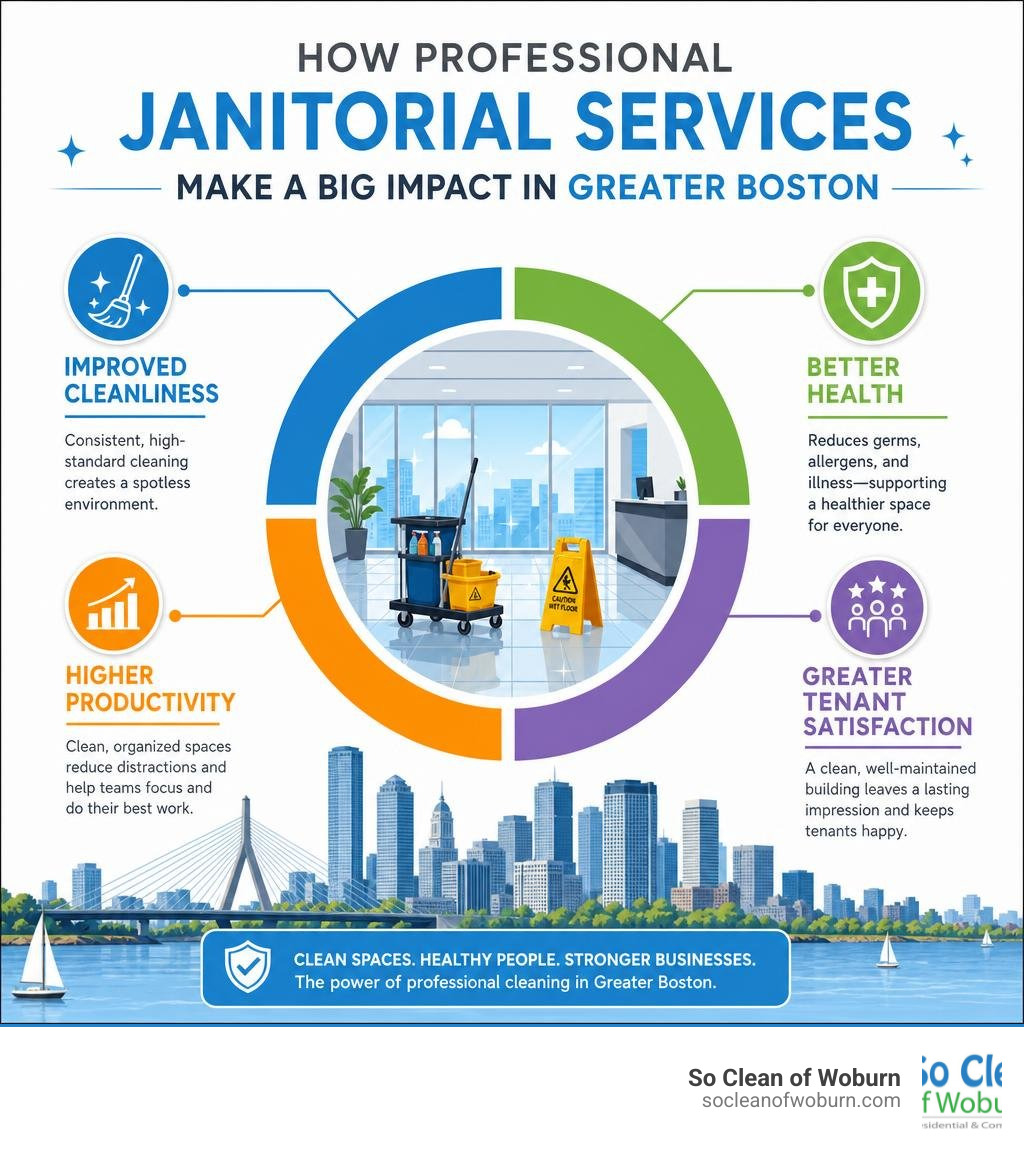
Greater Boston has more than 25,000 commercial buildings that need regular professional cleaning — and the local market is now worth over $1.2 billion annually, growing at 6.2% per year through 2030. That growth isn’t a surprise. Over 85% of facility managers in the Boston area say professional janitorial services directly improve employee productivity and can cut absenteeism by up to 20%.
A dirty office isn’t just an eyesore. It affects how clients see your business, how your team feels at work, and even how healthy your air is day to day. Choosing the right janitorial partner — one who shows up consistently, communicates clearly, and actually cleans to a standard — matters more than most business owners realize until something goes wrong.
This guide pulls together what the best office janitorial companies in Boston actually do, what they cost, and how to tell the good ones from the ones who just look good on paper.
I’m Bill McGrath, owner of So Clean of Woburn, and I’ve spent years working hands-on with businesses across Greater Boston as one of the area’s trusted Greater Boston janitorial experts — from small offices to large commercial facilities. That experience is the foundation of everything you’ll find in this guide.
Greater Boston janitorial experts vocabulary:
What Greater Boston janitorial experts typically include in commercial cleaning plans
A strong janitorial plan is not just “someone comes in and wipes stuff.” At least, it should not be. For most offices and commercial facilities, the best plans combine daily or weekly cleaning, periodic deep work, restroom care, floor maintenance, and clear accountability.
Most commercial cleaning plans in Greater Boston include some mix of:
- Daily janitorial service
- Weekly maintenance cleaning
- Nightly office cleaning
- One-time deep cleans
- Restroom sanitation
- Trash and recycling removal
- High-touch disinfection
- Kitchen and breakroom cleaning
- Reception area cleaning
- Conference room cleaning
- Floor care
- Interior glass cleaning
- Move-in and move-out cleaning
- Post-construction cleanup
- Day porter service
- Supply restocking for paper goods, soap, and liners
For many businesses, the right plan starts with a walkthrough. We look at the building size, traffic patterns, restroom count, flooring types, employee count, and the way the space is actually used. A quiet professional office in Winchester does not need the same program as a busy medical office in Cambridge or a high-traffic commercial space in Boston.
If you want a deeper look at what is typically included, our Janitorial Services page explains how recurring cleaning can be customized by space, schedule, and need.
Core office cleaning services most Boston businesses request
Most Boston-area offices ask for a practical cleaning program that keeps the workplace healthy, presentable, and easy to operate. The most common requests include:
- Emptying trash and recycling bins
- Vacuuming carpets and rugs
- Mopping hard floors
- Dusting desks, ledges, shelves, and common surfaces
- Cleaning reception areas
- Sanitizing conference tables
- Wiping door handles, light switches, phones, and shared equipment
- Cleaning breakroom counters, sinks, tables, and appliance exteriors
- Restroom cleaning and disinfection
- Restocking paper towels, toilet paper, soap, and liners
- Spot cleaning glass doors and interior windows
- Cleaning high-traffic entry areas
High-touch areas matter more than most people think. Door handles, elevator buttons, shared phones, refrigerator handles, and breakroom surfaces can collect germs quickly. In busy offices, those surfaces often need more frequent attention than the areas that simply look dusty.
For businesses comparing service levels, our guide to Commercial Janitorial Services MA breaks down what commercial facilities should expect from a professional janitorial program.
Specialty services that separate basic cleaners from expert janitorial teams

Basic cleaning keeps an office looking decent. Specialty cleaning protects the building, extends the life of surfaces, and handles the jobs that regular nightly cleaning cannot fully solve.
Specialty services often include:
- Carpet extraction and spot treatment
- VCT floor stripping and waxing
- Floor buffing and burnishing
- Tile and grout cleaning
- Stone floor maintenance
- Upholstery cleaning
- Interior window cleaning
- Exterior glass cleaning where access allows
- Pressure washing for entry areas or exterior surfaces
- Post-construction dust removal
- Event cleanup
- Move-in and move-out cleaning
- Emergency cleaning after spills, leaks, or unexpected messes
- Infection control cleaning for high-risk environments
Floor care is one of the biggest separators between a basic cleaner and an expert janitorial team. Commercial flooring takes a beating from salt, grit, moisture, rolling chairs, foot traffic, and the occasional mystery stain that no one wants to claim. A professional floor care schedule can reduce premature wear and keep a facility looking sharp.
For more detail on specialized programs, see our Commercial Janitorial Services MA Complete Guide.
How Greater Boston janitorial experts tailor services by industry
No two industries use their space the same way. A cleaning plan should reflect that.
Here is how commercial janitorial work often changes by industry:
- Corporate offices: Focus on workstations, restrooms, conference rooms, kitchens, reception areas, and nightly consistency.
- Medical and dental offices: Require stronger disinfection protocols, touchpoint cleaning, HIPAA-aware behavior, and careful handling of patient-facing areas.
- Tech and startup offices: Often need flexible schedules, kitchen and collaboration-space cleaning, and after-hours service to avoid disrupting teams.
- Retail stores: Need clean floors, glass, fitting rooms, checkout areas, and customer-facing presentation.
- Schools and education facilities: Require high-touch disinfection, restroom care, floor maintenance, and attention to common areas.
- Manufacturing and light industrial spaces: May need dust control, floor degreasing, safety-conscious cleaning, and coordination around operations.
- Life sciences and lab-adjacent facilities: May require GMP-aware procedures, controlled access, documentation, and specialized training.
- Banks and secure offices: Need background-aware staffing, access control, confidentiality, and cleaning logs.
- Apartment buildings and condominiums: Often require lobby, hallway, stairwell, amenity, mailroom, and trash-area cleaning.
The best janitorial companies do not force every building into the same checklist. They build the checklist around the building. That sounds obvious, but in cleaning, the obvious things are usually the things that prevent complaints.
Service areas, scheduling, and response times across Greater Boston
For So Clean of Woburn, local coverage matters because route density affects reliability. When crews are already working throughout Greater Boston, they can respond faster, maintain more consistent staffing, and better understand local building types.
We serve businesses across Boston, Cambridge, Somerville, Woburn, Burlington, Medford, Arlington, Lexington, Waltham, Watertown, Winchester, Reading, Stoneham, Wakefield, Malden, Melrose, Wilmington, Bedford, Belmont, Billerica, Beverly, Danvers, Lynnfield, Middleton, Andover, Lincoln, and surrounding North Shore, Essex County, and Middlesex County communities.
If your business is comparing options in Cambridge, our article on Janitorial Services Cambridge MA: How to Choose the Best for Your Business is a helpful next read.
Boston neighborhoods and nearby communities commonly served
In Boston itself, commercial cleaning needs vary widely by neighborhood. Downtown offices, Back Bay professional suites, Seaport workplaces, Fenway-area facilities, South End offices, Charlestown businesses, Allston/Brighton commercial spaces, and East Boston properties all have different access, parking, timing, and building requirements.
Nearby commercial hubs also drive strong janitorial demand, including:
- Cambridge office and lab corridors
- Kendall Square
- Harvard Square
- Somerville business districts
- Assembly-area commercial properties
- Woburn and Burlington business parks
- Waltham offices near the Route 128 corridor
- Medford, Arlington, Lexington, and Winchester professional buildings
- North Shore offices and commercial properties in Beverly, Danvers, Lynnfield, and Middleton
The key is not just whether a company says it serves your area. It is whether they can staff it consistently. A cleaning company can have a big service map and still struggle if the crews are stretched too thin. Local coverage should mean reliable routes, not heroic daily road trips.
How janitorial companies minimize disruption to business operations
The best janitorial work often happens when no one notices it happening. That is the goal. Clean office, full trash removed, restrooms stocked, floors tidy, no drama. Very glamorous, we know.
Common scheduling options include:
- After-hours cleaning
- Early morning cleaning
- Weekend service
- Day porter coverage
- Phased cleaning for larger offices
- Lockbox, key, or badge access
- Tenant coordination in multi-tenant buildings
- Elevator scheduling for larger properties
- Quiet equipment when cleaning during operating hours
- Cleaning logs for communication
- Security protocols for sensitive areas
Day porters are especially helpful for high-traffic buildings. Instead of waiting until night, a porter can handle restroom checks, spills, lobby touchups, conference room resets, trash overflow, and supply restocking during the day.
If you are searching for a nearby provider, our Janitorial Services Near Me guide explains how to evaluate local cleaning support without choosing based on distance alone.
Typical emergency and post-construction cleaning response times
Emergency cleaning and post-construction cleaning require fast communication and realistic scheduling. In Greater Boston, typical response patterns look like this:
- Same-day request review: Often possible for urgent issues, depending on crew availability.
- Next-day starts: Common for smaller emergency jobs or simpler deep cleans.
- 24-hour urgent response: Available in some cases for spills, restroom issues, move-in problems, or weather-related messes.
- 24-48 hour quotes: Common after a walkthrough or scope review.
- 1-3 day project mobilization: Typical for larger post-construction or multi-floor jobs.
Post-construction cleaning is not the same as routine janitorial service. It can include construction dust removal, adhesive residue cleanup, cabinet and ledge detailing, interior glass cleaning, floor preparation, restroom detailing, and final inspection readiness.
A word of caution: construction dust is sneaky. It settles, gets stirred up, then settles again just when everyone thinks the job is done. A proper post-construction clean often needs multiple passes.
Pricing, contracts, and quote factors for office janitorial companies in Boston
Commercial cleaning pricing depends on several factors: square footage, cleaning frequency, occupancy, restroom count, flooring type, access complexity, supply needs, special equipment, and whether the work is recurring or project-based.
Most office janitorial companies in Boston use one of four pricing models:
| Pricing model | Best for | Average example | High-end example, 2X average |
|---|---|---|---|
| Hourly labor | Small jobs, add-ons, emergency work | $50 per hour | $100 per hour |
| Per-square-foot monthly | Offices with predictable recurring service | $0.25 per sq. ft. per month | $0.50 per sq. ft. per month |
| Monthly retainer | Recurring office cleaning plans | $1,250 per month | $2,500 per month |
| Project-based quote | Deep cleans, move-outs, post-construction | $5,000 per project | $10,000 per project |
These are general 2026 market ranges, not a substitute for a walkthrough. A 5,000-square-foot office with one restroom and light traffic will price very differently from a 5,000-square-foot medical office with multiple restrooms, treatment rooms, and daily disinfection requirements.
Common commercial cleaning price ranges in 2026
In 2026, many Greater Boston businesses can expect wide ranges like these:
- Monthly square-foot pricing: About $0.10-$0.50 per square foot per month, depending on frequency and scope.
- Hourly commercial cleaning labor: Often $35-$100 per hour, with $50 per hour as a common average and $100 per hour representing a high-end rate at 2X the average.
- Small-office monthly plans: Often $300-$2,500 per month, with $1,250 as a practical average and $2,500 as 2X that average.
- Larger facility monthly plans: Often $1,500-$15,000 per month, with $7,500 as a midpoint average and $15,000 as 2X the average.
- One-time deep cleans: Often $500-$10,000, with $5,000 as a broad average and $10,000 as 2X the average.
Why such a wide spread? Because “office cleaning” can mean a once-a-week vacuum and trash service, or it can mean nightly cleaning, restroom disinfection, day porter service, consumable restocking, floor care, and monthly quality inspections.
Frequency can also affect pricing. More frequent cleaning often lowers the per-visit cost because the space is easier to maintain. Bundling services such as nightly cleaning, floor care, and supply management can also create better value than buying each service separately.
Contract structures businesses should expect
Commercial janitorial contracts in Greater Boston usually fall into a few categories:
- No-contract or one-time cleaning: Good for deep cleans, event cleanup, move-in cleaning, or trial service.
- Month-to-month agreements: Useful for businesses that want flexibility.
- Annual agreements: Common for recurring office cleaning and often better for stable pricing.
- Longer-term agreements: Sometimes used for larger facilities that need dedicated staffing or customized service levels.
- Project-based contracts: Used for post-construction cleaning, floor restoration, or one-time specialty work.
- Seasonal add-ons: Helpful for winter salt cleanup, heavier entryway maintenance, or increased restroom service during busy periods.
A good contract should explain the scope, schedule, supplies, access method, communication process, cancellation terms, insurance requirements, and satisfaction policy. If the proposal is vague, ask questions before signing. “Clean office weekly” is not a scope. It is a wish.
What to ask during a walkthrough before accepting a quote
Before you approve a janitorial quote, ask specific questions. Better questions lead to better service and fewer awkward “I thought that was included” conversations later.
Use this checklist:
- What exact tasks are included each visit?
- How often will restrooms be cleaned and restocked?
- Are consumables such as paper goods, liners, and soap included or billed separately?
- Will the same crew service our building regularly?
- Who supervises the account?
- How often are inspections performed?
- Do you use digital checklists or written cleaning logs?
- What is your re-clean policy if something is missed?
- Are you insured and bonded?
- Are team members trained in OSHA safety practices?
- Can you accommodate after-hours or weekend cleaning?
- How do you handle keys, badges, alarms, and restricted areas?
- Do you offer green cleaning products?
- What floor care is included, and what is considered an add-on?
- How do you price deep cleaning or emergency requests?
- Can the scope be changed as our office grows?
For more help comparing local options, read our guide to Commercial Janitorial Companies Near Me.
Certifications, green cleaning, and quality control standards that matter
A professional janitorial company should be able to explain how it trains staff, protects your facility, handles chemicals, and verifies quality. This matters even more for medical offices, labs, manufacturing spaces, and other regulated environments.
Important standards and signals include:
- OSHA safety training
- EPA-registered disinfectants where appropriate
- CDC-informed cleaning practices for infection control
- HIPAA-aware behavior in medical settings
- GMP awareness for production or lab-adjacent environments
- FDA-related awareness where applicable
- LEED or green cleaning familiarity
- Green Seal or EPA Safer Choice product knowledge
- SDS sheets for chemicals
- PPE training
- Bloodborne pathogen awareness
- HazCom training
- Ladder safety training
- Chemical handling procedures
- Quality inspections and documentation
For additional context on safer product selection, businesses can review the EPA’s Safer Choice program, which helps identify cleaning products that meet safer chemical criteria. Our Professional Janitorial Services page explains how professional cleaning supports healthier, more consistent workplaces.
Compliance and training signals to look for
Not every business needs medical-grade cleaning, but every business should expect safe, professional cleaning.
Look for providers that can discuss:
- OSHA-aligned safety practices
- Proper PPE use
- Safe chemical dilution and storage
- Slip-and-fall prevention
- Cross-contamination prevention
- Restroom disinfection procedures
- Secure access protocols
- Background checks where appropriate
- Insurance and bonding
- Cleaning documentation
- Audit logs for regulated spaces
- HIPAA-aware cleaning for medical and dental offices
- GMP-aware cleaning for applicable production environments
For healthcare, dental, and lab-adjacent spaces, training is not a nice bonus. It is part of risk management. Cleaners may encounter private information, restricted areas, sharps containers, sensitive equipment, or regulated processes. They need to know what to clean, what not to touch, and when to ask before acting.
Green cleaning practices common among Boston-area janitorial services
Green cleaning has become a major priority for many Greater Boston companies, especially those focused on indoor air quality, employee wellness, tenant satisfaction, and ESG goals.
Common green cleaning practices include:
- EPA-registered disinfectants used correctly
- Low-VOC cleaning products
- Non-toxic or reduced-toxicity chemicals where suitable
- HEPA-filter vacuums
- Microfiber cloths and mop systems
- Dilution control to reduce chemical overuse
- Reusable bottles
- Fragrance-reduced products
- Proper ventilation during cleaning
- Fewer harsh residues on surfaces
- Safer storage and labeling
Research across the market shows that companies using certified green cleaning programs in Greater Boston report a 15-25% reduction in indoor air quality complaints and better tenant satisfaction. That tracks with what we see in real facilities: people notice when a space smells fresh instead of chemical-heavy.
Green cleaning does not mean weak cleaning. The key is matching the product to the task, following dwell times, and using the right process. A safer product used incorrectly is still ineffective. A strong disinfectant wiped off too soon is basically expensive water with confidence issues.
How reputable companies handle quality control and accountability
Quality control is where professional janitorial companies prove their value. Anyone can say, “We clean well.” The better question is, “How do you know?”
Strong accountability systems may include:
- Digital checklists
- Room-by-room task lists
- Supervisor walkthroughs
- Daytime and evening inspections
- Photo reports
- Cleaning logs
- Issue tickets
- Customer portals
- GPS clock-ins
- Corrective action notes
- Periodic performance reviews
- ATP testing in higher-risk settings
- 24-hour issue resolution standards
Some companies use detailed inspection systems with 50-point checklists or software-based scoring. Others use supervisor walkthroughs and client sign-offs. The system matters less than whether it is consistent, documented, and acted upon.
At So Clean of Woburn, we believe accountability should be simple: clear scope, consistent service, responsive communication, and fast correction if something is missed. Cleaning is physical work done by humans, so occasional issues can happen. The difference is whether the company owns the issue or sends it into the black hole of “we’ll look into that.”
For a deeper look at janitorial service standards, see our Janitor Services Complete Guide.
Frequently Asked Questions about Greater Boston janitorial experts
Choosing a janitorial company can feel harder than it should. Here are the questions we hear most often from Boston-area offices and commercial facilities.
What guarantees should Greater Boston janitorial experts offer?
A reputable janitorial company should offer a clear satisfaction policy. That may include:
- Re-cleaning missed areas
- 24-hour issue response for urgent concerns
- 24-48 hour response for non-urgent service adjustments
- Supervisor follow-up
- Checklist verification
- Final walkthroughs for deep cleans or project work
- Service credits in some contract situations
- Clear communication with one point of contact
The most important part is clarity. If a company says “100% satisfaction,” ask what that means in practice. Will they come back? How fast? Who do you contact? Is there a documented process?
A good guarantee is not just a marketing line. It is an operating system.
Are green cleaning products as effective as traditional disinfectants?
Yes, when they are chosen and used correctly.
Green cleaning products can be very effective for routine cleaning, dust removal, soil removal, and indoor air quality improvement. For disinfection, the key is using EPA-registered disinfectants and following the label instructions, especially dwell time. Dwell time is the amount of time a disinfectant must stay wet on a surface to work properly.
Effective green cleaning often combines:
- EPA-registered disinfectants for high-touch surfaces
- Microfiber systems that physically remove soil and microbes
- HEPA filtration for dust and allergens
- Low-VOC products for better indoor air quality
- Proper dilution and application
- Fragrance-sensitive options for allergy-prone workplaces
Medical and dental offices may still require hospital-grade disinfectants in certain areas. The goal is not to choose between “green” and “effective.” The goal is to build a cleaning plan that is safe, compliant, and appropriate for the facility.
How do I choose between local janitorial companies and larger cleaning providers?
The right choice depends on your building, industry, budget, and service expectations. Larger providers may offer scale, but local janitorial companies often offer faster communication, more flexible plans, and more direct accountability.
When comparing providers, look at:
- Local response time
- Experience with your industry
- Staff consistency
- Supervisor access
- Customization options
- Pricing transparency
- Contract flexibility
- Quality control systems
- Proof of insurance
- Training practices
- References or reputation
- Re-clean policy
- Ability to handle specialty services
A local company can be especially valuable when you need practical problem-solving. Maybe your building has tricky parking. Maybe the alarm system is fussy. Maybe the third-floor restroom gets heavy traffic every Tuesday because of a recurring training session. Local teams are often better positioned to adapt to those real-world details.
For a broader comparison framework, read Who Makes the Grade: Best Janitorial Companies in Massachusetts.
Conclusion
The right janitorial company does more than make your office look clean. It helps protect your staff, impress your clients, reduce complaints, extend the life of your floors and furnishings, and keep your building running smoothly.
As Greater Boston janitorial experts, we know every facility has its own rhythm. A law office in Boston, a tech workspace in Cambridge, a medical office in Waltham, and a commercial building in Woburn all need different cleaning plans. That is why we focus on customized cleaning, affordable pricing, healthy environments, and service that fits your schedule instead of disrupting it.
If you need recurring office cleaning, a one-time deep clean, post-construction cleanup, apartment building cleaning, or a more reliable janitorial partner, So Clean of Woburn is here to help.
Ready to compare options or schedule a walkthrough? Request professional janitorial services and let us build a plan that keeps your workplace clean, healthy, and ready for business.