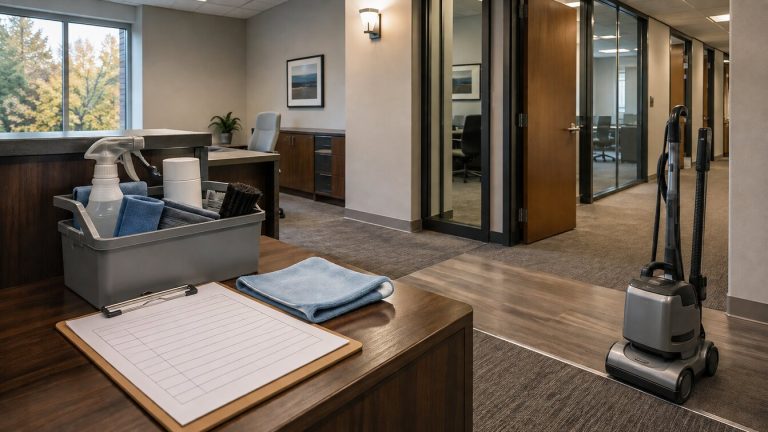

Winter office cleaning in Greater Boston should respond to weather, not just the calendar. Snow, slush, and ice-melt residue arrive through the same few entrances, then spread along employee and visitor routes. A useful plan captures that material early, changes service when conditions change, and makes each party’s responsibility clear.
The practical goal is a clean, orderly, and usable path from the exterior door to the office. That begins with the entrance system, not with more mopping throughout the building.
Use weather triggers instead of one fixed winter schedule
A normal weekly scope may work during a dry stretch and fall behind during a storm cycle. Build three operating modes into the plan:
- Pre-storm mode: Check mat placement, confirm the interior route, empty or replace saturated equipment, and make sure the cleaning team knows which entrance will carry the most traffic.
- Active-weather mode: Inspect entrances more often based on visible moisture, salt residue, mat saturation, and traffic. Remove tracked material near the source before it spreads to elevators, corridors, and work areas.
- Post-storm mode: Lift and clean beneath mats when conditions allow, remove dried residue from compatible surfaces, and inspect the full travel path for material that moved beyond the lobby.
OSHA’s general requirements for walking-working surfaces require workplaces to keep those surfaces clean, orderly, and sanitary, and floors clean and, to the extent feasible, dry. Your facility’s safety program—not a blog checklist—should determine inspection, guarding, and corrective-action procedures.
Build a three-zone entrance system
Each zone has a different job. One mat at the interior door cannot scrape, absorb, and finish the whole process effectively on its own.
| Zone | Primary job | What to inspect | Cleaning response |
|---|---|---|---|
| Exterior approach | Reduce loose snow and grit before the threshold | Blocked path, displaced scraper mat, material accumulating at the door | Property management or the snow contractor clears exterior conditions; keep the entry mat correctly positioned |
| Vestibule | Capture moisture and coarse residue | Mat saturation, curled edges, residue around the mat, door clearance | Extract or replace the mat as planned and clean the surrounding floor with a material-compatible method |
| Interior walk-off | Remove remaining fine moisture and residue before office circulation | Footprints beyond the mat, dried film, residue at elevators or stairs | Vacuum or clean the route before the material reaches work areas |
In a small suite, the three zones may fit within one short path. In a multi-level facility, treat the loading entrance, parking connection, main lobby, and employee entrance as separate systems. The production office and commercial cleaning service confirms that carpet vacuuming and hard-floor cleaning can be tailored to the actual workspace.
Assign winter responsibilities before the first storm
Interior cleaning cannot compensate for an exterior route that has not been cleared, and an office cleaning scope should not silently absorb snow-removal duties. Use a responsibility matrix.
| Task | Property manager or landlord | Office contact | Cleaning team |
|---|---|---|---|
| Exterior snow and ice | Assign and manage the qualified exterior vendor | Report blocked or changing entrance conditions | Outside routine interior-cleaning scope unless expressly contracted |
| Mats and entrance layout | Approve mat type, placement, and building rules | Keep furniture, deliveries, and displays out of the walk-off path | Inspect condition and clean, exchange, or report mats according to scope |
| Storm communication | Identify closures and building-access changes | Provide the cleaning contact with occupancy and schedule changes | Adjust the approved task sequence to the actual open entrances |
| Interior track-in | Escalate building-wide conditions | Flag affected routes promptly | Capture residue and moisture using the approved floor method |
Match the cleaning method to the floor
Winter residue looks similar across surfaces, but the correct response depends on the floor and its finish. Record the material at every entrance: sealed stone, ceramic tile, resilient flooring, finished wood, concrete, or carpet.
- Remove loose grit before adding moisture so it is not dragged across the finish.
- Use the floor manufacturer’s approved product, dilution, tools, and contact limits.
- Use clean pads, mop heads, and solution so residue is removed rather than spread.
- Avoid treating an unknown white film with a guessed chemical combination.
- Report worn finish, lifted mat edges, damaged thresholds, or recurring leaks to the property contact instead of hiding them with a temporary clean.
Periodic floor work and storm-day entry cleaning belong to different parts of the contract. So Clean’s guide to daily touchpoints and periodic office-cleaning tasks can help keep those responsibilities separate.
Set trigger points the office can actually observe
A facility does not need a complicated dashboard to know when the winter mode should change. Use observable triggers:
- The mat is visibly wet, loaded with grit, displaced, or no longer lying flat.
- Footprints or residue extend beyond the interior walk-off zone.
- A second entrance opens for deliveries, events, or a schedule change.
- Occupancy is higher than the normal cleaning scope assumes.
- Residue appears at elevator doors, stair landings, reception, or other downstream points.
- A dry period begins, making under-mat and edge cleaning practical.
These triggers complement the normal office cleaning frequency. They do not require the entire office to receive a deep clean every time weather changes.
Add a winter section to the cleaning scope
A concise winter addendum should name the active months, covered entrances, mat responsibilities, approved floor methods, storm communication contact, inspection triggers, downstream routes, excluded exterior duties, and the process for authorizing extra service.
During the walkthrough, trace the path people actually take from the door to reception, elevators, restrooms, breakrooms, and shared corridors. That route—not a generic checklist—should determine where winter tasks begin and end.
So Clean of Woburn serves offices across Greater Boston and the North Shore. A winter office cleaning plan can be built around your entrances, floor materials, occupancy, and building responsibilities so the scope changes when the conditions do.