
A practical house cleaning schedule should keep everyday mess from turning into a full-day project. The right rhythm depends on the people, pets, surfaces, and high-use rooms in the home, so the most useful schedule separates quick resets from deeper work.
Start with the rooms that create the most work
Kitchens, bathrooms, entries, and frequently used living areas usually need attention sooner than guest rooms or formal spaces. Build the schedule around how the household actually lives instead of assigning every room the same frequency.
| Frequency | Priority tasks | Reason |
|---|---|---|
| Daily or after use | Clear counters, wash dishes, wipe food-prep surfaces, contain laundry, spot-clean spills, and reset entry areas | Prevents clutter, moisture, and food residue from spreading |
| Weekly | Clean bathrooms, dust reachable surfaces, vacuum carpets, mop hard floors, change bed linens, and empty small waste bins | Addresses the soil and dust that normal use creates |
| Monthly | Dust vents and trim, clean cabinet fronts, vacuum upholstery, wash interior glass as needed, and reach beneath movable furniture | Catches buildup outside the normal cleaning path |
| Seasonally | Review closets, clean behind large appliances where accessible, wash window treatments as appropriate, and rotate deep-cleaning zones | Prevents infrequent tasks from being forgotten |
Use a short daily reset
A daily reset is not a deep clean. It is a brief pass that returns items to their homes and removes the mess most likely to become harder later. Focus on dishes, crumbs, spills, bathroom counters, entry clutter, and anything that blocks tomorrow's routine.
Keep the reset small enough to repeat. If it regularly takes too long, move lower-priority work to the weekly list rather than abandoning the schedule.
Give the weekly clean a consistent order
Working in the same sequence reduces backtracking. Start by picking up and removing trash. Dust from higher surfaces toward lower ones. Clean kitchens and bathrooms with products appropriate for each surface. Vacuum, then mop where needed. Finish by replacing linens and supplies.
Allow disinfectants to remain visibly wet for the contact time on their labels. Do not mix cleaning products, and keep products in their original containers. Good ventilation and manufacturer directions matter more than using extra product.
Build a monthly zone rotation
Trying to deep-clean the entire home in one weekend often makes the routine fragile. Assign one or two zones each week instead. For example:
- Week one: kitchen cabinet fronts, appliance exteriors, and pantry review
- Week two: bathroom grout, exhaust-fan covers, and storage
- Week three: bedrooms, mattress-area vacuuming, and closet floors
- Week four: living areas, upholstery, baseboards, and interior glass
When a month has a fifth week, use it for a skipped task or a seasonal project.
Adjust for pets, children, allergies, and entertaining
A home with shedding pets may need more frequent floor and upholstery care. Young children can shift attention toward food surfaces and play areas. Allergy concerns may make controlled dust removal and filter maintenance more important. Before guests arrive, prioritize the entry, bathroom, kitchen, and the rooms they will actually use.
Know when professional cleaning changes the plan
Professional service can replace part of the weekly or monthly workload, but it works best when expectations are defined. Decide whether the priority is recurring maintenance, a deeper reset, or preparation for a specific event. Note delicate surfaces, restricted rooms, pets, access details, and any task that requires special attention.
So Clean provides house cleaning services in the Woburn area. A clear room-by-room priority list helps align the visit with the way the home is used.
The best first-visit intake gives the cleaning team five things before arrival: the rooms in scope, the household’s top priorities, access instructions, surface or product cautions, and any condition that changes the time or equipment required. Ten focused minutes of preparation can prevent missed expectations without asking a homeowner to “pre-clean.”
First, define the result you want
“Deep clean” can mean very different things. One household may care most about kitchen grease and bathroom buildup; another may need pet hair removed from stairs and upholstery-accessible areas. Identify three must-do priorities, then separate recurring maintenance from one-time catch-up work.
| Tell the cleaning team | Why it matters | Example |
|---|---|---|
| Priority rooms | Time can be allocated to the spaces that matter most | Kitchen, two bathrooms, and first-floor floors |
| Current condition | Buildup, renovation dust, or a long gap may change the visit | Hard-water scale in shower; heavy pet hair on stairs |
| Surface cautions | Stone, wood, specialty finishes, and delicate items need appropriate methods | Unsealed stone counter; waxed wood floor |
| Access and pets | Safe entry and a secure work area prevent delays | Lockbox at side door; dog secured upstairs |
Use this pre-visit checklist
- Confirm the address, parking instructions, arrival window, and best contact number.
- List included bedrooms, bathrooms, finished basements, offices, stairs, and common areas.
- Point out surfaces with manufacturer care requirements or known damage.
- Identify allergies, fragrance preferences, or product restrictions before the team arrives.
- Explain where pets will be and whether any door or gate must remain closed.
- Secure medications, cash, sensitive paperwork, firearms, and fragile keepsakes.
- Make sinks and key counters reasonably accessible; place loose clothing and toys in a basket if possible.
- Ask in advance about appliance interiors, interior windows, laundry, dishes, or bed linens; do not assume they are included.
This is preparation, not pre-cleaning. The goal is to remove ambiguity and provide safe access—not to do the contracted work yourself.

Cleaning and disinfecting are not the same service
Routine residential service usually focuses on removing soil and maintaining surfaces. The CDC says cleaning with soap and water removes most germs and that household disinfection is generally most relevant when someone is sick or at higher risk. If your household needs targeted disinfection, say which rooms or touchpoints are involved and disclose illness information without sharing unnecessary private details.
Never combine products or request an off-label chemical use. Product labels control dilution, surface compatibility, ventilation, contact time, and personal protection. If fragrance or ingredient sensitivity matters, the EPA’s Safer Choice product search is one useful reference to discuss with the provider.
Plan for Woburn-area seasonal conditions
New England homes bring predictable seasonal work. Winter salt and grit can scratch floors if it is not removed correctly. Spring pollen settles on sills and entry surfaces. Humid summer conditions can make bathrooms and basements higher priorities, while fall leaves and wet footwear increase entryway debris. Mention active leaks or visible mold-like growth before the appointment; routine cleaning is not a substitute for correcting a moisture problem or assessing a potentially hazardous condition.
Set boundaries for items that need separate approval
A first-visit estimate should state whether it includes oven or refrigerator interiors, interior windows, wall washing, post-construction dust, high fixtures, carpet extraction, heavy lifting, bodily-fluid cleanup, pest waste, or hoarding conditions. Those tasks can require different time, tools, products, or safety controls.
What to review before the team leaves
- Walk the priority rooms while the scope is still fresh.
- Separate a true missed item from work that was excluded or could not be accessed.
- Record surface concerns or maintenance issues the team noticed.
- Adjust recurring frequencies based on the home’s actual use.
- Confirm entry, alarm, parking, pet, and product instructions for the next visit.
First-visit questions
Do I need to be home?
Not necessarily. What matters is a confirmed entry method, alarm instructions, a reachable contact, secured pets, and a clear way to lock the property when service is complete.
Should I provide products and equipment?
Ask the provider. If you require a particular manufacturer-approved product, disclose that during intake and keep the label available. Do not leave an unmarked homemade mixture for a cleaner to use.
How long should the first visit take?
Square footage alone cannot answer that. Condition, clutter, number of bathrooms, flooring, pets, requested detail work, and team size all affect duration. A walkthrough or thorough intake produces a more useful expectation.
Homeowners can review So Clean’s house cleaning service, compare needs that may fit apartment cleaning, and confirm the company’s Woburn and Greater Boston service area before scheduling.
Why Choosing the Best Dust Mop for Wood Floors Matters More Than You Think
Finding the best dust mop for wood floors is one of the simplest ways to protect your hardwood investment and keep your home looking its best — without spending hours cleaning.
Quick Answer: Best Dust Mops for Wood Floors
| Type | Best For | Price Range |
|---|---|---|
| Reusable microfiber flat mop | Daily dust removal, allergens | $15 - $50 |
| Natural wool dust mop | Fine particle trapping, chemical-free cleaning | $50 - $90 |
| Disposable pad mop (e.g. Swiffer PowerMop) | Quick cleanups, convenience | $30 - $60 |
| Spray/wet-dry hybrid mop | Deeper cleaning on sealed hardwood | $40 - $80 |
Here's why it matters: dirt and dust on hardwood floors act like sandpaper underfoot. Every footstep grinds particles into the finish, causing tiny scratches that dull the surface over time. Regular dry dusting is your first line of defense.
And the stakes are real. Choosing the wrong mop — or skipping dry dusting in favor of wet mopping too often — can lead to warping, swelling, and a finish that wears out years too soon.
The good news? The right dust mop makes daily maintenance fast and effortless, even for the busiest households.
I'm Bill McGrath, owner of So Clean of Woburn, and after years of professionally cleaning hardwood floors across Greater Boston, I've seen which tools actually protect wood floors and which ones cause damage — and I'll share everything you need to know to find the best dust mop for wood floors for your home.
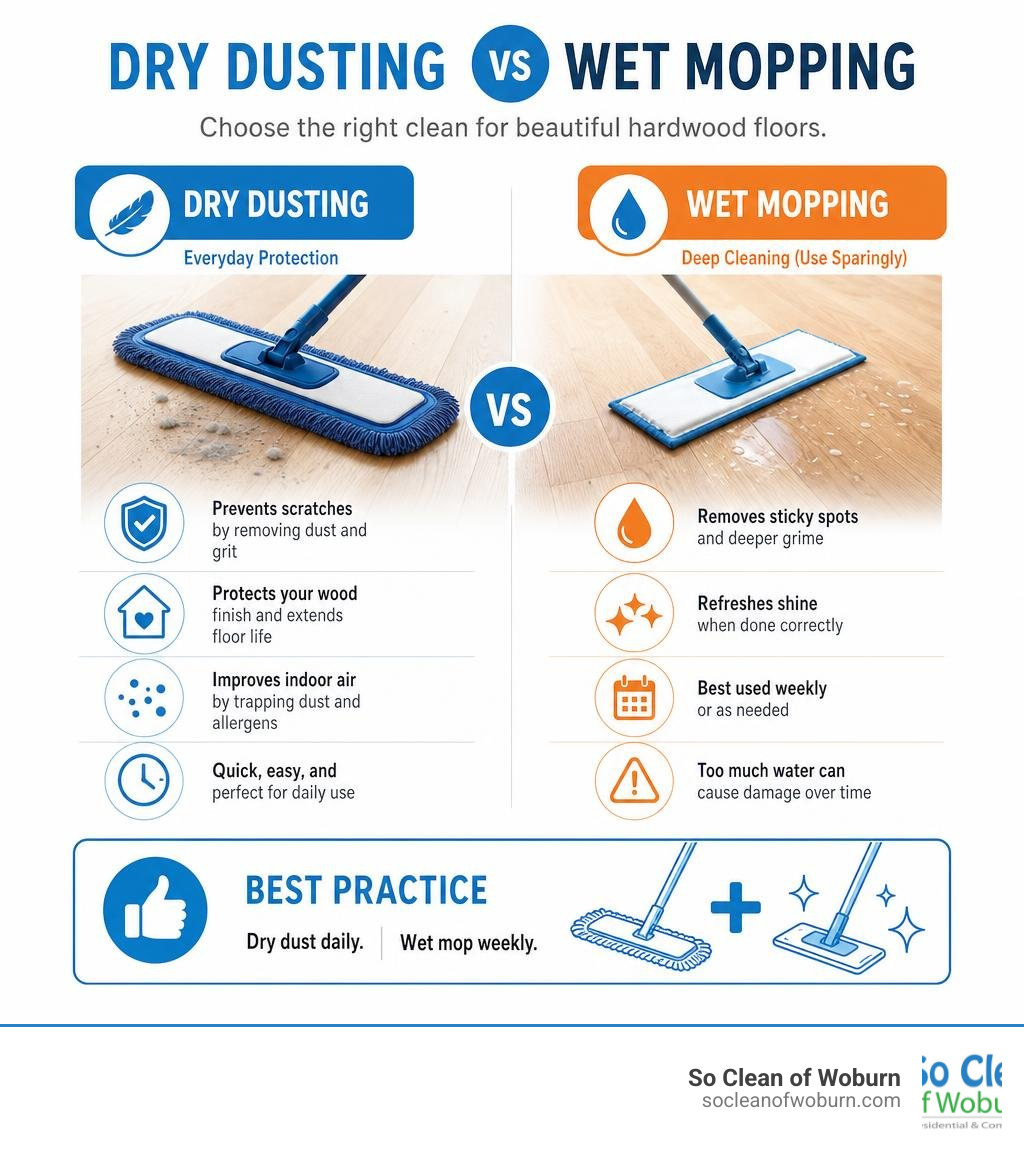
Know your best dust mop for wood floors terms:
What Features Make the Best Dust Mop for Wood Floors?
When you are hunting for the ultimate dust-busting tool for your home, you cannot just grab the first broom-like object you see at the local hardware store in Woburn or Burlington. Hardwood floors require a gentle touch combined with high-performance engineering. Here are the key features that define the absolute best dust mop for wood floors:

1. High-Quality Mop Head Material
The material doing the actual sweeping is the most critical factor. You want fibers that do not just push dirt around but actually lift and lock it away.
- Microfiber: Synthetic fibers split to be finer than a human hair. They create a natural static charge when rubbed against wood, acting like a magnet for pet hair, pollen, and dust bunnies.
- Natural Wool: A time-tested traditional choice that naturally contains lanolin. Wool is incredibly effective at trapping fine dust particles without requiring any chemical sprays.
2. Swivel Joint Maneuverability
Dust bunnies love to hide in the worst possible places—under the sideboard in your dining room, behind the legs of your favorite armchair, and deep in the corners of your hallway. A high-quality dust mop must feature a 360-degree swivel head. This allows you to glide smoothly around obstacles and flat-lay the mop to reach deep under low-profile furniture.
3. Telescoping Handle
Save your back! A telescoping handle that adjusts to your exact height is a lifesaver. Look for sturdy handles made of lightweight aluminum or stainless steel. Cheaper plastic handles tend to flex and break when you apply light pressure.
According to the comprehensive testing detailed in the Best Hardwood Floor Mops of 2026, flat mops with generous widths and flexible joints consistently outperform bulky traditional mops when it comes to dry dust removal.
If you ever find that your floors have gone too long without a proper dusting and the buildup is more than a simple mop can handle, you might want to look into professional hardwood floor cleaning near me to restore that deep, clean shine.
Top Types of Dust Mops for Hardwood Surfaces
To help you decide which style fits your cleaning personality, let’s break down how the main types of dust mops stack up against each other.
| Feature | Reusable Microfiber | Natural Wool | Disposable Pads |
|---|---|---|---|
| Dust Attraction Method | Electrostatic charge | Natural lanolin + static | Synthetic texture + chemical adhesive |
| Environmental Impact | Low (washable up to 500 times) | Very Low (biodegradable & durable) | High (single-use waste) |
| Best For | Daily pet hair & allergens | Fine dust particles & delicate finishes | Quick cleanups & maximum convenience |
| Machine Washable | Yes | No (hand wash/shake out only) | No |
| Life Expectancy | 1 to 3 years | 5+ years | Single-use |
Using a reusable wool or microfiber dust mop can reduce household cleaning waste by up to 80% compared to disposable pads. That is a massive win for both your wallet and the environment in Middlesex County! If you are looking to round out your cleaning closet, check out our guide on the best floor cleaning products to find compatible, wood-safe solutions.
Reusable Microfiber: The Best Dust Mop for Wood Floors in Daily Cleaning
Microfiber is the undisputed modern king of dry dusting. Microfiber dust mops can remove up to 99% of dust and allergens from hardwood floors in a single pass. This is because synthetic microfiber heads are engineered with millions of tiny hooks and loops that scoop up debris instead of just sliding over it.
When you glide a dry microfiber pad across your floor, it generates a mild electrostatic charge. This charge acts like a tractor beam for pet dander, hair, and fine pollen.
For daily maintenance, we highly recommend the O-Cedar Hardwood Floor 'N More. You can find this classic favorite at local retailers or online via O-Cedar Hardwood Floor 'N More on Walmart. It features a wide, double-sided microfiber head that makes quick work of large living areas.
To get the absolute most out of your microfiber dusting routine, follow these expert tips adapted from Bona's guide on how to dust wood floors:
- Dust in a continuous path: Try to keep the mop head in contact with the floor as much as possible, moving in a "figure-eight" pattern to keep the collected dust piled in front of the mop.
- Do not lift the mop: Lifting the mop head releases the trapped dust back into the air.
- Shake it out outside: Once you finish a room, take the pad to your back porch or yard and shake it out vigorously.
For more deep-dive comparisons on microfiber options, explore the industry insights from Best Mops for Hardwood Floors - Microfiber Wholesale and see what makes these synthetic powerhouses so reliable. You can also view official product lineups directly at Best Mops for Hardwood Floors | O-Cedar®.
Natural Wool: The Best Dust Mop for Wood Floors to Trap Fine Particles
If you prefer a traditional, chemical-free, and highly sustainable approach, a genuine wool dust mop is your holy grail. Wool dust mops are 3x more effective at trapping fine dust particles than synthetic microfiber alternatives.
Why is wool so magical? It comes down to nature. Genuine wool fibers contain natural lanolin, a mild, waxy substance that acts as a natural dust binder. When you combine this natural stickiness with the static electricity generated by natural wool scaled fibers rubbing against wood, you get an incredibly powerful dust magnet.
Brands like Sladust have been handcrafting these beautiful, old-fashioned cleaning tools for over 115 years. They feature gorgeous wooden handles and thick, fluffy wool heads.
- The Eco-Friendly Choice: Wool is completely biodegradable and lasts for years if properly cared for.
- Delicate Finishes: Because wool is incredibly soft, it is the safest possible choice for old, historic, or highly delicate wax-finished hardwood floors often found in historic homes throughout the North Shore of Massachusetts.
Spray and Wet-Dry Hybrid Mops for Deep Cleaning
While dry dusting is your daily defense, sometimes your floors need a bit more attention to remove sticky spots, muddy paw prints, or dried spills. That is where spray mops and wet-dry hybrid mops come in. The key here is moisture control. Wood and excess water are mortal enemies; too much liquid will seep into the seams, causing the wood to warp, cup, or split.
For a convenient, all-in-one spray system, the Swiffer PowerMop Wood is a popular modern option. It uses a specialized, fast-drying wood formula and soft, gentle-glide strips to lift away grime without leaving a dulling residue. You can check out the official details at Swiffer® PowerMop Wood Mop Kit with Lemon Scent | Swiffer or purchase it locally via Swiffer Power Mop Wood Mop Kit for Wood Floor Cleaning : Target.
Another incredible, long-time favorite of professional cleaners is the Hardwood Floor Premium Microfiber Spray Mop. It features an extra-large mop head that cleans up to 40% faster than leading competitors, paired with a refillable cartridge so you can use your favorite eco-friendly wood floor cleaners.
If you love high-tech gadgets, you might consider cordless wet-dry vacuums that sweep and wash simultaneously. These machines use smart water-control systems to ensure your floors are only lightly dampened and dry almost instantly:
- The Ryobi SWIFTClean: A great cordless utility option for sealed hard floors, available via the 18V ONE+ HP SWIFTClean Wet & Dry Vacuum Mop Kit.
- The Moprobo M1: A luxury, self-cleaning option featuring a floating track that prevents large debris from scratching your wood floors. You can find this limited edition helper at Moprobo Cordless 4 in 1 Pickup Mop M1 Gold Luxury Limited Edition.
Always ensure your wood floors are fully sealed before using any wet-dry hybrid or spray mop!
How to Clean and Maintain Your Dust Mop Without Damaging Wood
Buying the best dust mop for wood floors is only half the battle. If you do not maintain the mop head, you are essentially rubbing a dirty, abrasive pad across your beautiful hardwood. Dirt buildup on a mop head acts like sandpaper, micro-scratching your floors and stripping away their gorgeous luster.
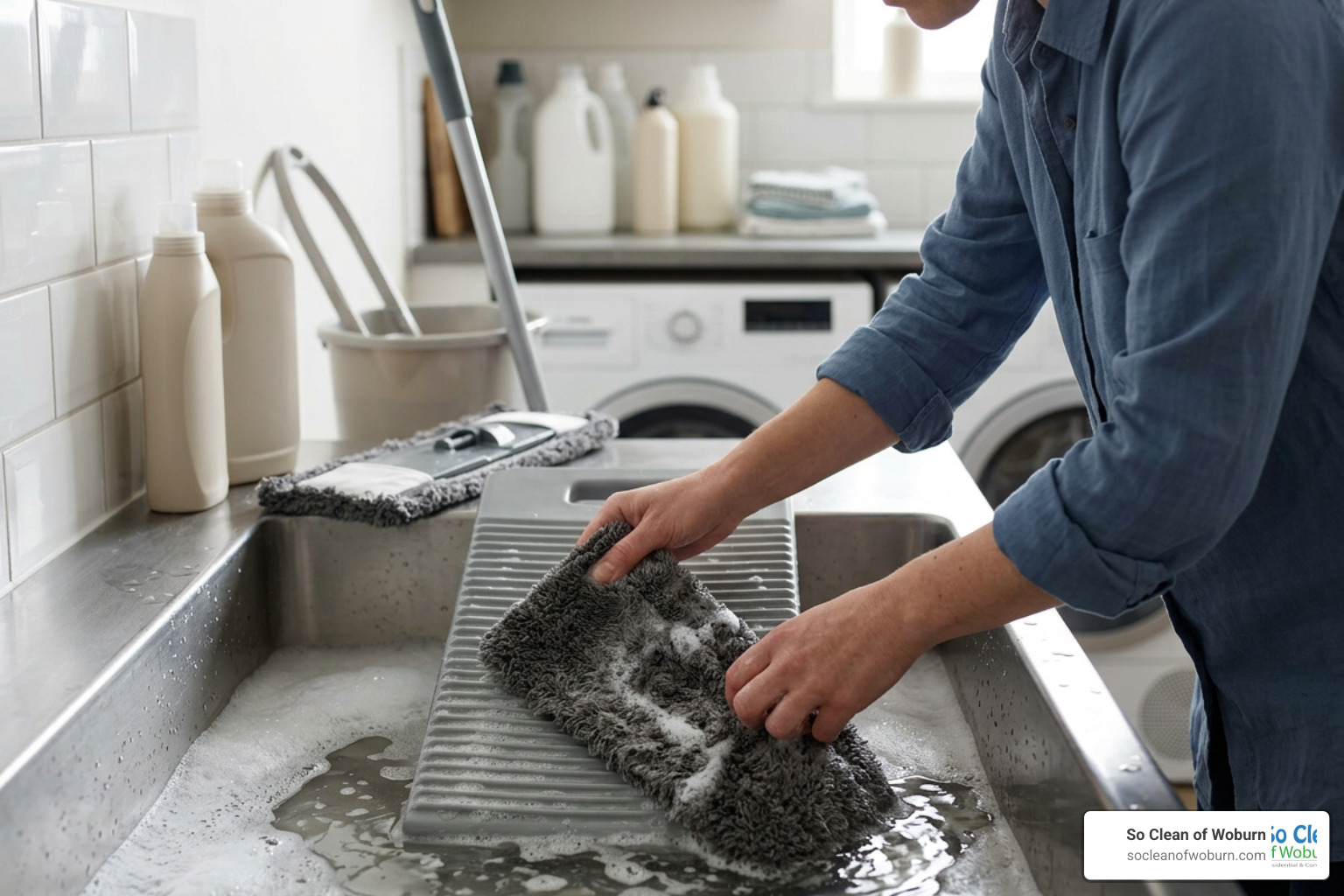
Here is how to keep your dust mop heads in pristine, floor-safe condition:
For Microfiber Mop Pads:
- Shake it out: After every single use, take the pad outside and shake it vigorously to release loose dust and hair.
- Machine wash regularly: Wash your microfiber pads in warm water with a mild, liquid detergent.
- ABSOLUTELY NO FABRIC SOFTENER: Fabric softeners coat the tiny synthetic fibers in a waxy layer, completely destroying their electrostatic charge and ability to trap dust.
- Air dry only: Hang them up to air dry. High heat in a dryer can melt the delicate microfiber tips.
For Natural Wool Mop Heads:
- Never machine wash: Machine washing will felt the wool and ruin the mop.
- Shake and spin: Take the wool mop outside and spin the handle between your hands to release the dust.
- Hand wash only when necessary: If it becomes incredibly dirty, hand wash it gently in cold water with a mild wool-safe soap (like Woolite). Rinse thoroughly, squeeze out excess water gently, and hang it up to air dry completely before using it on your floors again.
If maintaining your floors feels like a full-time chore, our team at So Clean of Woburn offers comprehensive Floor Cleaning Services to handle the hard work for you, ensuring your home stays fresh and sparkling.
Frequently Asked Questions About Wood Floor Dusting
Can dust mops scratch or damage hardwood floors?
Yes, but only if they are dirty! A clean microfiber or natural wool dust mop is completely safe and will not scratch your floors. However, if the mop head is saturated with trapped grit, sand, or small pebbles, dragging it across the floor will create a "sandpaper effect" that scratches the wood's finish. Always shake out your mop head before use and wash it regularly to prevent dirt buildup.
How often should you dust mop wood floors?
For high-traffic areas, entryways, and homes with pets, we recommend dust mopping daily. This prevents pet hair, dander, and outdoor grit from accumulating. For low-traffic areas or homes without pets, dust mopping 2 to 3 times a week is usually sufficient to maintain a healthy, allergen-free environment.
Where can you buy quality dust mops and what is the price range?
You can find high-quality dust mops at online retailers, local home improvement stores, and specialized cleaning supply shops throughout Massachusetts.
- The Price Range: Budget-friendly microfiber options start around $15, while high-end, heavy-duty commercial flat mops and handcrafted natural wool mops can go up to $90.
- Average Price: A great, durable, and highly effective dust mop typically averages around $45.
Conclusion
Keeping your hardwood floors looking radiant does not have to be a grueling task. By investing in the best dust mop for wood floors—whether you choose a high-performance reusable microfiber mop or a classic, dust-trapping natural wool mop—you can easily eliminate dust bunnies, protect your floor's protective finish, and extend the lifespan of your beautiful planks.
Of course, life gets busy. Between work, family, and enjoying everything the Greater Boston area has to offer, finding the time for daily floor maintenance can be tough.
That is where we come in! At So Clean of Woburn, we provide top-notch, customized residential cleaning solutions at affordable prices across Middlesex County, Essex County, and the North Shore. Let our professional team handle the dusting, mopping, and deep cleaning so you can step back and enjoy a sparkling, healthy home.
If you also run a local business or manage an office space in the area, be sure to check out our exceptional commercial floor cleaning services to keep your commercial property looking just as immaculate as your home. Contact us today for a free quote!
Why Apartment Pest Control Is a Building-Wide Challenge
Apartment pest control is one of the most frustrating challenges facing tenants, landlords, and property managers in multifamily housing — and it’s rarely as simple as calling an exterminator for one unit.
Here’s a quick overview of what you need to know:
- Who’s responsible? Landlords are generally required to maintain pest-free, habitable conditions. Tenants share responsibility by keeping units clean and reporting problems promptly.
- Most common apartment pests: cockroaches, mice, rats, bed bugs, ants, and flies
- How pests spread: through shared walls, plumbing lines, electrical conduits, and vents between units
- Best approach: coordinated building-wide treatment using Integrated Pest Management (IPM) — not just spraying one unit
- Typical costs in Massachusetts and New Hampshire: $150–$1,050 per visit, or $600–$4,100 per year depending on property size and pest type
- How to prepare: store food, clear baseboards, remove pets, and plan to stay out for a few hours after treatment
Unlike a single-family home, an apartment building is an interconnected system. Treating one unit without addressing shared spaces — trash rooms, pipe chases, hallways, and laundry areas — rarely solves the problem for long. Pests simply relocate to the next untreated space.
That interconnected reality is exactly what makes apartment pest control in Massachusetts and New Hampshire so challenging, and why a prevention-first approach matters just as much as the treatment itself.
I’m Bill McGrath, owner of So Clean of Woburn, and through years of providing residential and commercial cleaning services across the Greater Boston area, I’ve seen how cleanliness and pest control go hand in hand — a consistently clean building is one of the most effective defenses against recurring infestations. In this guide, I’ll walk you through everything you need to know to manage apartment pest control effectively, from understanding how pests move between units to what tenants and property managers can do to prevent them.
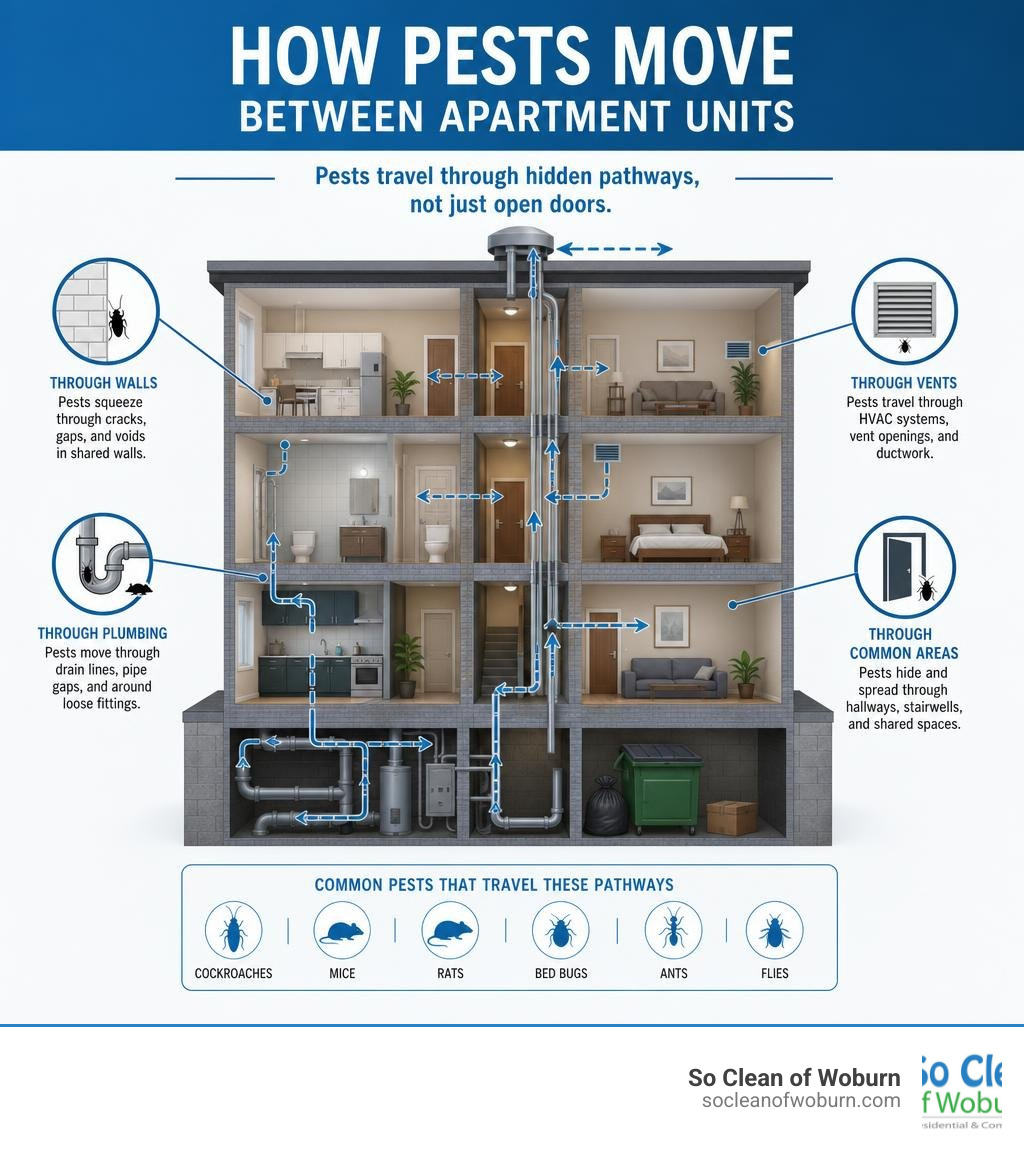
How Apartment Pest Control Works in Multifamily Buildings
Apartment buildings are convenient for people, and unfortunately, they are also convenient for pests. Shared utilities, connected walls, stacked kitchens and bathrooms, trash rooms, laundry areas, storage spaces, and frequent tenant turnover all create pest highways.
A pest control visit usually starts with inspection, not spraying. A licensed technician looks for:
- Pest activity, such as droppings, shed skins, nests, trails, or chew marks
- Entry points around pipes, baseboards, doors, windows, and utility lines
- Moisture sources under sinks, near tubs, in laundry rooms, and around drains
- Food sources in kitchens, trash rooms, pantries, and compactor areas
- Conditions in adjacent units and common spaces that may be feeding the problem
From there, treatment may include baits, traps, dusts in wall voids, crack-and-crevice applications, exclusion repairs, monitoring devices, and follow-up visits. The best programs combine pest control with cleaning, maintenance, and tenant communication.
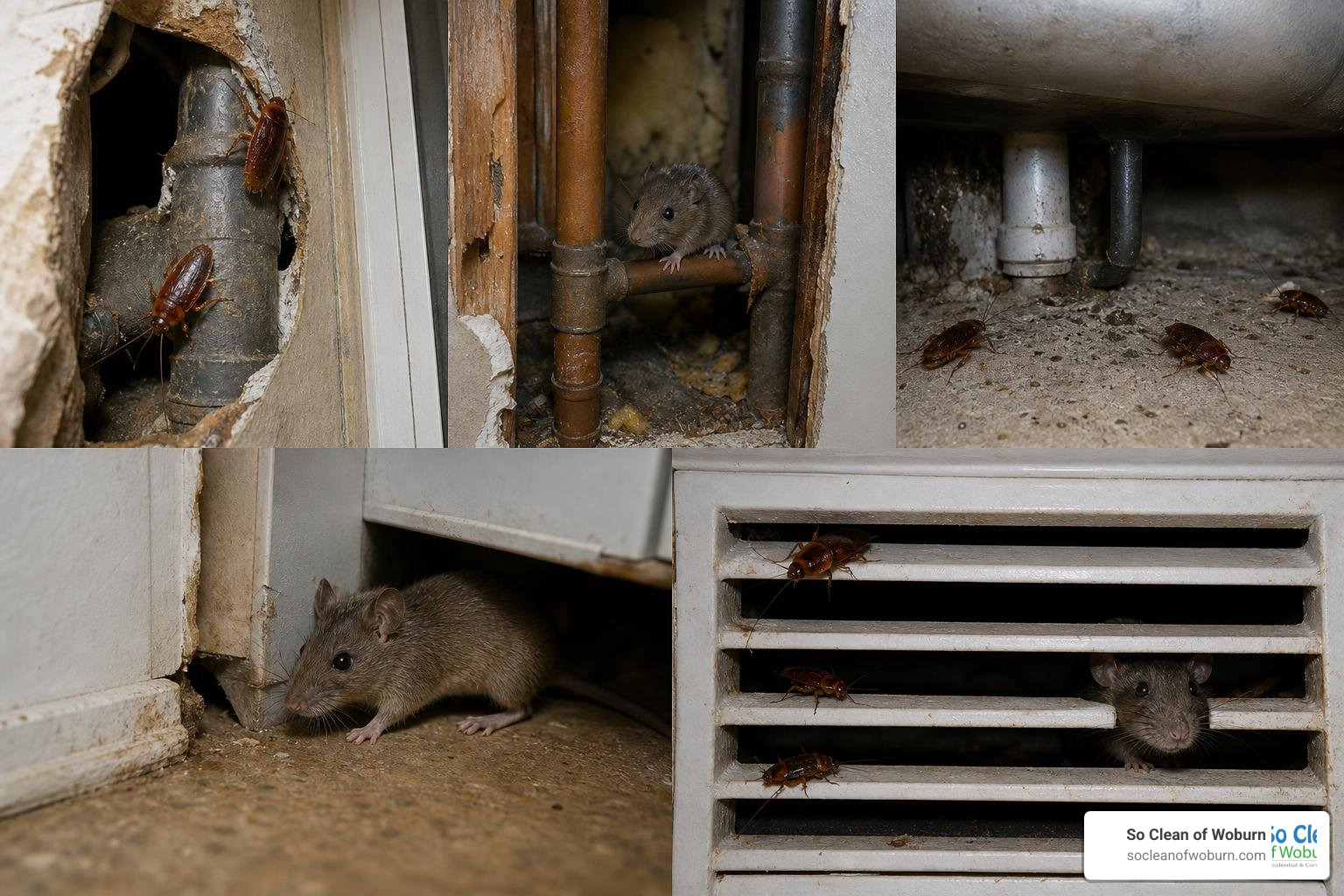
Why Pests Spread Quickly Between Units
Pests spread quickly in apartment buildings because the building gives them protected routes from one unit to another. They do not knock on the front door. Very rude of them.
Common travel paths include:
- Shared walls and wall voids
- Pipe chases behind kitchens and bathrooms
- Electrical conduits and outlet gaps
- Plumbing penetrations under sinks
- Baseboard gaps
- Hallways and stairwells
- Laundry rooms
- Trash rooms and compactor rooms
- Storage rooms and basements
- Vents and utility closets
Untreated units are a major issue. If one apartment has a roach infestation and the adjacent units are not inspected, pests can hide, breed, and return after treatment. Bed bugs can move through wall voids and may also spread through used furniture, mattresses, luggage, and shared laundry areas. Rodents can nest in ceilings, walls, basements, and utility spaces, then move from unit to unit as they search for food.
Tenant turnover also matters. New residents may unknowingly bring in infested furniture or boxes. Vacant units can hide pest activity until a new tenant moves in and discovers the problem.
The Most Common Apartment Pests in Massachusetts and New Hampshire
In Massachusetts and New Hampshire apartment buildings, the most common pests include:
-
Cockroaches
German cockroaches are especially common in kitchens and bathrooms because they need food, warmth, and moisture. They often hide behind refrigerators, under sinks, in cabinet hinges, and near plumbing lines. -
Mice and rats
Rodents enter through surprisingly small gaps and often travel through basements, utility rooms, walls, ceilings, and trash areas. They contaminate surfaces, chew materials, and can damage wiring. -
Bed bugs
Bed bugs are difficult because they spread through furniture, luggage, clothing, wall voids, and neighboring units. Early detection is critical. -
Ants
Ants are common in spring and summer, especially near kitchens, windows, foundation gaps, and moisture sources. -
Flies and fruit flies
These pests often come from trash rooms, drains, recycling areas, rotting food, and sticky residue around beverage containers. -
Spiders
Spiders usually follow other insects. If a building has many spiders, there may be a broader insect issue. -
Silverfish
Silverfish like damp, dark spaces such as bathrooms, basements, laundry areas, and storage rooms. -
Stink bugs and seasonal invaders
In fall, stink bugs and other occasional invaders look for warm hiding places around windows, siding gaps, attics, and wall voids. -
Pantry pests
Pantry moths and beetles often come from stored grains, flour, cereal, pet food, or bulk dry goods. -
Termites and carpenter ants
These are less about daily sanitation and more about moisture, wood-to-soil contact, structural conditions, and exterior maintenance.
For roach-specific advice, we also recommend reading The Ultimate Guide to Evicting Cockroaches in Apartments.
Health and Property Risks Property Managers Should Not Ignore
Pests are not just annoying. They can affect tenant health, property value, and a building’s reputation.
Key risks include:
- Cockroach allergens that can worsen asthma and indoor air quality
- Bacteria spread by roaches and rodents
- Rodent droppings and urine contamination
- Chewed wires, insulation, food packaging, and stored belongings
- Odors from dead rodents in walls or ceilings
- Bed bug bites, stress, and sleep disruption
- Tenant complaints and negative reviews
- Failed inspections or habitability concerns
- Higher long-term costs when small problems become building-wide infestations
Property managers should document pest reports, inspection findings, treatment dates, cleaning work, repairs, and tenant communication. Good records help prove that issues are being handled responsibly.
Who Is Responsible for Pest Control in Apartments?
Responsibility depends on the lease, local rules, the cause of the infestation, and how quickly everyone responds. In general, landlords and property managers are responsible for maintaining habitable rental housing, which usually includes addressing pest infestations. Tenants are responsible for keeping their units reasonably clean, reporting issues promptly, and allowing access for inspection and treatment.
In plain English: pest control works best when nobody plays the blame game and everyone does their part.
What Leases and Local Laws Usually Require
In Massachusetts and New Hampshire, rental housing is generally expected to be safe, sanitary, and habitable. While exact responsibilities can vary by city, town, lease language, and building type, most leases include terms about:
- Maintaining clean and sanitary conditions
- Proper trash disposal
- Reporting leaks, pests, and maintenance problems
- Allowing reasonable access for repairs and pest control
- Preventing damage or unsafe conditions
- Cooperating with building-wide service
Local health departments or housing inspectors may become involved when pest issues are not addressed. Tenants are usually expected to notify the landlord or property manager first, preferably in writing. If management does not respond, tenants may contact local code enforcement, inspectional services, or the appropriate municipal department.
Property managers should provide advance notice before entering units unless there is an emergency. For building-wide pest issues, clear notices and preparation instructions are essential.
When Tenants May Be Responsible
Tenants may be responsible for pest problems when their actions create or worsen the infestation. Examples include:
- Leaving food uncovered
- Allowing trash to build up
- Failing to report leaks
- Keeping heavy clutter that blocks inspection and treatment
- Bringing in infested secondhand furniture
- Leaving pet food out overnight
- Refusing access for scheduled treatment
- Ignoring pest sightings until the infestation spreads
- Violating sanitation terms in the lease
That said, apartment infestations are often shared problems. A clean tenant can still get roaches from a neighboring unit or mice from a basement entry point. That is why documentation matters. Tenants should report sightings with dates, locations, photos if possible, and notes about where pests were seen.
Can Tenants Hire Their Own Pest Control Company?
Sometimes, yes, but tenants should be careful. Before hiring a pest control company, tenants should review the lease and ask the landlord or property manager for written permission. This protects the tenant and helps avoid treatment conflicts.
| Option | Pros | Cons |
|---|---|---|
| Landlord-provided service | Usually coordinated with building access, lease requirements, and common areas | May be limited to scheduled service days or basic treatments |
| Tenant-hired service | Tenant may get faster attention or a second opinion | May violate lease if not approved; may only treat one unit |
| Building-wide professional program | Best for shared infestations, common areas, and recurring issues | Requires scheduling, tenant cooperation, and management oversight |
| DIY products | Can help with minor monitoring or prevention | Misuse can scatter pests, create safety issues, or interfere with professional baits |
The biggest downside of tenant-only treatment is that it may not solve the root problem. If pests are coming from wall voids, trash rooms, or neighboring units, one apartment treatment may only provide temporary relief.
Tenants should also avoid mixing products. For example, spraying over gel bait can make the bait less attractive to roaches. Always tell management and the pest technician what products have already been used.
What Technicians Treat and How Tenants Should Prepare
A professional pest control visit is usually targeted. Technicians do not normally spray every surface in an apartment. They inspect first, then treat pest travel paths, hiding spots, and entry points.
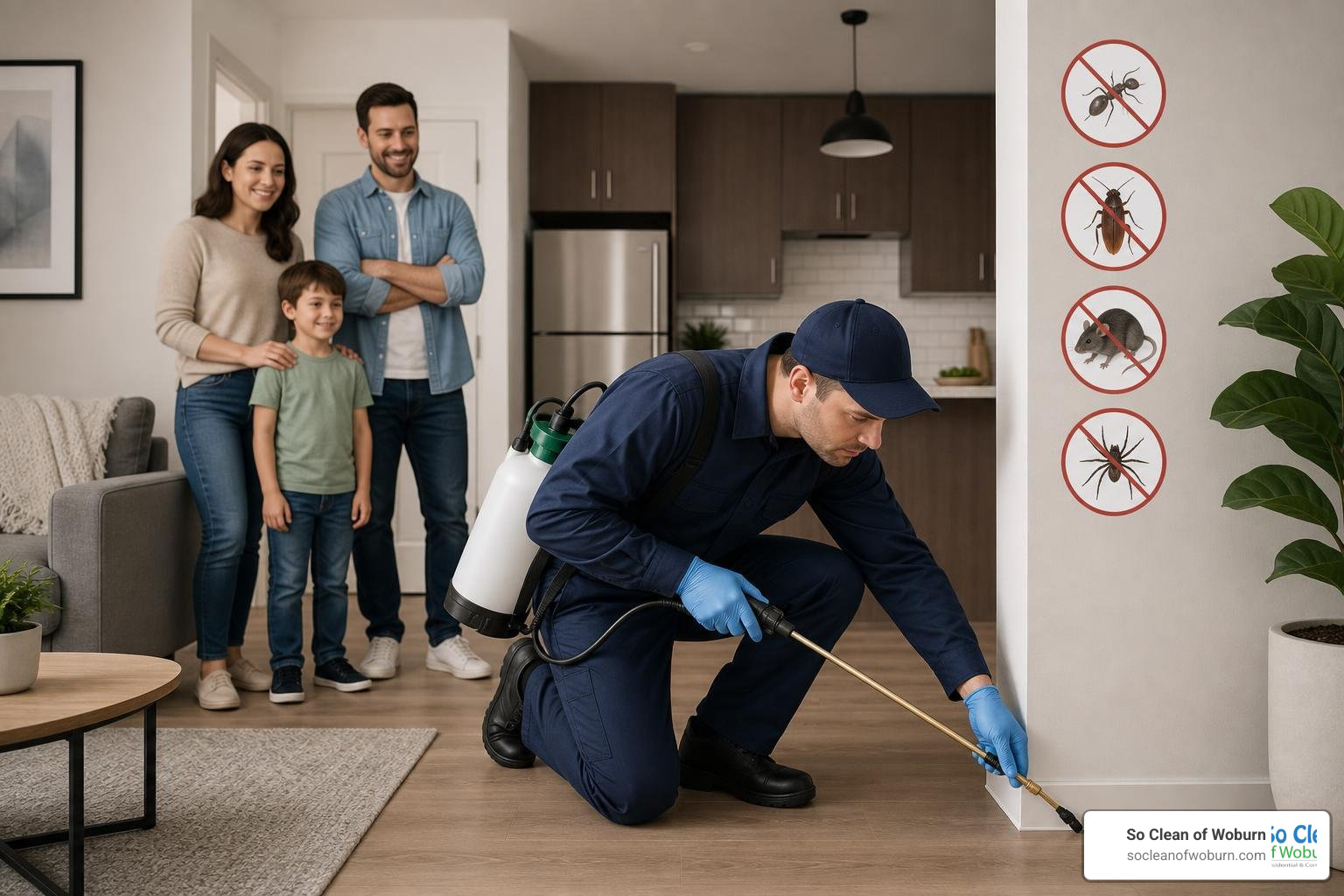
What Apartment Pest Control Technicians Treat Inside a Unit
Depending on the pest, technicians may inspect and treat:
- Under kitchen sinks
- Cabinet corners and hinges
- Behind and beside refrigerators
- Around stoves and dishwashers
- Baseboards
- Cracks and crevices
- Door thresholds
- Window frames
- Pipe penetrations
- Pantries
- Bathroom plumbing areas
- Closets and storage spaces
- Utility closets
- Wall void access points
- Areas where droppings, nests, or trails are found
- Monitoring trap locations
For rodents, technicians may focus on exclusion, snap traps, tamper-resistant stations, and sealing holes. For roaches and ants, they may use gel baits and non-repellent products. For bed bugs, the process is more specialized and preparation is usually more detailed.
How Targeted Are Professional Applications?
Modern pest control is not about soaking an apartment in chemicals. A good technician uses the least amount of product necessary in the right location.
Targeted tools may include:
- Gel baits in cracks, cabinet corners, and roach harborages
- Crack-and-crevice treatments
- Non-repellent products that pests unknowingly contact
- Insect growth regulators for roach life-cycle control
- Rodent traps and stations
- Exclusion materials to close gaps
- Glue boards for monitoring
- Dusts in inaccessible voids when appropriate
Products must be applied according to label directions. Tenants should follow re-entry instructions, keep children and pets away until treated areas are dry, and avoid touching baits or traps.
How to Prepare Before a Pest Control Visit
Preparation makes treatment more effective. Before service, tenants should:
- Store food in sealed containers
- Cover or put away dishes, utensils, and small appliances
- Empty trash and recycling
- Clear clutter from floors and counters
- Move furniture away from baseboards if requested
- Vacuum floors, especially along edges
- Remove items from under sinks if those areas need treatment
- Report exact pest sightings to management or the technician
- Secure pets away from treatment areas
- Cover aquariums and turn off air pumps if instructed
- Unlock rooms, closets, basements, or storage areas that need access
- Avoid using DIY sprays before the visit
For bed bugs or fleas, preparation may include laundering fabrics, bagging items, vacuuming mattresses and furniture, and following a separate checklist.
What to Do After Treatment for Safety and Effectiveness
After treatment, tenants should follow the technician’s instructions. Common aftercare steps include:
- Stay out of the unit until the recommended re-entry time has passed
- Ventilate if instructed by opening windows
- Do not mop treated baseboards immediately
- Leave gel baits and traps undisturbed
- Keep food sealed and counters clean
- Repair or report leaks
- Continue vacuuming as directed
- Track sightings after treatment
- Report ongoing activity to management
It is normal to see some pests after treatment, especially roaches, because products and baits may take time to work. However, sightings should decrease. If activity continues, follow-up service may be needed.
Integrated Prevention for Long-Term Apartment Pest Control
The strongest apartment pest control programs use Integrated Pest Management, or IPM. IPM combines prevention, monitoring, sanitation, exclusion, maintenance, and targeted treatment. The goal is not just to kill pests today, but to make the building less inviting tomorrow.
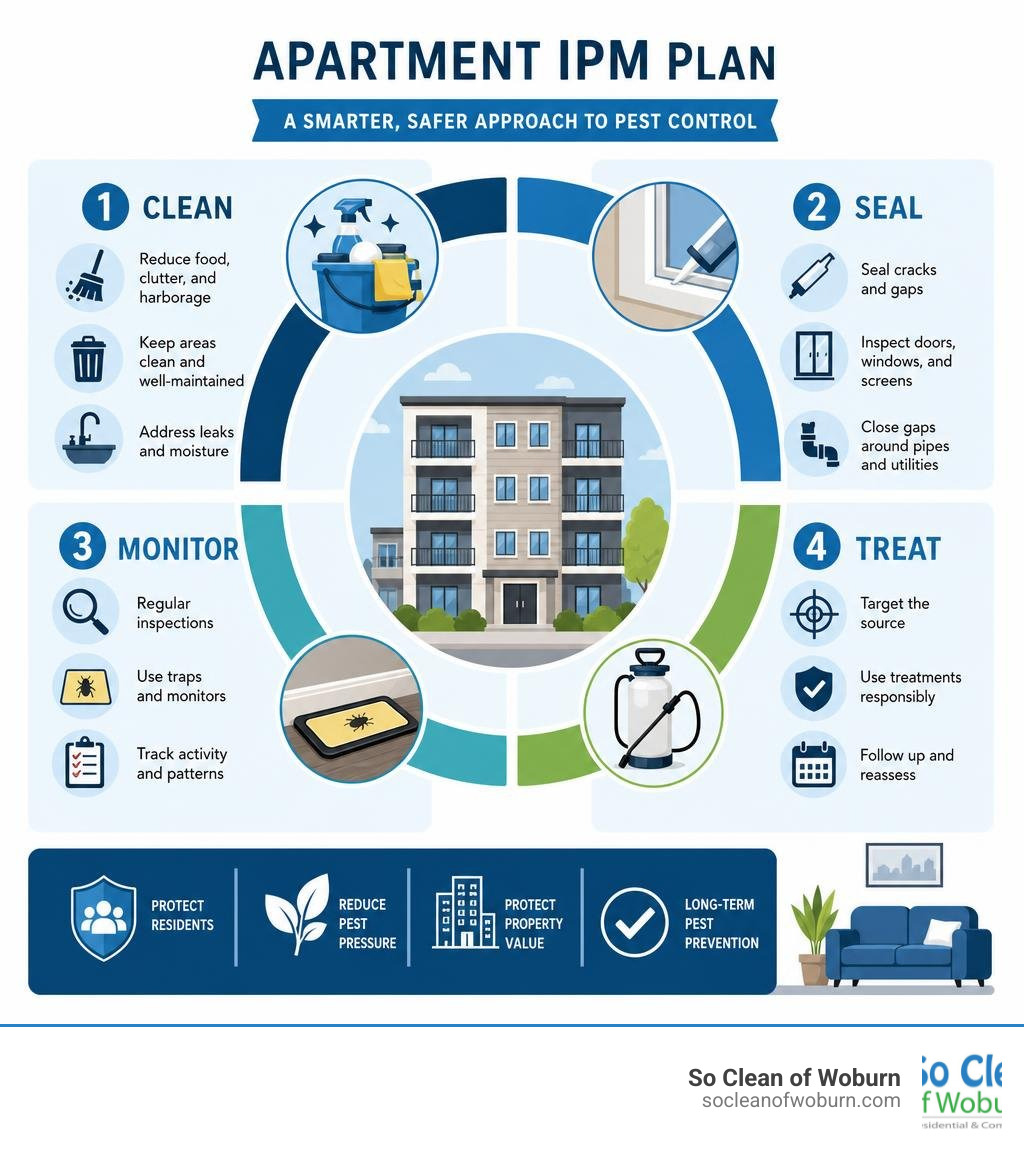
Sealing, Exclusion, and Building Maintenance
Exclusion means keeping pests out or limiting how easily they move. In apartments, exclusion should include individual units and common areas.
Important steps include:
- Install or repair door sweeps
- Caulk baseboard gaps and wall cracks
- Seal around pipes under sinks
- Use escutcheon plates or pipe collars where appropriate
- Repair window screens
- Weatherstrip exterior doors
- Seal utility penetrations
- Repair foundation cracks
- Inspect basements and crawlspaces
- Close gaps around trash rooms and loading areas
- Rodent-proof exterior entry points
Older buildings in Boston, Cambridge, Somerville, Medford, Woburn, and surrounding communities often have charming character and, occasionally, charming little gaps that mice absolutely love. Regular maintenance is essential.
Sanitation Strategies That Reduce Pest Pressure
Sanitation is one of the most powerful pest prevention tools in multifamily housing. Pests need food, water, and shelter. Cleaning removes the buffet.
Focus on:
- Trash rooms
- Compactor rooms
- Chute doors
- Recycling areas
- Laundry rooms
- Basement storage areas
- Hallways and stairwells
- Kitchen common areas
- Floor drains
- Grease and sticky residue
- Food debris behind appliances
- Odors from spills or waste buildup
Trash and compactor rooms are especially important. Spilled garbage and liquids can attract flies, roaches, mice, and rats. Regular scraping, washing, deodorizing, and degreasing can reduce odors and pest pressure.
We cover this in more detail here: More on apartment common-area cleaning.
Monitoring, Reporting, and Tenant Education
Monitoring helps identify pest problems early, before they spread. Property managers should consider:
- Glue boards in utility and trash areas
- Sighting logs for tenants and staff
- Unit maps showing recurring hotspots
- Photos of droppings, damage, or entry points
- Maintenance tickets for leaks and gaps
- Sanitation reports when housekeeping issues contribute
- Follow-up inspections after treatment
- Written tenant notices before service
- Clear preparation checklists
Tenant education is not about shaming residents. It is about making prevention easy. Simple reminders about storing food, reporting leaks, avoiding used furniture, and preparing for service can make a huge difference.
For a deeper look, see More multifamily pest prevention strategies.
Why Clean Buildings Have Fewer Recurring Infestations
Clean buildings are not pest-proof, but they are much harder for pests to exploit. Regular cleaning helps by:
- Removing food crumbs and residue
- Reducing roach allergens
- Lowering dust and debris
- Improving indoor air quality
- Reducing odors that attract pests
- Making droppings and activity easier to spot
- Supporting consistent housekeeping standards
- Encouraging resident cooperation
Cleanliness also helps technicians do better work. If baseboards, sinks, trash areas, and storage rooms are accessible, pest control treatments can be more precise and effective.
For more on the connection between cleaning and indoor health, read More on reducing allergens in apartment buildings.
Building-Wide Treatments, Difficult Pests, and Service Frequency
Some pests can be handled with a unit-level response. Others require coordinated building-wide action. Cockroaches, rodents, and bed bugs often fall into the second category, especially when multiple tenants report activity.
Why Building-Wide Coordination Beats Single-Unit Treatment
Building-wide coordination works better because pests do not respect unit lines. If only one apartment is treated, pests may move into untreated spaces and return later.
A coordinated plan may include:
- Inspecting adjacent units
- Treating units above, below, and beside the problem unit
- Checking shared plumbing walls
- Servicing hallways, basements, and laundry rooms
- Cleaning and treating trash areas
- Sealing exterior entry points
- Scheduling follow-up visits
- Sending tenant preparation notices
- Tracking results by unit and common area
For property managers comparing local service coverage, examples of Massachusetts pest service area information include resources for the North Shore, Essex County, Middlesex County, Andover, Arlington, Bedford, Belmont, and Beverly.
Specialized Services for Bed Bugs and Other Difficult Pests
Bed bugs require a different approach from general pest control. Standard baseboard spraying is not enough.
Specialized bed bug services may include:
- Detailed bed, mattress, furniture, and baseboard inspection
- Mattress and box spring encasements
- Heat treatment
- Steam treatment
- Precision chemical treatment
- Vacuuming
- Canine detection in larger properties
- Follow-up monitoring
- Treatment of adjacent units when needed
Tenants should watch for early signs such as small blood spots on sheets, dark specks on mattresses, shed skins, bites in clusters, or live insects in seams and crevices.
Other difficult pests also need special handling:
- Fleas: often require pet treatment, laundering, vacuuming, and follow-up.
- Rodents: require exclusion, trapping, sanitation, and exterior inspection.
- Severe roaches: may require bait rotation, growth regulators, repeated visits, and adjacent-unit inspections.
- Termites or carpenter ants: require structural inspection and moisture correction.
Apartment Pest Control Costs, Contracts, and Scheduling in Massachusetts and New Hampshire
Costs vary widely depending on the pest, building size, number of units, severity, access, preparation, and follow-up needs.
Typical planning ranges in Massachusetts and New Hampshire include:
- One-time visit: about $150 to $1,050
- Annual service plan: about $600 to $4,100
- Routine preventive service: often priced by unit count, building layout, and service frequency
- Specialized bed bug, termite, or rodent exclusion work: often costs more than general pest service
The high end is usually tied to larger buildings, severe infestations, difficult access, repeated visits, or specialized treatment methods. A small ant issue in one unit will not be priced like a building-wide bed bug response. Thankfully.
Property managers should ask whether pricing includes:
- Inspection
- Common area service
- Unit treatments
- Follow-up visits
- Emergency calls
- Reporting
- Tenant preparation materials
- Exclusion recommendations
- Bed bug or rodent add-ons
How Often Preventive Service Should Be Scheduled
For many apartment buildings, quarterly preventive pest control is a reasonable baseline. Higher-risk buildings may need service every two months or monthly.
Frequency depends on:
- Building age
- Number of units
- Tenant turnover
- History of infestations
- Trash room conditions
- Nearby restaurants or food businesses
- Basement and storage conditions
- Moisture problems
- Seasonal pest pressure
- Rodent activity in fall and winter
- Cockroach activity in warm, humid areas
- Bed bug reports
Buildings with recurring issues should not rely on occasional emergency service alone. Preventive inspections, cleaning, sealing, and routine monitoring are much more effective.
Frequently Asked Questions About Apartment Pest Control
Do Exterminators Spray Everywhere in an Apartment?
No. Professional technicians usually use targeted treatments. They focus on baseboards, cracks, crevices, entry points, under sinks, behind appliances, cabinet areas, and places where pests live or travel.
For many pests, baits and traps are more effective than broad spraying. Technicians should follow product labels and avoid unnecessary applications on surfaces where people cook, eat, sleep, or sit.
Is Apartment Pest Control Safe for Children and Pets?
When performed by licensed professionals according to label directions, apartment pest control can be done safely. Tenants still need to follow instructions.
Common safety steps include:
- Remove pets during service
- Cover aquariums
- Keep children away from treated areas until dry
- Follow re-entry times
- Ventilate if instructed
- Do not touch baits, traps, or treated cracks
- Tell management about asthma, pregnancy, chemical sensitivities, or medical concerns
If you are unsure, ask the technician what was applied, where it was applied, and when it is safe to return.
Can a Tenant Refuse Pest Control in an Apartment?
A tenant may have concerns about treatment, but refusing access can create problems in a shared building. Most leases allow landlords or property managers to enter with reasonable notice for repairs, inspections, and necessary services.
If pests threaten multiple units, tenant cooperation is important. Refusal may allow infestations to spread and may violate lease terms. Tenants with health concerns should communicate early so management can discuss options, timing, ventilation, or alternative treatment methods with the pest professional.
Conclusion
Effective apartment pest control is not just about killing pests after they appear. It is about understanding how apartment buildings work: shared walls, shared utilities, shared trash areas, shared habits, and shared responsibility.
The best results come from combining:
- Prompt reporting
- Professional inspection and treatment
- Building-wide coordination
- Tenant cooperation
- Sealing and maintenance
- Trash room and common-area cleaning
- Moisture control
- Regular monitoring
- Clear communication
At So Clean of Woburn, we help property managers, landlords, and residents create cleaner, healthier apartment buildings across the Greater Boston area, including Middlesex County, Essex County, the North Shore, Woburn, Boston, Cambridge, Somerville, Medford, Arlington, Burlington, Waltham, and nearby communities.
A clean building will not magically repel every pest, but it removes the conditions that allow infestations to return again and again. And that is where long-term prevention really begins.
If you want to support pest prevention with cleaner common areas, healthier living spaces, and a more consistent building maintenance plan, start here: keep your apartment building cleaner and healthier.
What You Need to Know About Residential House Cleaning
Residential house cleaning services give busy professionals a practical way to keep their home healthy, tidy, and stress-free — without spending their limited free time scrubbing floors.
Here’s a quick overview of what to expect:
- What’s included: Dusting, vacuuming, mopping, kitchen and bathroom cleaning, trash removal, and light organizing
- How often: Weekly or bi-weekly for most homes; monthly for smaller or lower-traffic households
- Typical cost: $174–$512 per visit depending on home size, condition, and frequency
- Supplies: Most professional services arrive fully equipped — you don’t need to provide anything
- Do you need to be home? No. Most clients are not home during their cleaning visit
A clean home isn’t just about appearances. Research consistently links a tidy living space to lower stress levels, better sleep, and reduced allergens — all things a busy professional can’t afford to ignore.
I’m Bill McGrath, owner of So Clean of Woburn, and I’ve spent years leading one of the Greater Boston area’s most trusted teams in residential house cleaning for homes across Massachusetts and New Hampshire. In this guide, I’ll walk you through everything you need to evaluate your options and choose the right service for your home and schedule.
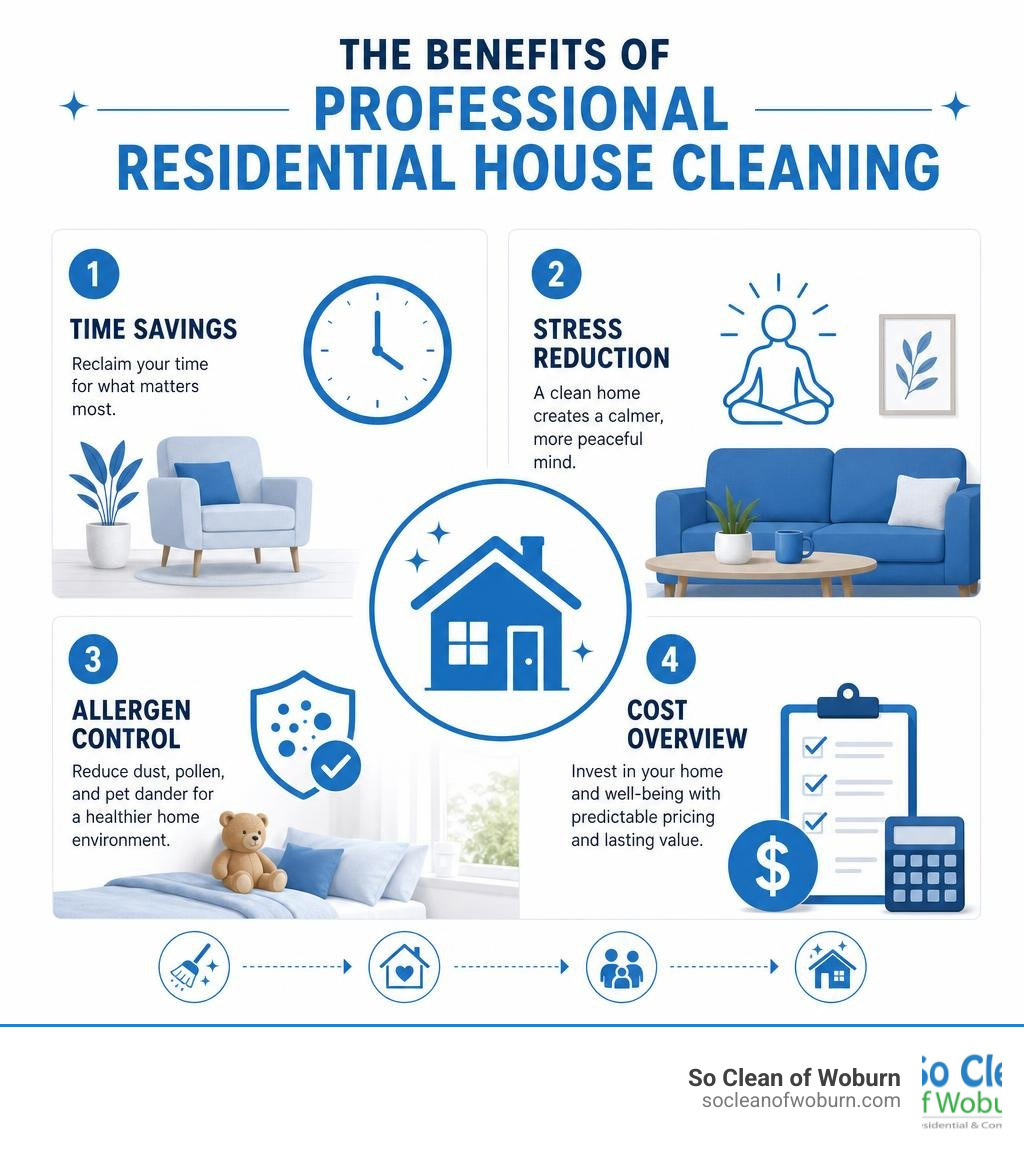
Residential House Cleaning terms at a glance:
The Complete Checklist for Standard Residential House Cleaning
When you hire a professional service for recurring residential house cleaning, you aren’t just paying for someone to sweep your floors. You are investing in a systematic, top-to-bottom process designed to keep your living space healthy and pristine.
A high-quality standard cleaning service is built around maintaining a baseline of cleanliness. This keeps day-to-day grime, dust, and bacteria from taking over your home. To understand exactly what you are paying for, it helps to look at the room-by-room breakdown of a standard cleaning checklist.
Kitchen Sanitization
The kitchen is the heart of the home, but it is also a magnet for grease, food splatters, and bacteria. A standard visit covers:
- Wiping and sanitizing countertops, backsplashes, and sinks.
- Cleaning the exterior of major appliances (refrigerator, oven, microwave, and dishwasher).
- Cleaning the inside of the microwave.
- Wiping down stovetops and range hoods.
- Mopping and sanitizing hard-surface flooring.
Bathroom Scrubbing
Bathrooms require rigorous sanitizing to prevent mold, mildew, and soap scum buildup. Standard tasks include:
- Thoroughly scrubbing and disinfecting toilets, tubs, showers, and sinks.
- Cleaning and polishing fixtures, faucets, and mirrors.
- Wiping down vanity tops and cabinet exteriors.
- Mopping and disinfecting bathroom tile floors.
Living Areas and Bedrooms
These spaces are where you relax, meaning they accumulate dust, pet dander, and hair. To keep these areas fresh, we focus on:
- Dusting all surfaces, including furniture, shelves, picture frames, and decorative items.
- Dusting window ledges, blinds, light fixtures, and ceiling fans.
- Vacuuming upholstered furniture, carpets, rugs, and stairs.
- Mopping hardwood, laminate, or vinyl floors.
- Making beds and, if requested, changing linens.
- Tidying up common clutter and emptying all trash bins.
By sticking to a comprehensive checklist, professional teams ensure that no corner is overlooked. For a deeper look into how these tasks are structured to save you time, check out our guide on The Secret to a Spotless Home: Unpacking House Cleaning Services.
Routine Maintenance vs. Deep Cleaning: Which Do You Need?

One of the most common points of confusion for homeowners is deciding between a routine maintenance clean and a deep clean. Choosing the wrong one can lead to unmet expectations or unnecessary costs.
What is Routine Maintenance Cleaning?
Routine cleaning is all about upkeep. It is designed for homes that are already in relatively good shape and just need regular help to stay that way. If you have your home cleaned weekly or bi-weekly, you are receiving routine maintenance. This service focuses on surface-level dirt, dust, and sanitization to keep your home consistently fresh.
What is Deep Cleaning?
Deep cleaning is a restorative service. It goes far beyond the surface to tackle years of accumulated grime, grease, dust, and hard water stains. Deep cleaning targets the neglected, hard-to-reach areas of your home that are not covered in a standard visit.
For example, while a routine clean involves wiping down the outside of your kitchen cabinets, a deep clean involves scrubbing grease buildup off the cabinet fronts, dusting individual baseboards by hand, and cleaning behind major appliances.
To help you decide which service fits your current needs, review this comparison table:
| Cleaning Task | Routine Maintenance Clean | Deep Cleaning (Restorative) |
|---|---|---|
| Dusting Surfaces & Furniture | Yes | Yes (plus hand-wiping detailed woodwork) |
| Vacuuming & Mopping Floors | Yes | Yes (including under light furniture) |
| Baseboards & Trim | Light dusting | Hand-wiped and detailed |
| Inside Oven & Refrigerator | No (Available as add-on) | Yes |
| Cabinet Fronts | Light wipe-down | Heavy degreasing and detailing |
| Grout & Tile Scrubbing | Standard wash | Deep scrub to remove mildew/stains |
| Window Tracks & Blinds | No | Yes |
Most professional cleaning companies require an initial deep clean for all new clients. This establishes a “clean baseline.” Once the deep-seated grime is removed, the team can easily maintain that standard of cleanliness with regular routine visits.
If your home has gone several months without a thorough scrubbing, you will want to start with a deep clean. To learn more about this restorative process, read Everything You Need to Know About Professional Residential Deep Cleaning.
How Much Does Professional House Cleaning Cost in 2026?
Understanding the financial investment of residential house cleaning is crucial when evaluating your options. In June 2026, pricing models have become highly transparent, allowing homeowners to plan their budgets with confidence.
Professional cleaning companies generally charge using one of two methods:
- Hourly Rates: You pay for the exact amount of time the cleaning crew spends in your home. This is common for one-time cleans, deep cleans, or homes with highly customized task lists.
- Flat-Rate Pricing: The company charges a set fee per visit based on the size of your home (number of bedrooms, bathrooms, and square footage). This is the standard model for recurring, routine cleaning because it provides predictable costs.
To better understand how these rates are calculated and what to look for in a quote, check out our comprehensive Professional Residential Cleaners Guide.
Factors That Affect the Price of Residential House Cleaning
No two homes are identical, which is why professional cleaning rates vary. When a service provider calculates your quote, they look at several key variables:
- Home Size and Layout: The total square footage and the number of bedrooms and bathrooms directly dictate how long the job will take. Bathrooms and kitchens require the most intensive scrubbing, so a home with four bathrooms will always cost more to clean than a home with two, even if the total square footage is similar.
- Presence of Pets: Pets bring joy, but they also bring shedding hair, dander, and tracked-in dirt. Homes with pets require extra vacuuming, specialized upholstery cleaning, and pet hair removal, which can increase the overall cost.
- Cleaning Frequency: Ironically, the more often you have your home cleaned, the less you will pay per visit. Weekly and bi-weekly visits keep dirt from building up, making each visit faster and easier. A monthly clean, on the other hand, requires more “catch-up” work and therefore carries a higher per-visit rate.
- Condition of the Home: If a home has not been professionally cleaned in years, the initial visit will require significantly more labor, specialized products, and time.
Average Rates for Recurring Residential House Cleaning
To give you a clear picture of the market in June 2026, let’s look at the average rates across Massachusetts.
For a standard, one-time or recurring visit, the national average cost range is $174 to $256. However, for larger homes, properties with pets, or those requiring extensive deep cleaning, the high-end range can reach up to $512 per visit (representing a wide range where the high-end is twice the average high).
If you prefer an hourly rate model, the average hourly rate nationwide ranges from $40 to $55 per hour per cleaner. For highly detailed, specialized, or high-demand services, the high-end hourly rate can go up to $110 per hour (twice the average hourly high).
In Massachusetts, local labor rates and cost-of-living factors place our state on the higher end of these averages. For example, a routine bi-weekly cleaning for a typical 3-bedroom, 2-bathroom home in the Greater Boston area generally runs between $200 and $220 per visit, whereas a larger 3,000-square-foot home might range from $150 for standard maintenance up to $300 or more for a deeper clean.
To explore localized pricing structures and options specific to our state, you can read more about House Cleaning Massachusetts and our dedicated Residential Cleaning Services.
Frequently Asked Questions About Home Cleaning
Hiring a professional cleaning service is a big decision that comes with plenty of practical questions. We want you to feel completely confident when bringing a team into your private living space. Below, we address the most common questions homeowners ask.
How often should I schedule professional cleaning?
The ideal cleaning frequency depends entirely on your lifestyle, household size, budget, and personal tolerance for mess.
- Weekly Service: This is highly recommended for busy families, homes with multiple pets, or individuals with severe allergies. Weekly cleaning keeps pet hair, dust, and dander under tight control, ensuring your home is always guest-ready.
- Bi-Weekly Service: This is the “sweet spot” for most suburban households. It provides an excellent balance of cost and cleanliness, preventing grime from building up in bathrooms and kitchens without requiring a weekly financial commitment.
- Monthly Service: Best for smaller households, single professionals, or those who don’t mind doing light touch-ups between professional visits. A monthly visit acts as a deep maintenance clean to handle the heavy scrubbing you’d rather avoid.
For practical advice on keeping your home tidy between professional visits, read our guide on Maintaining a Clean Home.
Do I need to provide my own cleaning supplies?
In almost all cases, no! Reputable professional cleaning services arrive fully equipped with professional-grade vacuums, microfibers, mops, and specialized cleaning solutions. This saves you money and spares you the hassle of keeping your utility closet stocked.
However, if you have specific preferences—such as wanting the team to use a particular wood polish on your antique furniture or a specific scent-free cleaner due to allergies—most companies are happy to accommodate you if you provide the product.
At So Clean of Woburn, we are proud to offer health-focused, eco-friendly options. To learn more about how sustainable products protect your family and pets, read about our Green Residential Cleaning Services.
How should I prepare my home before the cleaners arrive?
To get the absolute most value out of your cleaning visit, we recommend taking a few minutes to prepare your space:
- Declutter: Professional cleaners are there to clean dirt, dust, and grime, not organize your personal belongings. Clearing toys, clothes, and loose paperwork off the floor and countertops allows the cleaners to focus their time and energy on deep scrubbing and sanitizing.
- Secure Valuables: While professional teams are thoroughly background-checked and insured, it is always best practice to put away jewelry, cash, and sensitive financial documents before your appointment.
- Make Arrangements for Pets: If your pets are nervous around loud vacuums or new people, secure them in a comfortable room, crate, or backyard during the cleaning.
- Provide Clear Access Instructions: If you won’t be home, ensure the company has your door code, lockbox information, or key.
For a step-by-step checklist on preparing your home for a healthy, efficient cleaning visit, consult Your Guide to a Healthier Home: Choosing the Right Cleaning Service. If you are looking for local recommendations and reviews in the Waltham area, you can also read Professional Home Cleaners in Waltham MA Recommendations Reviews.
Conclusion
At the end of a long work week, the last thing you want to do is spend your Saturday morning scrubbing toilet bowls and vacuuming baseboards. Hiring a professional residential house cleaning service is an investment in your physical health, mental well-being, and free time.
At So Clean of Woburn, we understand that your home is your sanctuary. We specialize in providing top-notch, customized cleaning solutions at affordable prices across the Greater Boston area, Essex County, and Middlesex County. Whether you need a deep, restorative clean or a reliable bi-weekly maintenance schedule, our vetted, background-checked, and fully insured team is here to deliver impressive results and a healthy living environment.
Let us handle the dirty work so you can focus on what matters most. Ready to experience the peace of mind that comes with a professionally cleaned home? Get started today by visiting our House Cleaning Services Page to request your free, customized estimate!
Why Professional Residential Floor Cleaning is Essential
When it comes to keeping your home healthy and beautiful, professional Residential Floor Cleaning is the single most effective step you can take.
Here is a quick summary of what you need to know about keeping your floors truly clean:
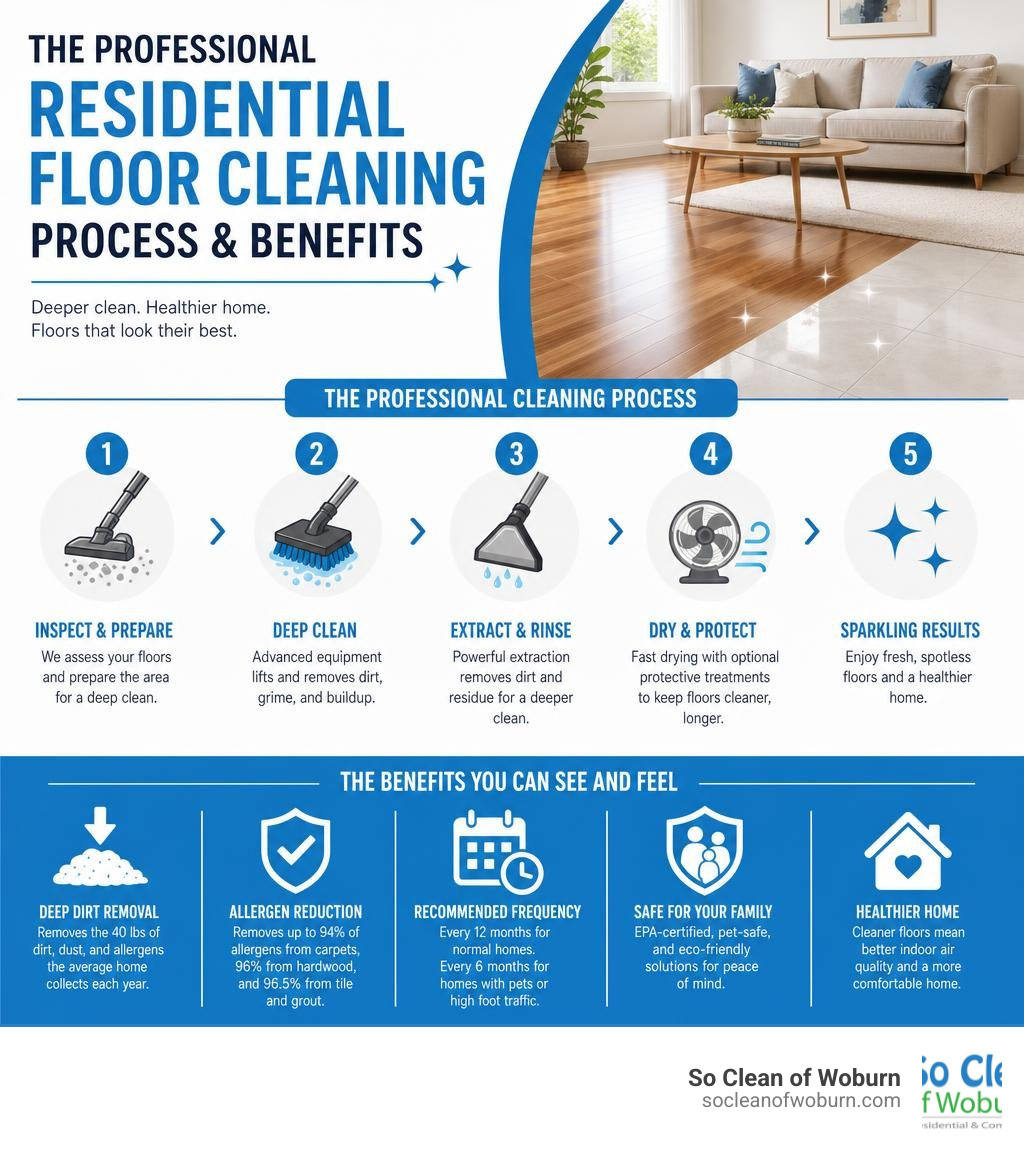
- Deep Dirt Removal: Standard sweeping and mopping only clean the surface. Professional extraction removes the 40 lbs of dirt, dust, and allergens that the average home collects each year.
- Allergen Reduction: Professional cleaning removes up to 94% of allergens from carpets, 96% from hardwood, and 96.5% from tile and grout.
- Frequency: Plan to schedule a professional deep clean every 12 months for normal homes, or every 6 months if you have pets or high foot traffic.
- Safety: Modern professional services use EPA-certified, pet-safe, and eco-friendly solutions to keep your family safe.
Mopping and vacuuming are great for weekly maintenance. However, daily foot traffic constantly forces tiny dirt particles deep into your carpet fibers, wood grain, and porous grout lines. Over time, this buildup dulls your floors and ruins your indoor air quality.
I’m Bill McGrath, owner of So Clean of Woburn and a veteran specialist in Residential Floor Cleaning across Massachusetts. With years of hands-on experience restoring local homes, I wrote this guide to help you get the cleanest floors possible with zero stress. Whether you are searching for affordable carpet cleaning $25 a room near me, professional hardwood floor cleaning near me, or specialized tile floor cleaning services, we have you covered.
The Core Methods of Professional Residential Floor Cleaning
Understanding how professional teams clean your floors is the first step toward choosing the right service. Different materials require wildly different approaches. If you use the wrong method, you risk warping wood, cracking grout, or ruining delicate carpet fibers.
When you hire a professional team, they don’t just show up with a standard mop and bucket. They utilize advanced extraction systems, customized pressure levels, and specialized cleaning agents designed for specific materials.
For a complete overview of what we can handle in your home, check out our comprehensive Floor Cleaning Services. Let’s break down the primary high-tech methods used by the pros.
Hot Water Extraction and Deep Steam Cleaning
For carpets and heavily soiled rugs, hot water extraction—often referred to as deep steam cleaning—is the industry gold standard. It is a common misconception that this process uses actual steam. Instead, it relies on highly pressurized, heated water mixed with eco-friendly cleaning agents to break down dirt.
Before the wet cleaning even begins, professional carpet cleaning removes about 80% of all dry soil and dirt through commercial-grade pre-vacuuming. Once the loose debris is gone, we apply a specialized pre-treatment to break down tough oils and spots.
Next, our high-pressure extraction machine pumps heated water deep into the carpet fibers and immediately sucks it back out into a powerful recovery tank. This dual action flushes out the deepest soil, pet dander, and dust mites, extracting up to 95% of the moisture so your carpets dry quickly—typically within 3 to 5 hours. If you want your home to look and feel refreshed, our Professional Floor Cleaning Services are designed to deliver exactly that.
Low-Moisture and Smart Tech Solutions
While carpets thrive on hot water extraction, hardwood, laminate, and engineered wood require the exact opposite: low-moisture care. Excess water is the natural enemy of wood flooring, often leading to swelling, buckling, and permanent structural damage.
To clean hard surfaces safely, we use specialized low-moisture scrubbing machines. These professional-grade scrubbers utilize counter-rotating brushes that gently lift dirt from the fine grain of the wood without saturating it. The machine immediately vacuums up the dirty solution, leaving the wood clean and dry within seconds.
For your daily or weekly maintenance between professional visits, modern smart home technology can make a massive difference. High-end cordless wet-dry vacuums are excellent for keeping up with pet hair and light spills. If you are looking to upgrade your home cleaning routine, you can explore some of the Best Floor Cleaning Products on the market.
For instance, smart tools like the Tineco FLOOR ONE S3 Extreme use intelligent sensors to detect wet and dry messes, automatically adjusting suction and water flow. For homes with tight spaces under furniture, the Dreame H12 Pro FlexReach offers a highly flexible, lie-flat design that minimizes water streaks.
Other premium options, such as the Tineco FLOOR ONE S9 Master, feature continuous hot water mopping, while the Tineco FLOOR ONE S6 Master and the Tineco FLOOR ONE i6 Stretch utilize heated air self-drying systems to prevent mold and odors on the brush rollers. While these consumer products are perfect for daily maintenance, they are meant to complement, not replace, periodic professional deep extraction.
Tailored Care for Every Surface: Hardwood, Tile, and Stone
Every home has a unique mix of flooring materials. A single house in Arlington, MA or Belmont, MA might feature historic oak hardwood in the living room, ceramic tile in the kitchen, and natural slate in the entryway. A professional cleaning crew always begins with a thorough surface inspection to identify the exact materials and determine the safest pH-neutral cleaners and protective sealants to use.

Hardwood Floor Preservation
Hardwood floors add timeless elegance and substantial value to Massachusetts homes. However, dirt and grit act like sandpaper underfoot, slowly wearing down the protective finish and exposing the raw wood grain underneath.
Our professional wood floor preservation process goes far beyond what a household mop can achieve:
- Inspection & Prep: We check for pre-existing scratches, water damage, and wear patterns. Next, we vacuum the floor to remove surface grit.
- Deep Extraction Scrubbing: Using specialized machines with a low-moisture, pH-neutral cleaner, we extract deeply embedded dirt from the wood grain and fine scratches.
- Detailing: We hand-clean corners and edges where machines cannot reach.
- Maintenance Coat: We apply a streak-free protective finish that restores the floor’s natural shine, hides minor scratches, and adds a fresh layer of defense against daily wear.
Regularly scheduling this service every 12 months will dramatically extend the lifespan of your wood floors, helping you avoid the massive mess and expense of full sanding and refinishing. To learn more about protecting your investment, visit our Hardwood Floor Cleaning Service page.
Tile and Grout Restoration
Tile floors are incredibly durable, but their grout lines are highly porous. Grout acts like a magnet for dirty mop water, grease, spills, and bacteria. Over time, light grout turns dark and dingy, and no amount of manual scrubbing seems to bring it back to life.

Our professional restoration process completely revitalizes your tile surfaces. We start by applying an eco-friendly, alkaline pre-spray degreaser to loosen embedded grease and soil. Next, we use a high-pressure washing system that combines hot water and powerful vacuum extraction. This system blasts away dirt from deep inside the grout pores while instantly capturing the dirty water, ensuring no messy puddles are left behind.
If your grout has permanent staining, we can perform a professional grout recoloring service. We apply a premium epoxy acrylic color sealant (which is far more durable than standard latex paint) to the grout lines. This not only restores a beautifully uniform color but also seals the grout to prevent future stains and mold growth. Explore our specialized Tile Floor Cleaning Services to see how we can make your kitchen and bathroom floors look brand new again.
Natural Stone Polishing and Sealing
Natural stone floors like travertine, slate, granite, and marble require incredibly gentle care. Because these stones are highly sensitive to acids, standard household cleaners can etch the surface, leaving dull, cloudy spots that are difficult to repair.
When cleaning natural stone, we strictly use specialized pH-neutral cleaners. We also adjust our equipment settings to protect the stone. For sensitive surfaces like slate or travertine, we reduce our machine pressure to 800–1000 PSI and utilize a protective brush ring to prevent scratching.
After a gentle deep clean, we can polish the stone to restore its natural, elegant luster and apply a premium penetrating sealer. This protective barrier sinks into the stone’s pores, giving you precious extra time to wipe up accidental spills before they can cause permanent stains.
Professional Solutions for Tough Stains, Odors, and Mold
Life happens. Whether it’s a spilled glass of red wine, a muddy pet tracking through the house, or a hidden plumbing leak, residential floors face serious challenges.
Dealing with Pet Stains and Odors
When pets have accidents on carpets or area rugs, the liquid quickly penetrates deep into the backing and the subfloor underneath. Standard retail spot cleaners only mask the smell temporarily. As the product dries, the urine salts crystallize, and the odor returns—often triggered by humid summer days in Massachusetts.
We tackle pet stains and odors at the source using advanced, professional-grade enzyme treatments. These biological enzymes break down the organic compounds in urine, feces, and vomit, completely eliminating the odor-causing bacteria rather than just covering it up. Our specialized extraction process removes more than 90% of most stains with relative ease, leaving your carpets clean, sanitized, and smelling fresh.
Mold Remediation and Allergen Reduction
In damp areas like basements or bathrooms, mold can begin colonizing on porous grout or carpet backing in as little as 24 to 48 hours after moisture exposure. This poses serious health risks, particularly for family members with asthma or allergies.
Our deep cleaning and extraction processes remove up to 96.5% of allergens from tile and grout, and 94% from carpets. By utilizing HEPA-filtered vacuum systems and professional-grade sanitizers, we neutralize mold spores and allergens, creating a healthier indoor environment for your entire family.
Why Professional Residential Floor Cleaning Beats DIY
Many homeowners attempt to clean their floors using rented carpet cleaners or grocery store products. While DIY cleaning seems cost-effective upfront, it often leads to disappointing results—and can even cause permanent damage to your floors.
| Feature | Professional Cleaning (So Clean of Woburn) | DIY / Rental Methods |
|---|---|---|
| Equipment Power | Commercial-grade truck-mounted or high-powered portable extraction systems. | Low-powered rental units with weak suction and minimal water pressure. |
| Allergen Removal | Removes up to 94% of allergens from carpet and 96.5% from tile/grout. | Often stirs up dust and allergens without fully extracting them. |
| Moisture Control | Extracts up to 95% of water; carpets dry in 3–5 hours, preventing mold. | Leaves carpets oversaturated; can take 24+ hours to dry, risking mold growth. |
| Chemical Residue | Specialized, eco-friendly, child- and pet-safe rinses that leave zero sticky residue. | Retail cleaners often leave a soapy residue that actually attracts dirt faster. |
| Risk of Damage | Certified technicians adjust pressure, temperature, and pH for your specific floor type. | High risk of warping wood, stripping finishes, or bleaching carpet fibers. |
By partnering with certified Professional Floor Cleaners, you save valuable time, protect your home investment, and enjoy a level of deep clean that consumer equipment simply cannot match.
What to Expect During Your Residential Floor Cleaning Appointment
We want your cleaning day to be completely seamless and stress-free. Here is exactly what you can expect when our professional team arrives at your home:
- Pre-Inspection Walkthrough: Our technicians will walk through the service areas with you to identify specific stain concerns, discuss floor types, and explain the expected results.
- Careful Preparation: We protect your baseboards, walls, and adjacent flooring with corner guards and protective drop cloths.
- Furniture Moving: We can carefully move light furniture (such as chairs, coffee tables, and small rugs) out of the cleaning zone and place protective blocks under heavier items.
- The Deep Clean: Using our specialized multi-step process, we pre-treat, deep-clean, and extract dirt from your floors.
- Post-Cleaning Care & Grooming: For carpets, we groom the fibers to promote fast, even drying. For hard surfaces, we apply any requested sealants or finishes.
- Final Walkthrough: We review the completed work with you to ensure you are absolutely thrilled with the results.
To make sure your booking process is just as smooth, check out our guide on How to Find the Best Floor Cleaning Near Me Without Losing Your Mind.
Frequently Asked Questions About Residential Floor Cleaning
How often should I schedule professional floor cleaning?
For the average home, we highly recommend scheduling a professional deep clean every 12 months to maintain your floor’s appearance and protect its warranty. However, if you have pets, young children, or high foot traffic, you should schedule a cleaning every 6 months to keep allergens, dirt, and odors at bay.
Are professional floor cleaning products safe for pets and children?
Absolutely! At So Clean of Woburn, we prioritize the health of your family and pets. We use eco-friendly, EPA-certified, and non-toxic cleaning solutions that thoroughly clean your floors without leaving behind any harsh chemical residues or strong odors.
How should I prepare my home before the cleaners arrive?
To help us provide the most efficient service, we suggest taking a few quick preparation steps:
- Clear the Clutter: Pick up toys, shoes, and loose items from the floors we will be cleaning.
- Secure Your Pets: Place your pets in a safe, quiet room away from the cleaning area, as our equipment can sometimes be loud.
- Remove Fragile Items: Move valuable or fragile items from tables and countertops in the cleaning zone to prevent any accidental bumps.
Conclusion
Your home’s floors are a major investment, and keeping them clean is essential for both your home’s beauty and your family’s health. While daily sweeping and vacuuming are important, nothing compares to the deep, restorative clean of a professional service.
At So Clean of Woburn, we are proud to offer customized, high-quality floor care solutions throughout Middlesex and Essex Counties. From restoring the warmth of your hardwood to bringing the sparkle back to your tile and grout, our team is dedicated to providing impressive results at affordable prices.
Ready to experience the difference of truly clean floors? Schedule Commercial and Residential Floor Cleaning Services with So Clean of Woburn today, and let us help you protect and revitalize your home!
What Are House Cleaning Services — and Are They Worth It?
House cleaning services are professional teams that clean your home on a schedule that works for you — weekly, bi-weekly, monthly, or as a one-time visit.
Here’s a quick overview of what they typically include:
- Standard cleaning — dusting, vacuuming, mopping, and sanitizing kitchens and bathrooms
- Deep cleaning — scrubbing baseboards, cleaning behind appliances, and tackling built-up grime
- Move-in/move-out cleaning — thorough top-to-bottom cleans for transitions
- Specialty services — post-renovation cleanup, eco-friendly cleaning, short-term rental turnovers
- Add-ons — oven cleaning, fridge cleaning, window washing, and more
Most professional services bring their own supplies, are fully insured and background-checked, and offer a satisfaction guarantee.
Between work, family, and everything else, most people simply don’t have time to keep their home as clean as they’d like. A dirty home isn’t just stressful to look at — it can affect your health. Dust, allergens, and bacteria build up fast, especially in high-traffic areas like kitchens and bathrooms.
Professional cleaners don’t just tidy up. They follow structured checklists and use professional-grade products to deliver a level of clean that’s genuinely hard to match on your own.
I’m Bill McGrath, owner of So Clean of Woburn, and I’ve spent years helping families and professionals across the Greater Boston area experience the real difference that reliable house cleaning services make in daily life. In this guide, I’ll walk you through everything you need to know — from choosing the right service to understanding what you’ll pay.
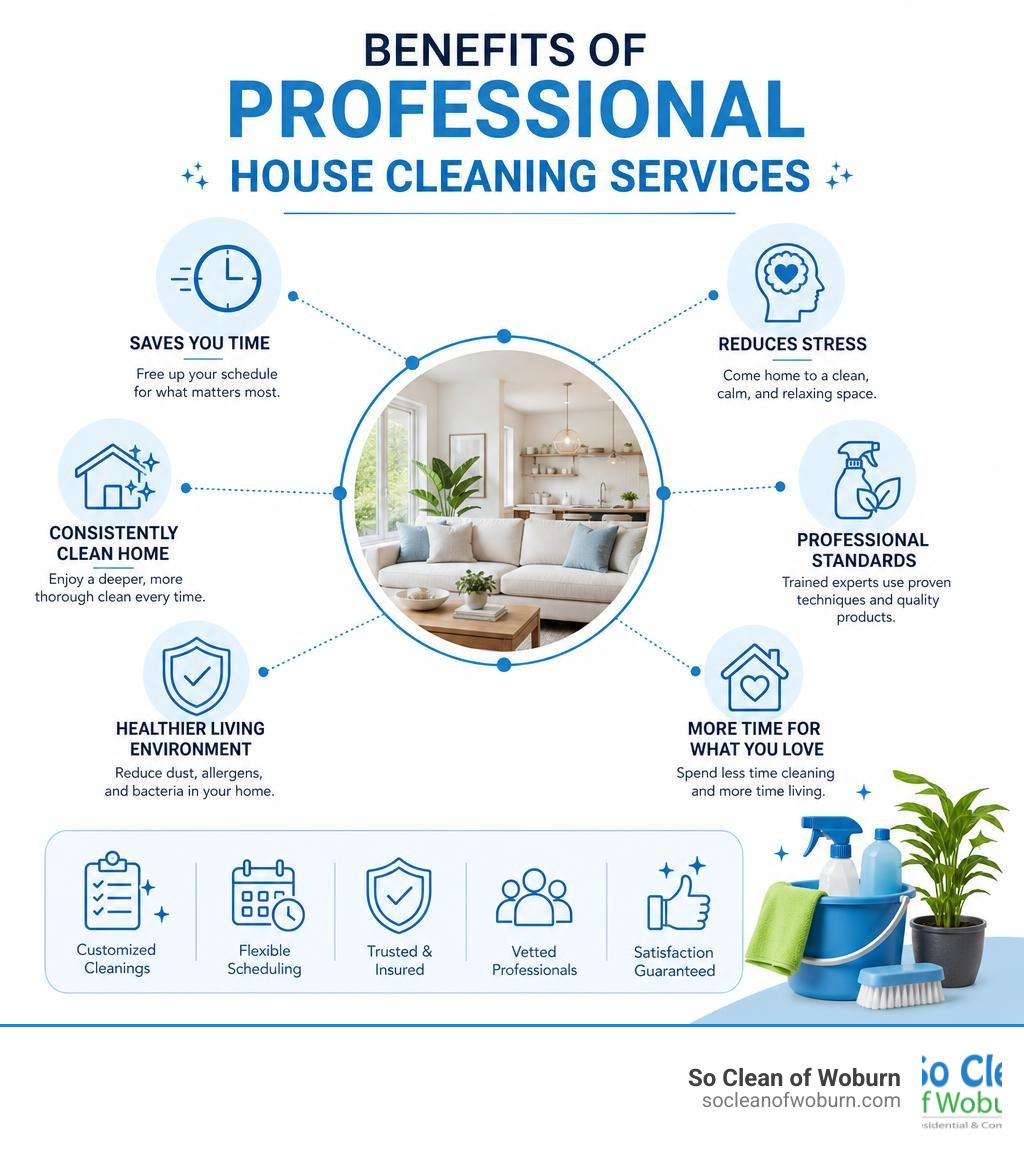
Quick look at House Cleaning Services:
Choosing the Right House Cleaning Services for Your Home

Finding the right team to welcome into your personal space is a decision that requires trust, clear communication, and a clear understanding of your household’s unique needs. Every home is a distinct ecosystem. A busy family home with three kids and two golden retrievers in Arlington requires a completely different approach than a minimalist, pet-free apartment in downtown Boston.
When searching for the perfect fit, you will find that the best companies do not offer rigid, one-size-fits-all packages. Instead, they provide customized cleaning plans designed to match your lifestyle, budget, and specific priorities.
The secret to a successful partnership lies in identifying your primary goals. Are you looking to reclaim your weekends so you can spend them at the park with your kids? Or are you trying to manage chronic allergies by keeping dust mites and pet dander at bay? By understanding The Secret to a Spotless Home: Unpacking House Cleaning Services, you can better evaluate how different service packages align with your daily routine. Your Guide to a Healthier Home: Choosing the Right Cleaning Service will help you focus on companies that prioritize health, consistency, and safety alongside cosmetic cleanliness.
Recurring Maintenance and Deep Cleaning
For most households, the key to maintaining a peaceful environment is consistency. This is where recurring maintenance visits come in. These visits are designed to keep your home at a baseline level of cleanliness so that grime never has the chance to build up.
- Weekly Services: This is the ultimate luxury for busy, high-traffic households. If you have multiple children, active pets, or a demanding work schedule in Cambridge or Somerville, weekly visits ensure that bathrooms are sanitized, floors are mopped, and dust is kept at bay before it can accumulate.
- Bi-Weekly Services: This is our most popular scheduling option. It strikes the perfect balance between affordability and maintenance. For many homes, a professional visit every two weeks is exactly what is needed to keep the kitchen sparkling and the carpets thoroughly vacuumed. You can read more about this in our Bi-Weekly House Cleaning Complete Guide.
- Monthly Services: Best for lower-traffic homes or individuals who do a great job of tidying up themselves but want a professional backup to handle the heavy lifting once a month.
While recurring visits keep things looking beautiful, they rely on your home having received a deep clean first. A deep clean is a highly detailed, labor-intensive process. While a standard clean focuses on surface-level dust, vacuuming, and wiping, a deep clean targets built-up grime, baseboards, door frames, window tracks, light switches, and the areas behind and under lighter furniture. Regular maintenance is much more effective once this deep baseline is established, as detailed in our guide on Maintaining a Clean Home.
Specialty and Eco-Friendly House Cleaning Services
Sometimes life presents transitions or projects that require specialized cleaning solutions. If you are preparing to move, the last thing you want to worry about while packing boxes is scrubbing the interior of kitchen cabinets or wiping down baseboards.
- Move-In Cleaning: This service ensures that your new home is a completely sanitized, fresh blank canvas before your furniture arrives. We clean inside closets, wash the interiors of cabinets, and disinfect every square inch so you can unpack with absolute peace of mind.
- Move-Out Cleaning: If you are renting in Boston or Malden, a professional move-out clean is often the key to securing your security deposit return. For sellers, it ensures the home looks pristine for open houses and final walkthroughs.
- Post-Renovation Cleanup: Home improvements are exciting, but they leave behind a fine, highly invasive dust that settles on every surface, inside drawers, and on light fixtures. Specialty post-construction cleaning uses heavy-duty HEPA filtration vacuums and detailed wiping techniques to make your newly renovated space livable.
- Eco-Friendly Cleaning: More than ever, homeowners are looking to minimize their environmental footprint and limit their exposure to harsh synthetic chemicals. Our Green House Cleaning services utilize certified non-toxic, biodegradable products that are tough on grease and grime but completely safe for your family, your pets, and the local waterways of Massachusetts. To learn more about how we protect both your indoor air quality and the planet, explore our Eco-Friendly Cleaning Complete Guide.
Tailored Support for Seniors and Allergy Sufferers
Professional home cleaning is not just about aesthetics; for many, it is a vital form of support that directly impacts physical health and independence.
For our senior neighbors living in communities like Winchester, Lexington, or Woburn, keeping up with physical chores like vacuuming, scrubbing tubs, or bending down to clean baseboards can become difficult or even unsafe. Tailored home care provides gentle, respectful assistance that allows seniors to maintain their independence in a clean, hazard-free environment. If you or a loved one could benefit from this, please read our guides on House Cleaning Services for Seniors and Deep Cleaning Services for Seniors.
For allergy and asthma sufferers, a professional clean can be life-changing. Indoor air can contain high concentrations of dust mites, pet dander, pollen, and mold spores. Reputable cleaning services address this by utilizing advanced HEPA (High-Efficiency Particulate Air) filtration vacuums, which capture 99.97% of particles as small as 0.3 microns—preventing them from being recirculated into your breathing zone. Combined with microfiber cloths that trap dust rather than merely spreading it around, professional cleaning significantly improves indoor air quality and reduces respiratory irritation.
The Cost of Professional Care: Rates and Pricing Factors
One of the most common questions homeowners have is: How much is this going to cost? We believe in absolute pricing transparency. The home cleaning industry has evolved significantly; gone are the days when a company had to perform an invasive, high-pressure in-home walkthrough just to give you a basic price. Today, reputable companies can provide highly accurate, transparent quotes online or over the phone using simple metrics like square footage, the number of bedrooms and bathrooms, and the overall condition of the home.
To get a complete breakdown of what to expect financially, you can review our comprehensive House Cleaning Cost Guide or read our article on How Much Does House Cleaning Cost.
Understanding Flat-Rate vs. Hourly House Cleaning Services
When comparing quotes from different local providers, you will generally run into two primary pricing structures: hourly rates and flat-rate fees.
- Hourly Rates: Under an hourly model, you pay for the exact amount of time the cleaners spend in your home. This is highly flexible and works well if you only want a partial clean or have a specific, rotating list of tasks (e.g., “please spend three hours focusing only on the kitchen and bathrooms”). However, the downside is predictability—if a team encounters stubborn grime, the cost can quickly climb beyond your budget.
- Flat-Rate Fees: Flat-rate pricing is based on the size of your home and the specific scope of work requested. This is the model we highly recommend for recurring services because it offers total predictability. You know exactly what the service will cost before the cleaners even arrive, regardless of whether a particular visit takes a little longer than usual.
To dive deeper into which model makes the most sense for your household, check out our guide From Hourly to Flat Fee: Understanding House Cleaning Rates and read about general House Cleaning Rates.
Key Factors That Influence Your Cleaning Quote
Several distinct variables influence the final quote for your home:
- Home Size & Layout: Naturally, a large historical home in Andover will take longer to clean than a modern condo in Somerville.
- Number of Bathrooms: Bathrooms are the most labor-intensive rooms in any house, requiring detailed scrubbing of tile, grout, glass doors, toilets, and fixtures.
- Pet Hair and Dander: Pets bring endless joy, but they also bring shedding. Homes with heavy shedding pets require specialized vacuuming and dust removal, which can add to the initial labor time.
- Frequency of Service: Interestingly, recurring services are more affordable per visit than one-time services. This is because a home cleaned every two weeks is much easier to maintain than a home that hasn’t been professionally cleaned in six months.
To give you an idea of standard pricing in the Greater Boston area (encompassing Middlesex and Essex counties), a standard recurring cleaning for a typical 2,000-square-foot home generally averages between $150 and $300 per visit. For massive estates, complex layouts, or intensive deep-cleaning projects, high-end professional rates can reach up to $600—which is exactly double our average baseline.
Here is a quick comparison table to help you visualize how these factors interact:
| Home Size (Sq. Ft.) | Bedrooms / Baths | Service Type | Average Cost Range | High-End / Deep Clean Rate |
|---|---|---|---|---|
| Under 1,500 | 1-2 Bed / 1-1.5 Bath | Recurring (Bi-Weekly) | $130 – $180 | Up to $360 |
| 1,500 – 2,500 | 3 Bed / 2 Bath | Recurring (Bi-Weekly) | $160 – $250 | Up to $500 |
| 2,500 – 3,500 | 4 Bed / 2.5+ Bath | Recurring (Bi-Weekly) | $220 – $300 | Up to $600 |
| Any Size | Custom | One-Time Deep Clean | $250 – $450 | Up to $900+ |
Professional Standards: Vetting, Training, and Safety Protocols

When you hire a professional service, you are not just paying for a clean home. You are paying for security, reliability, and peace of mind. A truly professional cleaning company treats its staff as its most valuable asset, investing heavily in recruitment, screening, and continuous education.
To understand what separates a premium, structured service from an independent, under-the-table cleaner, you can read our Professional Residential Cleaners Guide.
Background Checks, Insurance, and Bonding
Let’s talk about the administrative protections that keep you safe. Many homeowners do not realize the immense financial risk they take when hiring an independent cleaner who is not properly insured.
- Criminal Background Checks: Every single employee who steps foot in your home must undergo rigorous, multi-state background checks. This is a non-negotiable safety standard.
- General Liability Insurance: If an accident happens, such as a cleaner accidentally dropping a heavy vacuum on a delicate hardwood step or scratching a high-end marble countertop, liability insurance ensures that the cost of repairs is fully covered, protecting you from out-of-pocket expenses.
- Bonding Protection: Bonding protects you against any rare instances of theft or missing property, providing an extra layer of financial security.
- Workers’ Compensation: If an independent, uninsured cleaner slips on a wet tile floor in your bathroom, you as the homeowner could potentially be held liable for their medical bills. A professional company carries full workers’ compensation insurance for all its employees, completely removing this risk from your shoulders.
Green Seal Products and Hospital-Grade Disinfectants
The products used in your home have a direct impact on your health, your furniture, and the environment. Historically, the cleaning industry relied on harsh, ammonia- and bleach-based chemicals that left behind strong, eye-watering fumes. In 2026, we know that clean does not have to smell like chemicals.
We prioritize using products that carry the Green Seal certification. You can learn more about the standard from the independent nonprofit Green Seal, which evaluates products against strict environmental and health criteria. These products are designed to be biodegradable, non-toxic, and free of carcinogenic compounds while still delivering professional-grade cleaning power.
For high-touch sanitization, we combine these green products with targeted, hospital-grade disinfectants in areas like toilets and kitchen sinks to eliminate 99.9% of harmful pathogens without compromising your indoor air quality. If you are ready to eliminate toxic residues from your living space, explore our guide: Ditch the Toxins: Find Your Perfect Healthy House Cleaner Today.
Frequently Asked Questions About House Cleaning Services
We understand that you might have a few logistical questions before booking your first appointment. Here are the answers to the most common questions we hear from homeowners in Middlesex and Essex counties.
Do I need to be home during my cleaning appointment?
No, you do not need to be home! In fact, the vast majority of our recurring clients prefer to be away while we clean. It is incredibly satisfying to leave for work in the morning and return home to a sparkling clean, fresh-smelling house at the end of the day.
To facilitate this, we offer highly secure keyless entry options. You can provide us with a garage keypad code, a secure lockbox code, or leave a spare key with our office. All keys are strictly coded and kept in a secure safe when not in use by your designated cleaning team.
What is your cancellation and rescheduling policy?
We know that life in the Greater Boston area can be unpredictable. Kids get sick, business trips get rescheduled, and holiday plans change.
We simply ask for a minimum of two business days’ notice if you need to reschedule or cancel an upcoming visit. This allows us enough time to adjust our teams’ schedules and offer the open slot to another family on our waiting list. If your regular cleaning day happens to fall on a major holiday, we will reach out to you well in advance to arrange an alternative day so your home doesn’t miss a beat.
How do professional cleaners handle pets?
We are absolute animal lovers, and we want your pets to feel safe and comfortable while we work! During our initial booking conversation, we will ask you about your pets’ names, temperaments, and where they prefer to hang out.
- Kid- and Pet-Safe Products: Because we use non-toxic, hypoallergenic cleaning agents, you never have to worry if your dog or cat licks the kitchen floor right after we’ve finished mopping it.
- Pet Comfort: If your dog gets anxious around vacuums, we can arrange to clean their favorite room last while they hang out in a secure area, or you can leave them in a comfortable crate or room of your choice.
- Secure Entries: Our teams are highly trained to be incredibly careful when opening exterior doors, ensuring that indoor cats or curious pups don’t slip outside.
Conclusion
At the end of the day, outsourcing your home chores to a professional service is not an indulgence—it is a practical investment in your time, your mental clarity, and your physical health. Coming home to a clean space allows you to focus on what truly matters, whether that’s spending quality time with your family, focusing on your career, or simply relaxing on the weekend.
If you are looking for a reliable, local, and highly professional partner in the Greater Boston area, So Clean of Woburn is here to help. We proudly serve communities across Middlesex and Essex counties—including Woburn, Burlington, Lexington, Winchester, Reading, Wakefield, Stoneham, and Andover—delivering customized, affordable, and eco-friendly cleaning solutions that make a real difference. For general cleaning guidelines in the state, see House Cleaning Massachusetts.
Ready to experience the joy of a truly spotless home? Get a customized quote today and let us take the hard work off your hands!
The Best Floor Cleaner for Vinyl Plank: What Actually Works
Finding the best floor cleaner for vinyl plank is one of the most common questions homeowners ask after installing new LVP floors — and for good reason. Use the wrong product and you can dull the finish, void your warranty, or even cause permanent damage.
Here are the top options at a glance:
| Product | Best For | Avg. Price Range |
|---|---|---|
| Bona Hard-Surface Floor Cleaner | Daily maintenance, streak-free clean | $8 – $20 |
| Rejuvenate Luxury Vinyl Floor Cleaner | General cleaning + shine | $10 – $25 |
| Quick Shine Multi Surface Floor Finish | Restoring gloss and shine | $10 – $25 |
| Zep Neutral pH Industrial Floor Cleaner | High-traffic and commercial use | $15 – $35 |
| COREtec ENCORE Floor Cleaner | Brand-matched LVP cleaning | $12 – $30 |
| Better Life Floor Cleaner | Plant-based, eco-friendly homes | $10 – $22 |
The short answer: use a pH-neutral, residue-free cleaner made specifically for vinyl or hard-surface floors. Avoid ammonia, bleach, wax, and oil-based soaps — these damage the protective wear layer on LVP over time.
Vinyl plank flooring is tough, but it’s not indestructible. It has a factory-applied wear layer that protects it from daily scuffs and moisture. The wrong cleaner strips that layer — slowly and silently — until your floors look dull, streaky, or discolored.
The good news? Keeping LVP floors clean is simple when you know what to use.
I’m Bill McGrath, owner of So Clean of Woburn, and with years of professional residential and commercial cleaning experience across Greater Boston, I’ve seen how the right best floor cleaner for vinyl plank routine keeps floors looking brand new for years. In this guide, I’ll walk you through exactly what to use, what to avoid, and how to clean your LVP floors the right way.
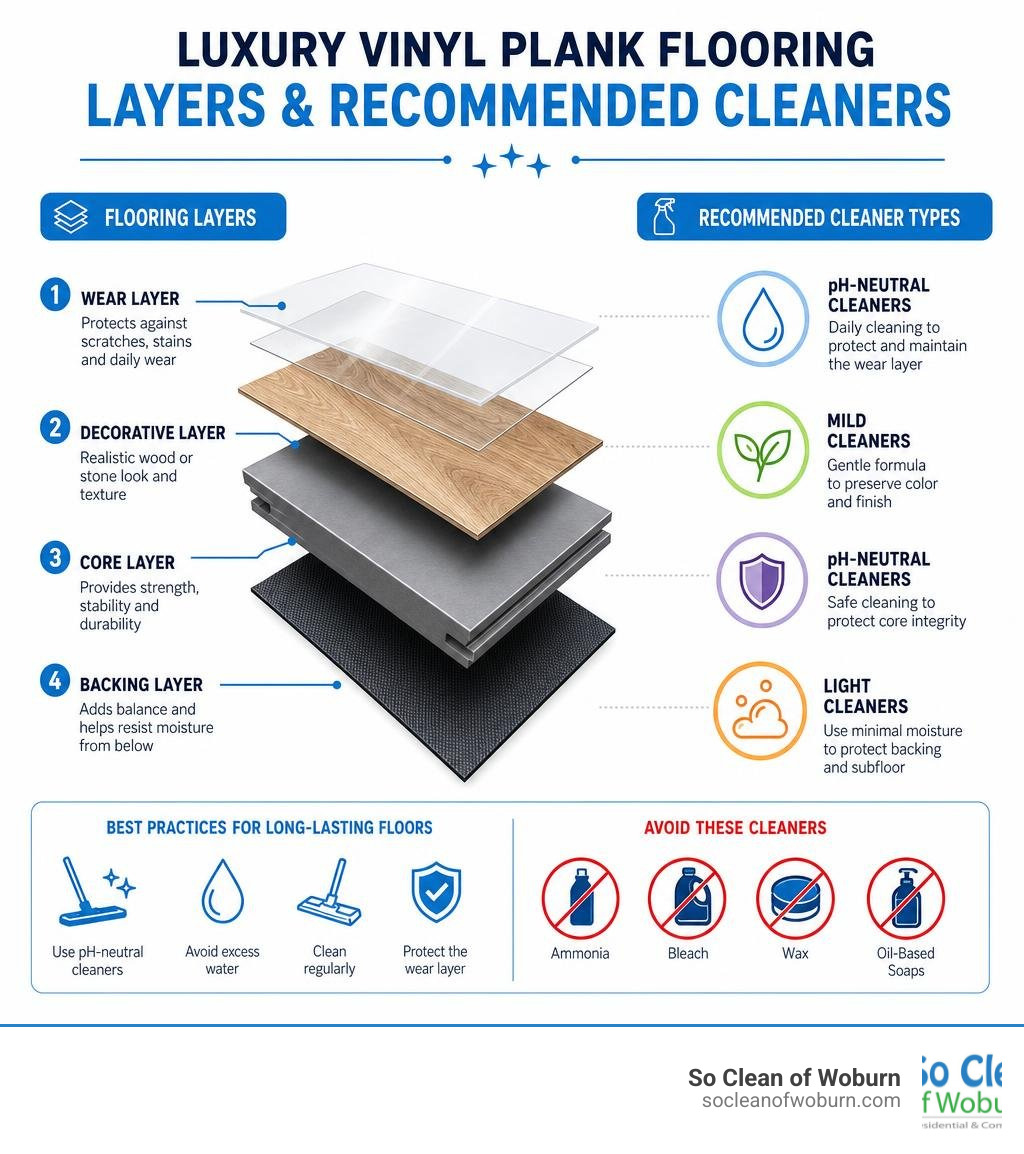
Discover more about best floor cleaner for vinyl plank:
What Makes the Best Floor Cleaner for Vinyl Plank Safe and Effective?
To understand what makes a product the best floor cleaner for vinyl plank, we have to look at how luxury vinyl plank (LVP) and luxury vinyl tile (LVT) are built. Unlike solid hardwood, vinyl planks are engineered in layers. The top layer, known as the wear layer, is a clear, factory-applied protective finish. This wear layer is what keeps dirt, moisture, and stains on the surface, preventing them from penetrating the core of your floor.
When selecting a cleaning solution, your primary goal is to preserve this wear layer. According to the experts at the Best Cleaning Products for Luxury Vinyl Plank (LVP) Floors guide, a safe and effective cleaner must have three key properties:
- pH-Neutral Formula: It should neither be highly acidic (like straight vinegar) nor highly alkaline (like bleach or ammonia).
- Residue-Free Performance: It must evaporate cleanly without leaving behind a sticky film that attracts more dust, pet dander, and footprints.
- Gentle Chemical Profile: It should dissolve grease and grime without eating away at the vinyl’s protective seal.
At So Clean of Woburn, we always emphasize to our clients in Middlesex County and the North Shore that choosing the right chemistry prevents the “dull floor syndrome.” Many homeowners believe their floors are wearing out when, in reality, they have simply built up layers of sticky cleaning residue. For a deeper dive into this, check out our guide on the Best Floor Cleaning Products.
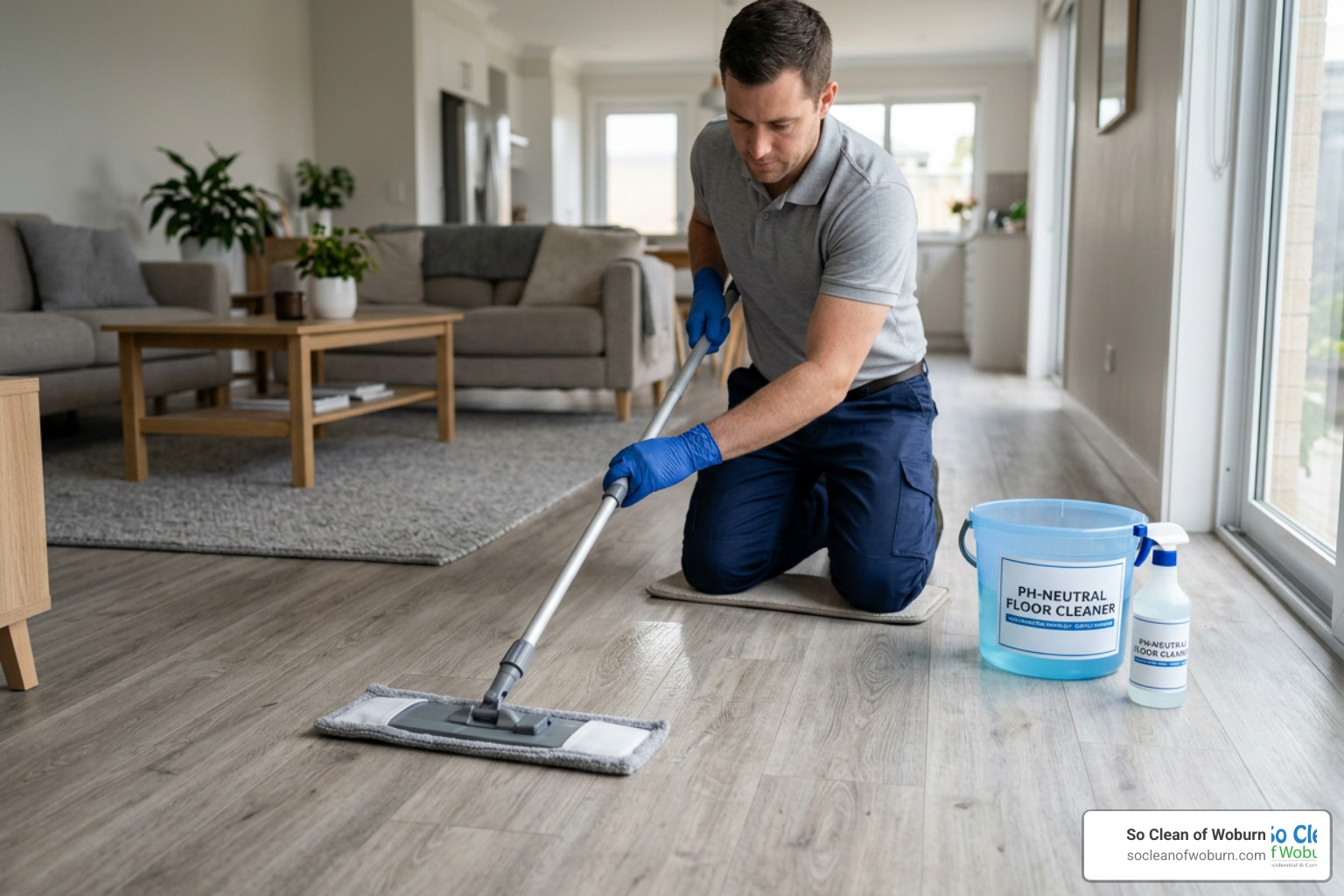
Key Ingredients to Avoid on LVP Floors
When shopping for cleaning products, reading the ingredient label is just as important as reading the front marketing panel. Some common household cleaners can cause irreparable damage to your vinyl planks:
- Ammonia: This harsh alkaline chemical can strip the factory-applied wear layer over time, leaving your planks vulnerable to scratches and looking completely lifeless.
- Bleach: While great for disinfecting non-porous bathroom tile, bleach is too harsh for vinyl flooring and can cause permanent discoloration or yellowing.
- Wax and Acrylic Polishes: Vinyl planks do not need to be waxed. Applying traditional wood wax or acrylic shines creates a build-up that requires professional chemical stripping to fix.
- Oil-Based Soaps: These leave a slick, greasy residue that dulls the finish and acts like a magnet for dirt, dust, and pet hair.
- Abrasive Scrubbers: Steel wool, stiff wire brushes, and abrasive scouring powders will scratch the wear layer, permanently ruining the floor’s sheen.
Why pH-Neutral Formulas Matter for Vinyl Planks
A pH-neutral cleaner sits right in the middle of the pH scale (around 7.0). This neutral balance is critical because it cleans without reacting chemically with the floor’s topcoat.
Using a highly acidic or alkaline cleaner can cause a chemical breakdown of the polyurethane or acrylic finish on your LVP. Over time, this chemical reaction leads to microscopic pitting, which dulls the floor’s natural gloss and makes it easier for dirt to become trapped. Furthermore, pH-neutral formulas are safer for your family, your pets, and our environment here in the Greater Boston area.
Top Commercial Products Compared
To help you find the perfect fit for your home, we have put together a comparison of the industry’s most popular commercial options.
When analyzing prices, we look at both the average retail price and the practical market range. To ensure a fair comparison, we use a standard pricing model where the high-end range limit represents twice the average market price of the product (for example, if a concentrated gallon averages $15, the high-end range extends up to $30 to account for premium packaging, spray kits, or specialty bundles).
| Brand & Product | Customer Rating | Key Feature | Average Price | Wide Price Range (Low to High-End) |
|---|---|---|---|---|
| Bona Hard-Surface Cleaner | 4.7 / 5 (20,443 reviews) | Plant-derived, streak-free | $14.00 | $7.00 – $28.00 |
| Quick Shine Multi Surface | 4.6 / 5 (15,159 reviews) | High-gloss restoration | $16.00 | $8.00 – $32.00 |
| Better Life Floor Cleaner | 4.5 / 5 (11,522 reviews) | 100% plant-based, safe | $13.00 | $6.50 – $26.00 |
| Zep Neutral pH Cleaner | 4.6 / 5 (5,203 reviews) | Concentrated, industrial | $20.00 | $10.00 – $40.00 |
| Rejuvenate Luxury Vinyl | 4.5 / 5 (4,281 reviews) | Specifically formulated | $15.00 | $7.50 – $30.00 |
| COREtec ENCORE Cleaner | 4.7 / 5 (1,337 reviews) | Approved for premium LVP | $22.00 | $11.00 – $44.00 |
For more tips on choosing commercial formulas, take a look at our expert guide, Walk on Sunshine: Top Products for Sparkling Floors.
Best Floor Cleaner for Vinyl Plank for Daily Maintenance
For your day-to-day cleaning routine, Bona Hard-Surface Floor Cleaner is an exceptional choice. It is EPA Safer Choice certified, meaning it uses safer, plant-derived, biodegradable ingredients.
The formula is completely rinse-free and dries incredibly fast without leaving streaks. For the best results, use it with a high-quality spray mop and a machine-washable microfiber pad. The fine mist spray prevents oversaturation, which is crucial for protecting the seams of your vinyl planks from moisture intrusion.
Best Floor Cleaner for Vinyl Plank for Restoring Shine
If your vinyl floors have lost their original luster due to age or improper cleaning habits, Quick Shine Multi Surface Floor Finish or Rejuvenate Luxury Vinyl Floor Cleaner can help restore that beautiful glow.
Unlike traditional wax, these modern formulations provide a protective polymer layer that fills in microscopic scratches without damaging the underlying vinyl. They dry to a beautiful, high-gloss shine that resists scuffing. However, remember to use these gloss restorers sparingly — once or twice a year is more than enough to maintain a stunning finish without causing product build-up.
Advanced Cleaning Tools and Wet-Dry Vacuums
While a simple microfiber mop works wonders, modern floor-cleaning technology has made maintaining luxury vinyl plank floors easier than ever. Cordless wet-dry vacuums have revolutionized hard floor care by combining vacuuming and mopping into one single, highly efficient step.

When using these advanced machines, we highly recommend products like the Tineco FLOOR ONE S7 Stretch Ultra Cordless Wet Dry Vacuum Cleaner. This premium tool features a 180-degree lay-flat design that allows you to clean easily under low furniture, along with a dual-sided edge cleaning system that gets right up against your baseboards. For a slightly lighter but equally smart option, the Tineco FLOOR ONE S5 Smart Wet Dry Vacuum Cleaner utilizes smart sensors to adjust water flow and suction dynamically depending on how dirty your floors are.
The Role of Steam Mops on Vinyl Flooring
A common question we receive from homeowners in Woburn, Burlington, and Lexington is: “Can I use a steam mop on my LVP floors?”
The short answer is no, unless your flooring manufacturer explicitly states otherwise.
While steam mops are incredible for sanitizing ceramic tile, the high-temperature steam (often exceeding 210°F at the nozzle) can severely damage vinyl planks. The intense heat can melt or weaken the adhesives holding the planks together, causing the edges to warp, cup, or buckle.
Even if you use a specialized machine like the Tineco FLOOR ONE S6 Stretch Steam Wet Dry Vacuum, which carefully manages steam output, you must proceed with extreme caution and only use the absolute lowest heat settings to protect the structural integrity of your floor.
Smart Wet-Dry Vacuums for Effortless Cleaning
If you want to skip the steam but still desire a deep, sanitary clean, smart wet-dry vacuums are the way to go. The Tineco FLOOR ONE S9 Master features continuous hot water mopping at a controlled 126°F, which easily loosens sticky kitchen messes and dried-on spills without exposing your vinyl to the dangerous, adhesive-melting temperatures of pressurized steam.
For busy households with pets, the Tineco FLOOR ONE i6 Stretch offers powerful 20,000Pa suction paired with an anti-tangle brush design, ensuring that pet hair and tracked-in dirt from your yard are swept away instantly, leaving your floors dry and streak-free in seconds.
Best Practices for Cleaning and Maintaining LVP Floors
Proper maintenance is about more than just finding the best floor cleaner for vinyl plank; it is also about establishing a consistent, protective routine. Here is our recommended blueprint for keeping your floors in pristine condition:
- Daily Sweeping: Run a soft-bristle broom or a dry microfiber dust mop over your floors daily. This removes abrasive dirt, sand, and grit that can act like sandpaper under foot traffic.
- Weekly Mopping: Clean your floors once a week using a damp microfiber mop and a pH-neutral cleaner. Avoid soaking the floors; your mop should be damp, not dripping wet.
- Furniture Protection: Place felt or rubber protector pads under all furniture legs, especially heavy items like dining tables, sofas, and chairs.
- Entryway Mats: Place high-quality doormats at all exterior entrances to trap dirt, moisture, and asphalt oils before they ever reach your vinyl planks.
If you are feeling overwhelmed by your cleaning routine, don’t worry! You can read our helpful guide on Don’t Sweep It Under the Rug: Finding Top Floor Cleaning Near Me for professional help.
Post-Installation Cleaning for New LVP
If you have just installed brand-new luxury vinyl planks in your home, congratulations! However, before you start cleaning, you must give the adhesive time to fully cure.
Avoid any wet cleaning or mopping for at least 48 to 72 hours after installation to prevent moisture from weakening the glue. During this initial period, stick to gentle sweeping or vacuuming (with the rotating beater bar turned off) to remove drywall dust and construction debris. Once the curing window has passed, perform your first light damp-mop using a clean, pH-neutral solution to reveal your floor’s true beauty.
Removing Scuffs and Stubborn Stains
Even with the best care, life happens. When tough stains or scuff marks appear, you don’t need harsh chemicals to remove them:
- For Rubber Heel Scuffs: Apply a few drops of jojoba oil or baby oil to a clean microfiber cloth and rub the scuff gently in a circular motion. Once the scuff lifts, wipe the area clean with a damp cloth to remove any oily residue.
- For Dried Food or Sticky Messes: Mix a small amount of baking soda with water to create a mild, non-abrasive paste. Apply it to the stain and gently rub with a soft nylon brush or microfiber cloth.
- For Ink, Marker, or Makeup: Dampen a clean cloth with a small amount of rubbing alcohol (isopropyl alcohol) and gently dab the stain. Rubbing alcohol evaporates quickly and is highly effective at dissolving pigment without harming the vinyl’s wear layer.
Frequently Asked Questions about Vinyl Plank Floor Care
Can I use a steam mop on luxury vinyl plank floors?
In almost all cases, no. The high heat and pressurized moisture of a steam mop can penetrate the seams between the planks, softening the adhesive underneath and causing the vinyl to warp, cup, or peel. Using a steam mop on LVP floors will also void the warranty of most major flooring manufacturers. Stick to microfiber damp mops or smart, low-temperature wet-dry vacuums instead.
How often should I clean my vinyl plank floors?
We recommend sweeping or dry-dusting your floors every one to two days to remove abrasive grit. For wet cleaning, a weekly or bi-weekly damp mopping with a pH-neutral cleaner is ideal for residential homes. High-traffic commercial spaces or homes with multiple pets may require more frequent damp mopping to maintain hygiene and shine.
Does vinegar damage vinyl plank flooring?
While highly concentrated, straight vinegar is too acidic and can slowly dull the protective wear layer of your floor over time, a highly diluted vinegar solution (such as one cup of white vinegar mixed with one gallon of warm water) is generally safe for occasional use. However, for daily or weekly maintenance, a commercially formulated, pH-neutral cleaner is always the safest and most reliable choice.
Conclusion
Your luxury vinyl plank floors are a beautiful, durable investment that can keep your home looking stunning for decades. By choosing a high-quality, pH-neutral cleaner, avoiding harsh chemicals like bleach and ammonia, and staying away from high-heat steam mops, you can easily preserve your floor’s protective wear layer and maintain its gorgeous, factory-fresh shine.
If you live in Woburn, Burlington, Reading, Winchester, or anywhere else in the Greater Boston area, and you would prefer to leave the deep cleaning to the experts, we are here to help! At So Clean of Woburn, we provide top-notch, customized residential and commercial cleaning solutions tailored to your home’s unique needs.
Let us handle the hard work so you can enjoy beautiful, sparkling floors without the stress. Contact us today or explore our professional Commercial Floor Cleaning Services to schedule your next service!
Why Finding the Right Floor Cleaning Near Me Matters
Quick Answer: Top Floor Cleaning Services Near You
Looking for a trusted local floor cleaner? Here’s what to look for:
- Licensed and insured professionals with verifiable reviews
- Services offered: carpet, hardwood, tile & grout, luxury vinyl plank (LVP), VCT, and concrete
- Average cost: $100-$500 for most residential jobs (national average is around $250)
- How often: Once or twice a year for most homes; up to four times yearly for pet owners or allergy sufferers
- Drying time: Most floors are ready to walk on within a few hours after cleaning
Finding reliable floor cleaning near me is one of those tasks that sounds simple – until you realize how much is riding on it.
Your floors take a beating every single day. Foot traffic, spills, pet dander, and dust grind into surfaces over time. Regular sweeping and mopping only scratch the surface. Meanwhile, dirt and allergens build up deep in carpet fibers and grout lines where no mop can reach. For broader context on why reducing dust and indoor pollutants matters, the EPA’s indoor air quality guidance explains how indoor air conditions can affect comfort and health.
The stakes are higher than most people think. Professional deep cleaning can remove up to 96.5% of common household allergens. And when you consider that replacing flooring in a 500-square-foot room can cost anywhere from $1,500 to $4,460, keeping your current floors well-maintained is just good math.
A clean floor isn’t just about looks – it’s about health, longevity, and protecting a real investment in your home or business.
I’m Bill McGrath, owner of So Clean of Woburn, and I’ve spent years helping homeowners and businesses across the Greater Boston area find smarter, more affordable solutions for floor cleaning near me. In this guide, I’ll walk you through everything you need to know to make the right call.
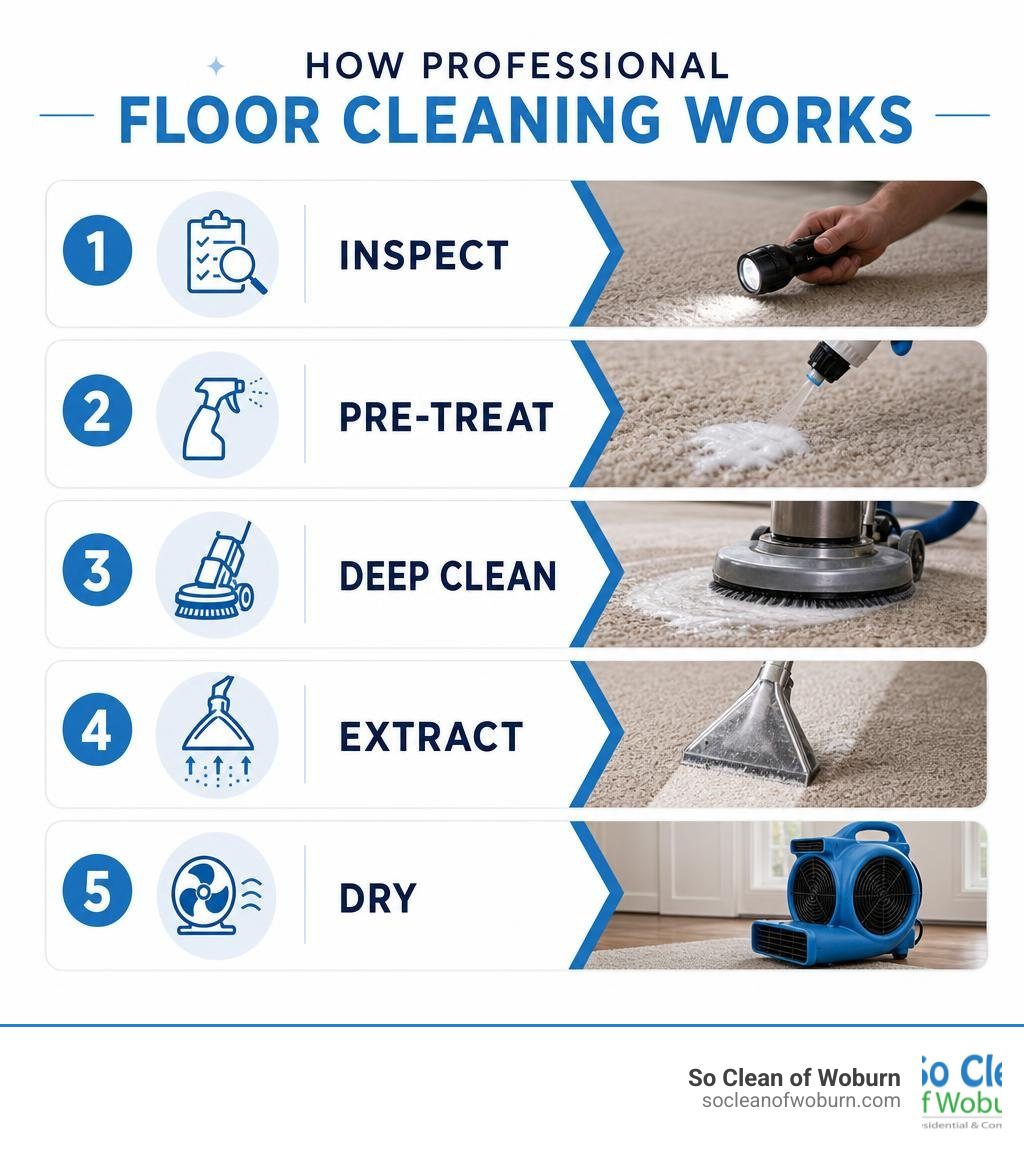
Common Floor Cleaning Near Me vocab:
- carpet cleaning $25 a room near me
- hardwood floor cleaning near me
- tile floor cleaning services
What to Expect from Professional Floor Cleaning Near Me
When searching for a Floor Cleaning Company Near Me, you shouldn’t have to guess what kind of service you’ll receive. Top-tier floor care starts long before the machines turn on. A reputable local company will always walk you through their process, starting with a clear, upfront inspection and a detailed estimate.
Licensing, Insurance, and Local Reputation
Never let a company touch your floors unless they are fully licensed, bonded, and insured. Professional floor care involves heavy machinery, high-pressure water, and specialized chemical solutions. Insurance protects your property in the rare event of an accident.
To find a reputable provider in your local area, check their customer reviews across platforms like Google and Yelp. A strong track record of five-star reviews from neighbors in your town is the best indicator of quality. Whether you need residential floor care in Belmont, specialized carpet cleaning in Arlington, or commercial floor maintenance in Lynnfield and Beverly, choosing a local expert with deep roots in the community ensures you get the personalized service you deserve.
Satisfaction Guarantees and Preparation
A great local floor cleaner will stand behind their work with a solid satisfaction policy. Many top-rated companies offer a satisfaction guarantee (often ranging from 14 to 30 days), meaning if a stubborn spot resurfaces or a section doesn’t meet your standards, they will return to make it right at no extra charge.
Before your technicians arrive, there are a few simple preparation steps you can take to ensure the appointment goes smoothly:
- Clear the clutter: Pick up toys, shoes, and lightweight decorative items from the floor.
- Secure your pets: The noise of commercial vacuums and truck-mounted extractors can be stressful for animals. Keep them safe in a closed room or take them out for a walk.
- Pre-vacuum (optional but helpful): While professionals will prep the floors, removing loose pet hair and surface crumbs beforehand allows them to focus immediately on deep grime extraction.
Residential vs. Commercial Floor Cleaning Near Me
The difference between residential and commercial floor cleaning comes down to scale, equipment, and foot traffic. While a home floor focuses on comfort, pet stain removal, and family-safe sanitization, commercial spaces require heavy-duty durability to protect high-traffic investments.
| Feature | Residential Floor Cleaning | Commercial Floor Cleaning |
|---|---|---|
| Primary Goal | Allergen removal, stain extraction, home comfort | High-durability protection, slip resistance, professional appearance |
| Common Materials | Carpet, hardwood, tile, luxury vinyl plank (LVP) | VCT (Vinyl Composite Tile), sealed concrete, industrial carpet, terrazzo |
| Cleaning Frequency | 1 to 2 times per year | Monthly, quarterly, or customized weekly programs |
| Key Methods | Hot water extraction, low-moisture cleaning | High-speed buffing, floor stripping & waxing, heavy industrial scrubbing |
Whether you need to refresh your living room carpets or require heavy-duty Commercial Floor Cleaning Services, choosing a provider that understands these unique differences ensures your floors are treated with the exact chemistry and machinery they require.
Specialized Floor Cleaning Near Me for Different Materials
Different flooring materials cannot be cleaned the same way. Using the wrong chemical or too much water on a delicate surface can ruin your investment. A professional team will design a material-specific cleaning plan tailored to your home or facility:
- Hardwood Floors: Hardwood is beautiful but sensitive to moisture. A professional Hardwood Floor Cleaning Service uses specialized wood-safe scrubbers and low-moisture extraction to lift embedded dirt out of the grain without warping the wood. We follow this up with a protective finish to restore that rich, warm glow.
- Carpet Care: Carpets act like giant air filters, trapping dust, pollen, and pet dander. Over time, these particles get ground into the backing. Deep carpet extraction pulls these irritants out, instantly improving your indoor air quality.
- Tile & Grout: Grout is incredibly porous, meaning it acts like a sponge for dirty mop water, grease, and bacteria. Standard mopping just pushes dirt around. Professional Tile Floor Cleaning Services use high-pressure, heated water systems combined with specialized extraction to blast dirt out of the pores, followed by a professional sealant to keep stains out.
- Luxury Vinyl Plank (LVP) & VCT: LVP has become incredibly popular in Massachusetts homes, while VCT remains a commercial staple. Both require specialized, pH-neutral cleaners to avoid stripping the protective factory wear layer. For older VCT floors, professional stripping and waxing is the only way to remove yellowed, scratched wax layers and lay down a pristine, glossy protective shield.
Advanced Methods and Equipment Used by Local Experts
To achieve deep, lasting results, professional floor cleaning relies on heavy-duty equipment and advanced chemistry that residential rental machines simply cannot match. Here is a look at the industry-standard methods we use to restore your floors:
Hot Water Extraction (Deep Steam Cleaning)
Often referred to as steam cleaning, hot water extraction is the gold standard for carpets and upholstery. This process uses a powerful truck-mounted system to pump heated water and eco-friendly cleaning solutions deep into the carpet fibers at high pressure.
Simultaneously, dual-jet extraction wands vacuum the dirty water back out into a waste tank in the truck. Because truck-mounted systems operate with incredible suction power, they extract up to 95% of the water, leaving your carpets slightly damp rather than soaking wet, which drastically speeds up drying times.
Floor Stripping and Waxing
Over time, the protective wax coating on commercial VCT, linoleum, or terrazzo floors scratches, discolors, and traps dirt. To fix this, Professional Floor Cleaners perform a complete “strip and wax”:
- Stripping: A highly effective, floor-safe chemical solution is applied to dissolve the old, dirty layers of wax.
- Agitation: Heavy-duty rotary floor machines scrub away the loosened wax.
- Extraction & Neutralization: The slurry is vacuumed up, and the floor is thoroughly rinsed and neutralized.
- Waxing: Multiple layers of high-quality, slip-resistant polymer finish are applied, leaving a brilliant, mirror-like shine that protects the floor from scuffs and moisture.
Old, Scratched Wax ---> Chemical Stripping & Scrubbing ---> Rinse & Neutralize ---> Apply Fresh Polymer Coats ---> High-Gloss, Protected Floor
The Cost of Professional Floor Care in Massachusetts and New Hampshire
Understanding the cost of professional floor maintenance helps you budget effectively. On average, homeowners spend about $250 on professional floor cleaning. Depending on the size of your home and the specific services required, you can expect a wide price range of $100 to $500 for standard residential projects.
Several key factors will influence where your final estimate lands:
- Flooring Material: Cleaning carpet or luxury vinyl plank is generally more straightforward than restoring hardwood or tackling heavily soiled tile.
- Square Footage: Larger areas require more time and materials, though many companies offer multi-room discounts or bundled service packages.
- Soil Level & Stain Treatment: Heavy pet stains, deep grease buildup, or odor removal require specialized pre-treatments and extra labor.
- Tile and Grout Specifics: Professional tile and grout cleaning typically costs between $0.50 to $3.50 per square foot, which is an incredibly cost-effective alternative to complete tile replacement.
Investing in regular Floor Cleaning Services is a smart financial decision. When you compare the modest cost of annual maintenance to the $1,500 to $4,460 cost of installing brand-new flooring in a 500-square-foot room, keeping your current floors in top shape easily pays for itself by extending their lifespan by decades.
Frequently Asked Questions About Floor Cleaning
How often should I schedule professional floor cleaning?
For most residential homes, we recommend scheduling a professional deep clean once or twice per year to remove set-in stains, resolve fine scratches, and keep your indoor air clean.
However, if you have a busy household with children, multiple pets, or family members who suffer from severe seasonal allergies, increasing that frequency to four times per year is highly recommended. For commercial spaces, high-traffic areas like entryways and hallways may need monthly or quarterly maintenance to preserve their professional appearance and slip-resistant safety.
Are the cleaning solutions safe for pets and children?
Yes, reputable modern floor cleaners prioritize the health of your family. We utilize eco-friendly, pet-safe, and non-toxic cleaning formulas that break down dirt and oils without leaving behind harsh chemical residues.
We also recommend using Best Floor Cleaning Products that are certified safe for indoor environments. Combined with our high-powered extraction equipment, your floors are left clean, residue-free, and perfectly safe for tiny hands and paws to crawl on.
How long does the cleaning process take and when can I walk on the floors?
The duration of the service depends on the size of the area, but most residential jobs take between 1 to 3 hours.
As for drying times, it varies by floor type:
- Hardwood and Tile: These dry very quickly and are usually ready for foot traffic within 30 to 60 minutes.
- Carpets: Thanks to our high-powered truck-mounted vacuums, carpets typically dry within 2 to 6 hours.
We recommend keeping pets and heavy foot traffic off the floors until they are completely dry to prevent tracking in fresh outdoor dirt. If you must walk on them sooner, wearing clean white socks is a great way to protect the damp fibers.
Conclusion
Your floors are one of the first things people notice when they walk into your home or business. Over time, daily wear and tear can dull their appearance and trap microscopic allergens that regular sweeping just can’t reach.
At So Clean of Woburn, we are proud to serve communities across the Greater Boston area, including Middlesex County, Essex County, and the North Shore. We specialize in providing top-notch, customized residential and commercial floor care at affordable prices. Our mission is simple: to deliver impressive, lasting results that create a healthier environment for your family, guests, and employees.
If your floors are ready for a professional refresh, don’t wait for the dirt to settle. Contact us today to explore our customizable Commercial Floor Cleaning Services and residential packages, and let us help you bring your floors back to life!
Why Finding the Best Bathroom Tile Scrubber Saves You Time and Energy
If you’re looking for the best bathroom tile scrubber, here’s a quick answer before we dive in:
Top Bathroom Tile Scrubbers at a Glance:
| Scrubber | Type | Best For | Runtime |
|---|---|---|---|
| Hoto Electric Spin Scrubber | Electric | Best Overall | 110 min |
| Casabella Power Spin | Electric Handheld | Longest Battery | 150 min |
| Rubbermaid Reveal Kit | Electric | Most Versatile | N/A |
| Black+Decker Power Scrubber | Electric | Grout Cleaning | N/A |
| Scotch-Brite Non-Scratch | Manual | Budget Pick | N/A |
Soap scum. Grout stains. Hard-to-reach corners. Bathroom tile cleaning is one of those chores that eats up your weekend — and your knees.
For busy professionals who already have enough on their plate, scrubbing tile by hand isn’t just tedious. It’s exhausting. And doing it wrong can mean streaky grout and scratched surfaces.
The good news? The right scrubber changes everything. After testing 22 bathroom scrubbers, experts found that electric spin scrubbers can cut cleaning time and effort significantly — especially models with extendable handles that let you clean shower walls and floors without bending or kneeling.
I’m Bill McGrath, owner of So Clean of Woburn, one of Greater Boston’s most trusted residential and commercial cleaning companies. With years of hands-on experience helping Massachusetts and New Hampshire homeowners keep their bathrooms spotless, I know exactly what separates a great best bathroom tile scrubber from one that wastes your money. Below, I’ll walk you through the top picks so you can spend less time scrubbing and more time living.
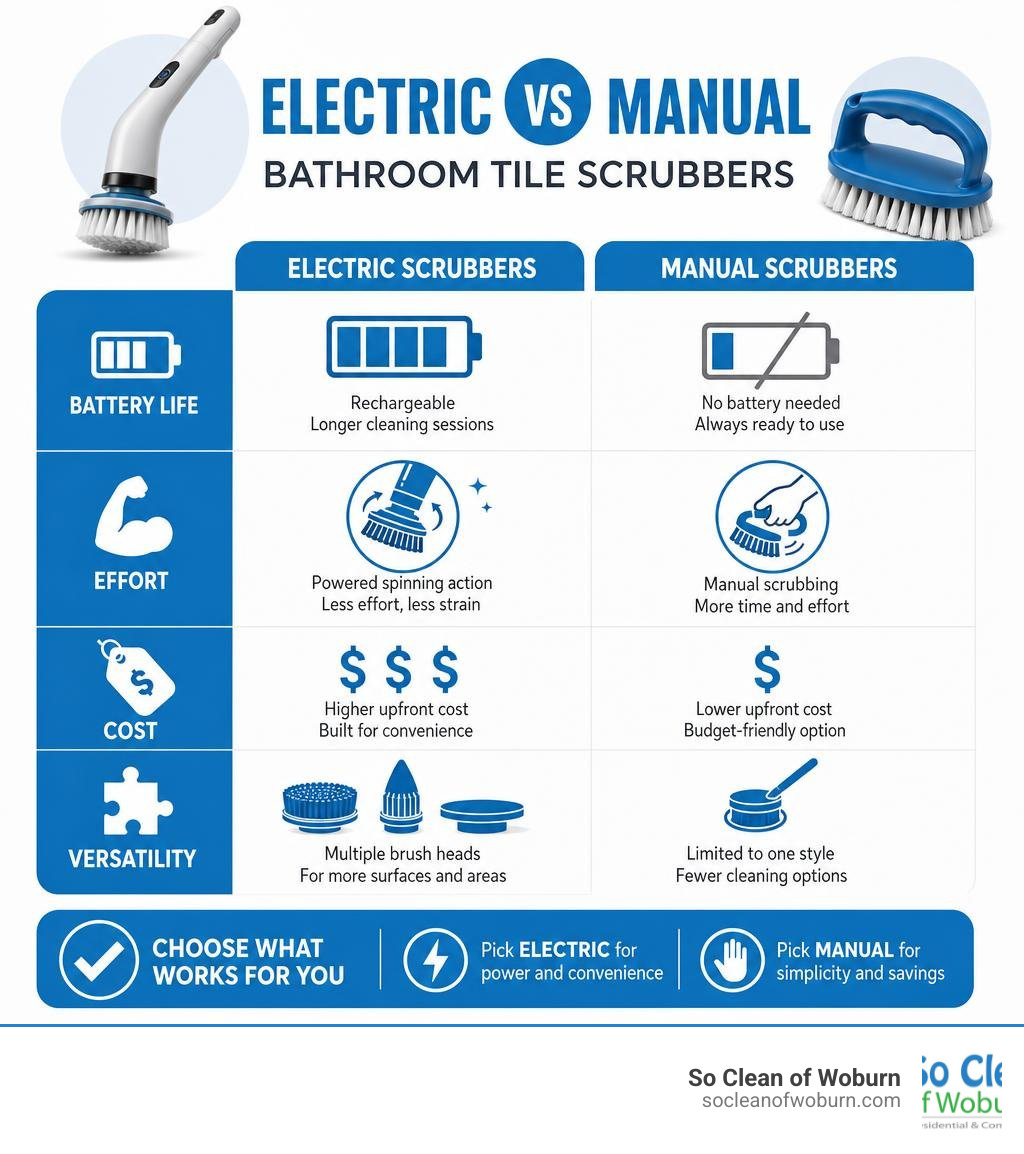
Related content about best bathroom tile scrubber:
Top-Rated Electric and Manual Scrubbers of 2026
When evaluating the market’s leading cleaning tools, we look beyond the flashy marketing claims. In our industry, we need tools that can withstand continuous use and deliver reliable results across different types of tile, from durable porcelain to delicate natural stone.
Our team analyzed the most rigorous lab reports and consumer feedback to compile this definitive list of the top scrubbers available in June 2026. According to the authoritative Best Power Scrubbers, Lab-Tested and Reviewed , the single biggest differentiator between a high-performing power scrubber and a subpar model is battery life. While some budget options sputter out after just 10 minutes, top-tier models can run for over an hour, allowing you to clean multiple bathrooms on a single charge.
Below is a detailed comparison of the top-rated models tested in real-world conditions:
| Scrubber Model | Type | Max Runtime | Key Strength | Best Suited For |
|---|---|---|---|---|
| Hoto Electric Spin Scrubber | Electric (Extendable) | 110 Minutes | Longest extendable runtime, 6 attachments | Large walk-in showers and high tile walls |
| Casabella Power Spin | Electric (Handheld) | 150 Minutes | Unmatched battery life for a handheld | Detailed tub and sink scrubbing |
| Amiluo Electric Spin Scrubber | Electric (Extendable) | Up to 360 Minutes (Med) / 1200 RPM | High-torque motor, dual 3000mAh batteries | Heavy-duty commercial and residential deep cleans |
| Rubbermaid Reveal Power Scrubber | Electric (Detail) | Battery Powered (AA) | 18-piece accessory kit for tight spaces | Grout lines, fixtures, and window tracks |
| Black+Decker Power Scrubber | Electric (Handheld) | N/A | Fully submersible, highly lightweight | In-shower daily touch-ups |
| Scotch-Brite Non-Scratch Scrubber | Manual (Extendable) | Unlimited | No-scratch recycled fibers, budget-friendly | Quick weekly maintenance without charging |
No matter if you are looking for Bathroom Deep Cleaners Near Me or simply trying to upgrade your own cleaning closet in Arlington, Waltham, or Winchester, choosing the right tool makes all the difference. Let’s take a closer look at these top performers.
Why the Hoto Electric Spin Scrubber is the Best Bathroom Tile Scrubber Overall
If you want a tool that does almost all the heavy lifting for you, the Hoto Electric Spin Scrubber is the undisputed champion. During comprehensive hands-on testing of 22 different bathroom scrubbers, this model consistently rose to the top.
What makes it the best bathroom tile scrubber overall? For starters, it features a robust rechargeable battery that delivers over 100 minutes (specifically clocked at 110 minutes) of continuous cleaning power on a full charge. This is a massive contrast to older electric models like the Bell + Howell Scrubtastic, which often lose power after a mere 10 minutes.
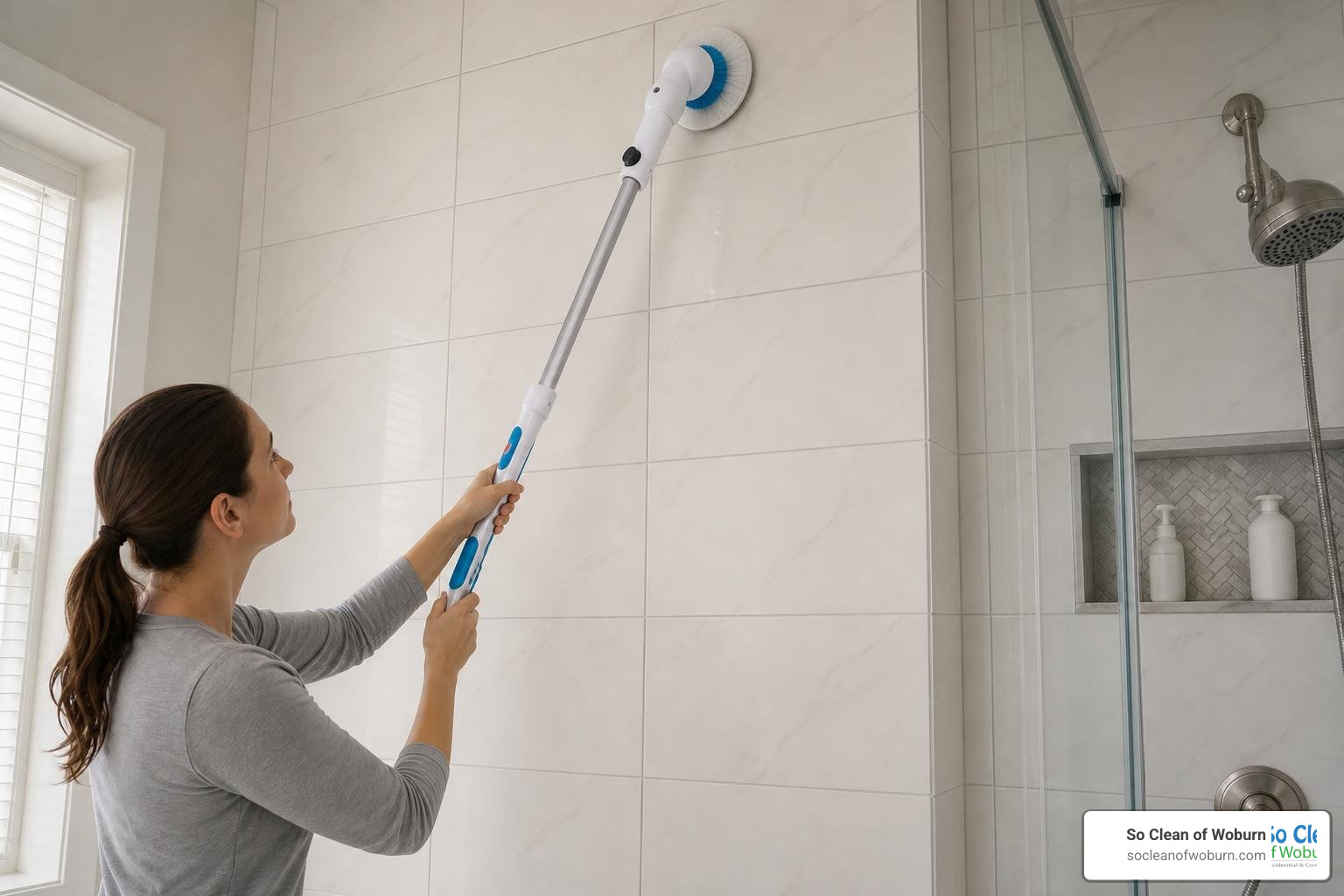
Additionally, the Hoto model comes equipped with six versatile attachments, allowing you to swap from a wide flat brush for floor tiles to a pointed brush designed specifically for tight corner grout lines. Its extendable handle reaches up to 51.2 inches, saving your back and knees from the strain of leaning over a tub or climbing a slippery step stool to reach the top of your shower enclosure. It completely revolutionizes the way we think about home cleaning, a sentiment echoed by users in The Laziest way to clean your Bathroom – Electric Spin Scrubber .
Finding the Best Bathroom Tile Scrubber for Grout and Tight Corners
While large extendable scrubbers are fantastic for open walls, grout lines and tight corners require a more surgical approach. For detailed tile work, we highly recommend the Rubbermaid Reveal Power Scrubber Starter Kit. This handy tool operates like an oversized electric toothbrush, oscillating rapidly to shake loose stubborn dirt from grout lines. The starter kit is incredibly versatile, packed with 18 different accessories and pad refills to tackle everything from shower door tracks to the grime behind bathroom faucets.
For those facing thick, mineral-heavy buildup, the Amiluo Electric Spin Scrubber, 6000mAh Ultra-Large Battery, 1200 RPM C is an absolute powerhouse. Boasting a massive 6000mAh total battery capacity and a motor that spins up to an incredible 1200 RPM, it provides the high torque necessary to strip away years of buildup.
If you prefer a highly durable, water-resistant option, the Amiluo Upgraded Electric Spin Scrubber upgraded spin scrubber variants and the Cordless Tile Scrubber by Sharper Image | Electric Power Scrubber offer excellent alternatives. The Sharper Image model features a motorized head that spins up to 270 RPM and adjusts to multiple angles (90°, 145°, and 180°), making it easy to scrub around awkward plumbing fixtures.
For a budget-friendly electric option, the Scrubtastic Electric Spin Scrubber Brush, Multipurpose Tile Cleaner for Bathroom, Rechargeable Power Scrubber with 3 Rotating Brush Heads – Walmart.com provides solid performance with over 300 RPM of cleaning power and a run time of 30+ minutes, proving that you don’t have to break the bank to go cordless.
Best Budget Manual Option: Scotch-Brite Non-Scratch Tub & Tile Scrubber
Sometimes, you don’t want to worry about charging batteries, or you just need to do a quick, silent touch-up while the kids are sleeping. That is where a high-quality manual scrubber shines.
The Scotch-Brite® Non-Scratch Tub & Tile Scrubber | 3M United States is our top manual recommendation. Its scrubbing fibers are made from 100% recycled content, making it an excellent pairing for those who practice eco-friendly home care. The non-scratch head is specially engineered to cut through hard water stains, limescale, and soap scum without leaving microscopic scratches on your glossy ceramic or acrylic surfaces.
If you have higher walls or want to avoid bending down altogether, you can opt for the Scotch-Brite® Non-Scratch Extendable Tub & Tile Scrubber | 3M United States , which extends over 25 inches. It is lightweight, highly affordable, and uses easily replaceable scrubber pads so you can keep the same handle for years.
How to Choose the Best Bathroom Tile Scrubber for Your Home
Selecting the best bathroom tile scrubber depends heavily on your bathroom’s layout, your physical comfort, and the specific types of tile you have. If you live in an older home in Cambridge or Somerville with historic, delicate tile work, your needs will differ from someone cleaning a modern, large-format porcelain shower in Burlington or Woburn.
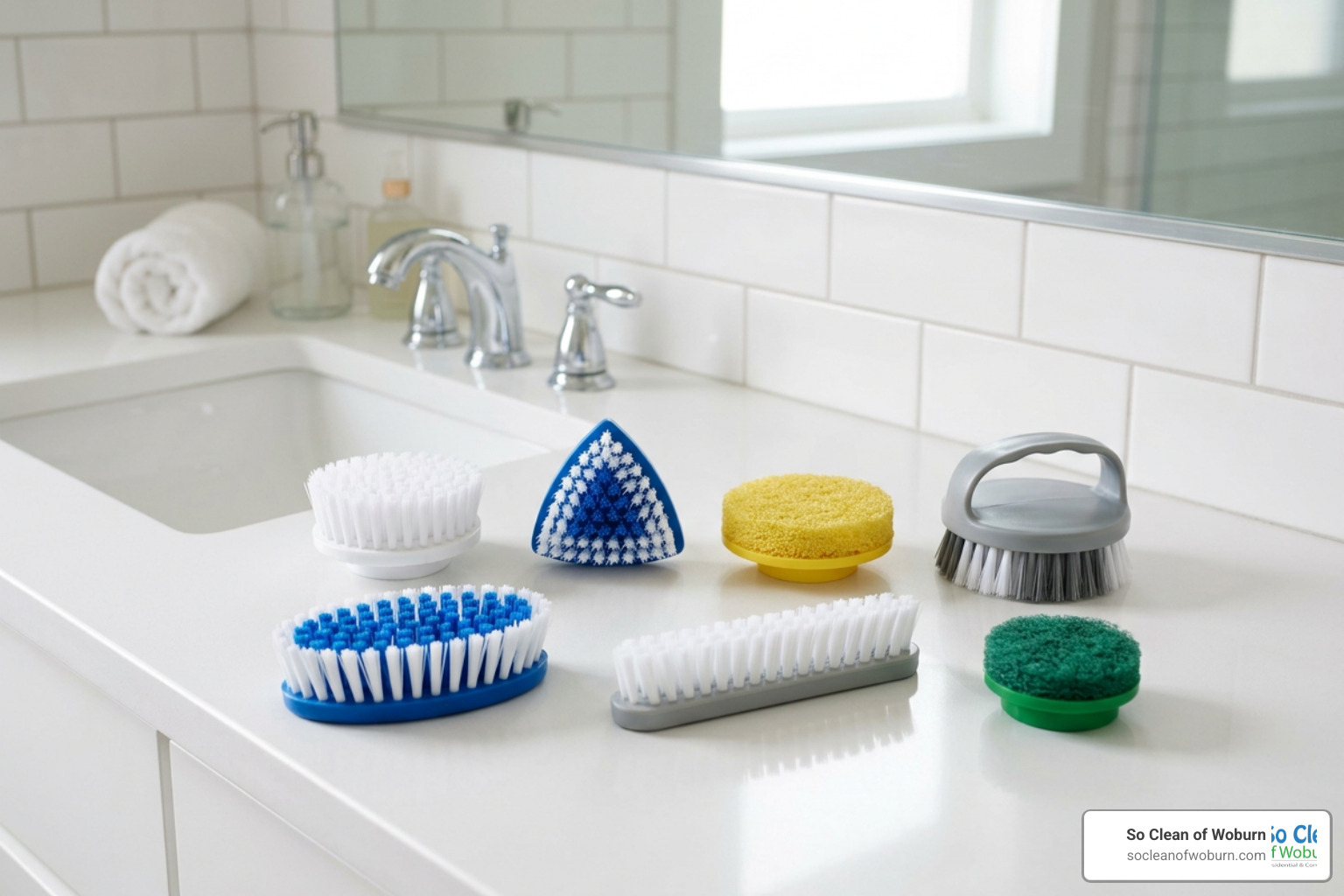
When shopping for a scrubber, keep these core factors in mind:
- Weight and Balance: Electric scrubbers with long extension poles can sometimes feel top-heavy. Look for models with ergonomic, non-slip rubber grips and balanced weight distribution.
- Surface Compatibility: Ensure the brush bristles or pads are rated for your specific tile. Hard, stiff nylon bristles are excellent for grout but can dull fiberglass or acrylic tubs.
- Chemical Compatibility: If you prefer using a Non-Toxic Bathroom Cleaner, ensure your scrubber’s pads can tolerate natural acids like citric acid or white vinegar without disintegrating.
Electric Spin Scrubbers vs. Manual Scrubbers
Are electric scrubbers truly worth the investment, or should you stick to a trusty manual brush? The answer depends on your cleaning style and physical needs.
- Electric Spin Scrubbers: These tools use motorized rotation (typically between 300 and 1200 RPM) to do the physical scrubbing for you. They are a game-changer for anyone suffering from arthritis, chronic back pain, or shoulder fatigue. They cut cleaning times in half and are incredibly effective at lifting deep-set soap scum.
- Manual Scrubbers: Manual brushes offer unmatched precision and control. You can feel exactly how much pressure you are applying, which is crucial when working around delicate grout or custom hand-painted tiles. They require no charging, have no electronic parts that can fail, and are highly cost-effective.
For the ultimate cleaning routine, we often recommend a hybrid approach: use an electric spin scrubber for your weekly deep cleans, and keep a manual scrubber on hand for quick daily touch-ups. If you are managing a larger building, implementing these tools alongside Green Cleaning Eco-Friendly Practices for Apartment Buildings can keep common areas sparkling with minimal labor.
Key Features: Battery Life, RPM, and Waterproofing
If you decide to go the electric route, pay close attention to these three technical specifications:
- Waterproofing (IPX Rating): Since you are working in a wet environment, waterproofing is vital. Look for a scrubber with at least an IPX7 waterproof rating on the brush head. This means the head can be safely submerged in a tub of water without short-circuiting. Note: Never submerge the entire handle or charging port unless the manufacturer explicitly states it is fully submersible.
- Rotations Per Minute (RPM): General cleaning requires about 300 RPM. For heavy-duty stains, look for dual-speed models that can ramp up to 400 RPM or higher.
- Battery Life and Pricing: Avoid models that require constant AA battery replacements, as these costs add up quickly. Instead, opt for rechargeable lithium-ion models.
To help you budget, high-quality bathroom scrubbers typically feature a wide range of pricing. The price ranges from $15 to $80 with premium models at $80 which is double the average $40 cost. Investing in a mid-to-high-range rechargeable model will save you money in the long run compared to cheap, disposable alternatives.
Step-by-Step Guide to Deep Cleaning Bathroom Tiles and Grout
Even the best bathroom tile scrubber needs a little help from the right cleaning agents to tackle stubborn stains. Here is our professional, step-by-step guide to achieving sparkling results using safe, eco-friendly methods:
Step 1: Steam Up the Room
Before you start scrubbing, turn your shower on to its hottest setting and let the bathroom fill with steam for 5 to 10 minutes. The heat and moisture will open up the pores of ceramic tiles and soften hardened soap scum, making it significantly easier to remove.
Step 2: Apply a Natural Cleaning Paste
Instead of harsh chemical fumes, mix a simple paste of baking soda and water, or follow our Green Bathroom Cleaner Guide to create a highly effective, non-toxic cleaner. Apply the paste directly to your grout lines and heavily soiled tile areas.
Step 3: Spray with White Vinegar
Lightly spray the baking soda paste with white vinegar. The resulting bubbling reaction naturally breaks down mineral deposits, limescale, and grease. Let it sit for 5 minutes.
Step 4: Let the Scrubber Do the Work
Attach a medium-stiff cone or flat brush to your electric spin scrubber. Turn it on to a low or medium speed, and glide it gently along the grout lines and tile faces. Let the spinning motion do the work — there is no need to press down hard, as too much pressure can stall the motor or wear down the bristles prematurely.
Step 5: Rinse and Dry
Rinse the walls thoroughly with warm water. Finally, use a squeegee or a clean microfiber cloth to dry the tiles. Drying the surfaces is the single best way to prevent new mold, mildew, and water spots from forming!
If you prefer to make your own cleaning solutions, you can find more excellent recipes in our guide to the Best Natural Cleaners.
Frequently Asked Questions about Bathroom Tile Scrubbers
Will an electric spin scrubber scratch my delicate bathroom tiles?
Generally, no. Most electric scrubbers are packaged with nylon bristles that are firm enough to clean but soft enough to prevent scratching glazed ceramic or porcelain tiles. However, if you have delicate natural stone (like marble or travertine) or acrylic panels, you should avoid stiff bristles. Instead, use soft microfiber or non-scratch sponge attachments, and always test a small, hidden area before cleaning the entire space.
How long do the batteries typically last on electric scrubbers?
Battery life varies dramatically by model. Budget-friendly or older wand scrubbers may only last 10 to 30 minutes. However, top-rated modern models like the Hoto Electric Spin Scrubber run for 110 minutes, and the Casabella Power Spin Handheld Scrubber offers up to 150 minutes of continuous runtime. Always charge your device using the manufacturer-recommended adapter (usually a 5V/2A adapter rather than a computer USB port) to protect the battery’s long-term health.
How often should I replace the scrubber brush heads?
For optimal cleaning performance and hygiene, you should replace your scrubber brush heads every 3 to 6 months, or as soon as you notice the bristles becoming frayed, bent, or permanently discolored. To prevent mold and mildew growth, always rinse your brush heads thoroughly under clean water after each use and hang them up to air-dry completely.
Conclusion
Finding the best bathroom tile scrubber can completely transform your weekly cleaning routine, saving your back, your knees, and your precious free time. Whether you choose a high-tech, long-lasting power scrubber like the Hoto or a simple, eco-friendly manual tool like the Scotch-Brite, having the right equipment makes maintaining a healthy, sparkling bathroom effortless.
Of course, we know that life in the Greater Boston area gets incredibly busy. Between commuting, family, and work, you might prefer to skip the scrubbing altogether.
That is where we come in! At So Clean of Woburn, we provide top-notch, customized Residential Bathroom Cleaning and commercial cleaning solutions at highly affordable prices. Our professional teams proudly serve communities across Middlesex County, Essex County, and the North Shore — including Andover, Arlington, Belmont, Boston, Burlington, Cambridge, Lexington, Malden, Medford, Melrose, Reading, Somerville, Stoneham, Wakefield, Waltham, Watertown, Wilmington, Winchester, and Woburn.
If you are looking to hand off the hard work to the professionals, check out our Bathroom Cleaning Services Near You Get the Best Deals and explore our specialized Commercial Floor Cleaning Services. Let us handle the deep cleaning so you can enjoy a spotless, healthy home without lifting a finger!